

AI Adoption in MENA: Why It Is Accelerating Digital Transformation Across the Region
See why AI adoption is accelerating digital transformation across MENA, what is driving the shift, and what businesses need to do next.
DIGITAL TRANSFORMATION
Key Points
AI adoption in MENA is accelerating as businesses push for faster decisions, better productivity, and less manual work.
GCC organizations are investing heavily in gen AI, with many already using it in daily business operations.
The biggest drivers of AI adoption are operational efficiency, digital transformation goals, and government investment in AI foundations.
Many businesses still struggle with poor data quality, disconnected systems, weak governance, and low data literacy.
The fastest AI wins often come from reporting automation, workflow automation, customer support, and decision support systems.
Companies that succeed with AI usually focus on data readiness, governance, team training, and clear business problems before scaling.
Actionable takeaway: Start AI adoption with one clear operational problem, connect the right data sources, and build a strong foundation before scaling across the business.
AI adoption in MENA is no longer a future topic. It is already changing how companies work, plan, and make decisions. Across the region, businesses are under pressure to improve speed, reduce manual work, and get more value from their data. That is why AI is becoming a core part of digital transformation, not just an extra tool on the side.
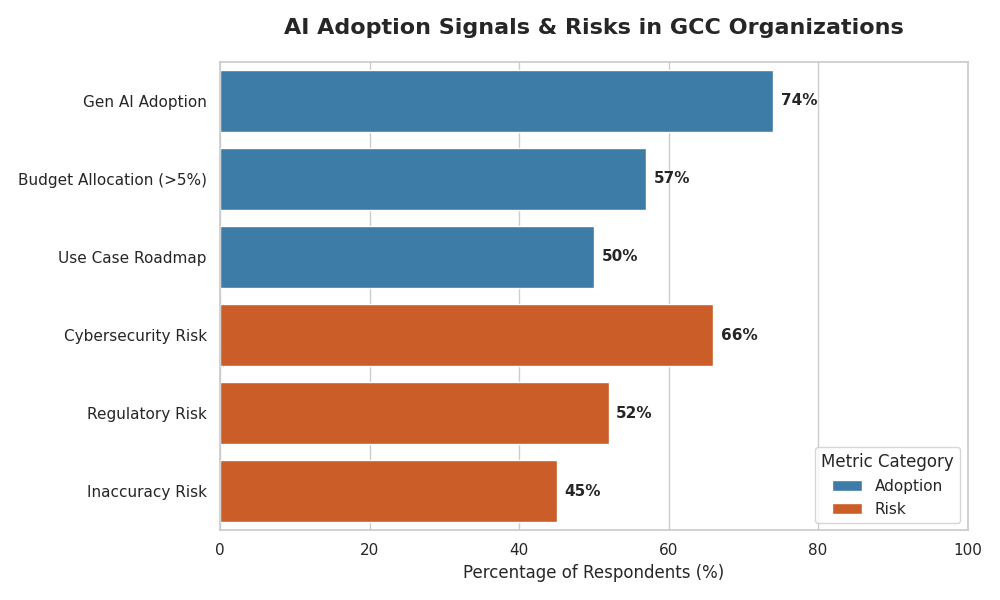
The shift is especially visible in the GCC. McKinsey’s 2024 survey found that almost three-quarters of respondents said gen AI was already being used in at least one business function. The same report found that 57 percent were investing at least 5 percent of their digital budgets in gen AI, and half had already built a roadmap for priority use cases. That is a strong sign that AI adoption is moving from interest to execution.
For MENA businesses, this matters because digital transformation is no longer only about moving systems online. It is about turning data into decisions faster. The companies that will benefit most are the ones that connect data, automate work, train teams, and build AI into real business processes.
What is driving AI adoption in MENA right now?
Why business pressure is pushing companies to move faster
The first driver is simple business pressure. Companies in finance, retail, manufacturing, logistics, healthcare, and government all need faster reporting, better visibility, and more reliable decisions. AI helps when it is connected to operational data and daily workflows. It becomes valuable when it reduces delays and gives leaders a clearer view of what is happening now.
AI is also attractive because it can support productivity gains. OECD says AI adoption can significantly boost firm productivity, but the benefits depend on complementary assets such as ICT infrastructure, management capabilities, and human capital, especially leadership and problem-solving skills. In practice, that means AI only works well when the business has the right systems and the right people around it.
Why governments are investing in digital and AI foundations
The second driver is public investment. The World Bank’s Digital Progress and Trends Report 2025 says AI is reshaping economies and societies, and it stresses the need for data governance, regulatory reform, and human capital to help AI take root. That matters for MENA because many governments are now treating AI as part of national digital growth, not just a private sector trend.
The IMF’s AI Preparedness Index shows why this foundation matters. It measures AI readiness across 174 countries using four dimensions, digital infrastructure, human capital, technological innovation, and legal frameworks. Those same areas are what determine whether AI can scale inside a business or stay stuck at pilot stage.
Why the GCC is moving faster than many other parts of the region
The GCC is moving quickly because several conditions already exist there. There is stronger digital infrastructure in many markets, more funding for transformation, and more urgency to diversify economies and improve performance. McKinsey’s GCC research shows that many organizations are already using gen AI, building roadmaps, and investing real budget behind it. That creates momentum that many other markets are still trying to build.
How is AI changing digital transformation in MENA businesses?
From manual reporting to faster decisions
One of the biggest changes AI brings is speed. Many companies still spend hours pulling data from different systems, cleaning it, and turning it into reports. AI can reduce that work and make reporting faster and more useful. When leaders can see current data sooner, they can act sooner too. That changes the quality of decision-making across the business.
From disconnected systems to connected workflows
AI is also changing how work flows between teams. In many businesses, data sits in separate tools, spreadsheets, emails, and manual trackers. That creates duplication, delays, and confusion. When AI is connected to ERP, CRM, and other internal systems, it helps unify the workflow and makes the business easier to run.
From basic automation to AI-driven operations
A lot of companies still think of AI as content generation or chatbot support. But the real value comes when AI is built into operations. McKinsey’s GCC report shows that organizations are focusing on functions such as marketing and sales, software engineering, and IT because those are areas where AI can create real business value. That is where transformation becomes practical, not theoretical.
From pilot projects to business value
The next step is not more experiments. It is scale. McKinsey found that many GCC organizations are already active in gen AI, but only a small group is turning it into measurable earnings. The difference is not simply who tried AI first. It is who rewired their organization around it, with better data, stronger governance, and more disciplined execution.
What does the latest data say about AI adoption in the region?
What GCC organizations are already doing
The latest GCC data shows clear adoption momentum. Almost three-quarters of respondents said their organizations were already using gen AI in at least one business function. That is important because it shows AI is already inside business operations, not just being discussed in strategy meetings.
What budgets and roadmaps tell us
The same survey found that 57 percent of GCC respondents were investing at least 5 percent of their digital budgets in gen AI, and half had already built a roadmap for priority use cases. Those numbers matter because budget and planning are what separate a test from a real transformation program.
What the biggest risks are
The main concerns are not abstract. In McKinsey’s survey, 66 percent named cybersecurity as the top risk, 52 percent pointed to regulatory compliance, and 45 percent cited inaccuracy. That tells us businesses are becoming more serious about AI, but they still want control, trust, and clear rules before they scale.
What the readiness gap means for the wider region
The wider MENA picture is more uneven. The IMF’s AI Preparedness Index shows that readiness depends on the quality of infrastructure, skills, innovation, and legal frameworks. The World Bank also says AI opens major opportunities, but low- and middle-income countries face steep challenges to adapt or deploy AI effectively at scale. In plain terms, some MENA markets are moving quickly, while others still need to build the base first.
Why are some MENA businesses still struggling to scale AI?
Data quality and data access problems
The biggest barrier is still data. AI needs clean, connected, and trusted data. If a company has multiple versions of the same KPI, or if the data sits in disconnected systems, AI will not fix that problem by itself. It will only make the weakness more visible.
Skills gaps and low data literacy
The second barrier is skills. The World Bank says AI adoption depends on strengthening the foundations for adoption, adaptation, and innovation, including the skills needed to thrive in the digital era. This is not just a technical issue. Teams need to understand how to use AI tools, how to question the output, and how to apply it in real work. Without that, adoption stays shallow.
Weak governance and risk controls
The third barrier is governance. The IMF’s AI Preparedness Index includes legal frameworks for a reason. AI needs rules, accountability, and oversight. McKinsey’s GCC report also shows that organizations are worried about cybersecurity, compliance, and inaccuracy, which means control is part of the adoption conversation from the beginning.
Legacy systems and disconnected tools
The fourth barrier is old infrastructure. Many businesses still rely on spreadsheets, disconnected software, and manual handoffs. AI performs best when it is built on top of clean workflows and connected systems. That is why digital transformation and AI should be planned together, not as separate projects.
Which AI use cases create the fastest value in digital transformation?
AI for reporting and decision support
The fastest wins often come from reporting. Instead of waiting for manual updates, companies can use AI to pull together data faster and present it in a form that leaders can act on. That reduces reporting delays and helps teams see what is changing before it becomes a bigger problem.
AI for customer support and internal knowledge access
AI assistants can help employees and customers get answers faster. Internally, they can reduce time spent searching for policies, procedures, or project information. Externally, they can improve response speed and consistency. These are practical use cases because they remove friction from daily work.
AI for workflow automation
AI can also automate repetitive work such as data entry, reminders, approvals, and handoffs between systems. This is where many companies see immediate value because it saves time and reduces errors. The best automation does not remove people from the process. It removes the low-value parts of the process.
AI for forecasting and planning
AI becomes especially useful when connected to sales, operations, and finance data. It can help companies identify patterns earlier and plan with more confidence. That matters in sectors where timing affects cost, service quality, and customer experience.
What should companies do before they invest in AI?
Start with one clear business problem
The first step is to define the problem clearly. Do not start with “we need AI.” Start with a real business issue such as slow reporting, manual workflows, or weak visibility across systems. Clear problems create clearer projects, and clearer projects are easier to measure.
Connect the right data sources
The second step is to connect the data. AI works much better when it can access data across the business, not just one team or one tool. That means bringing together ERP, CRM, spreadsheets, cloud systems, and databases into one usable view.
Define owners, rules, and controls
The third step is governance. Someone needs to own the project, define the rules, and track the risk. McKinsey’s report shows that leading organizations are already building roadmaps and putting protocols in place to support scale. That is what turns AI from a test into a system.
Train teams to use the system properly
The last step is training. The World Bank and OECD both stress that human capital and management capability are essential for AI value. If people do not know how to use the system, trust the output, or apply it to their work, the project will not create much business impact.
What is the future of AI-driven digital transformation in MENA?
Why the next phase will be about scale, not experiments
The next phase is not about trying AI once. It is about scaling what works. Many organizations in the region have already begun, but the real value will come when AI is built into repeatable business processes. That means less demo thinking and more operational thinking.
Why AI will matter more inside operations, not just in strategy decks
AI will matter most when it improves the way the business runs every day. That includes reporting, approvals, support, forecasting, and knowledge access. In other words, AI becomes useful when it helps teams do their work faster and better, not only when it looks impressive in a presentation.
Why data, governance, and training will separate leaders from laggards
The businesses that win will be the ones that build the full foundation around AI. That means strong data, clear governance, and people who know how to use the system. The IMF, World Bank, OECD, and McKinsey all point to the same pattern. AI value comes from capability, not just software.
Frequently Asked Questions
Is MENA ready for AI-driven digital transformation?
Some parts of MENA are ready and already moving fast, especially the GCC. But readiness is uneven across the region. The deciding factors are data infrastructure, skills, governance, and regulation.
Which industries benefit most from AI adoption?
Industries with a lot of data, repetitive work, or high decision pressure usually benefit first. That often includes finance, logistics, manufacturing, retail, healthcare, and government.
What is the biggest mistake companies make with AI?
The biggest mistake is starting with tools before fixing data and process. If the business problem is unclear, the data is fragmented, or the team is not trained, AI will not create lasting value.
How can AI support digital transformation without replacing people?
AI should support people, not replace them. It can automate repetitive work, surface insights faster, and help teams access knowledge more easily, while humans stay in control of judgment, context, and accountability.
How Exology Helps
We help businesses connect data from multiple systems into one clear reporting environment, making it easier for leadership teams to track performance, spot issues early, and make faster decisions. Exology has already delivered 150+ projects worldwide across 20+ countries.
We build dashboards and reporting systems that turn raw operational data into clear business insights. In 2025 alone, Exology has delivered 40+ dashboards live and empowering and processed 10M+ data rows, helping teams see what matters in real time.
We automate repetitive workflows and build AI-powered operational systems that reduce manual work and improve efficiency. Exology has saved clients 5,000+ hours of manual work in 2025, which gives teams more time for analysis and action.
Read More
Contact us
Whether you have a request, a query, or want to work with us, use the form below to get in touch with our team.