

The Ecosystem Advantage: Why AI Automation Works Best in Unified Environments
Discover why AI automation ecosystems like Microsoft and Google outperform standalone tools. Learn how unified data improves AI accuracy and reduces costs..
AI & AUTOMATION
Key Points
AI agents perform better in unified ecosystems because they have native access to company files and communications.
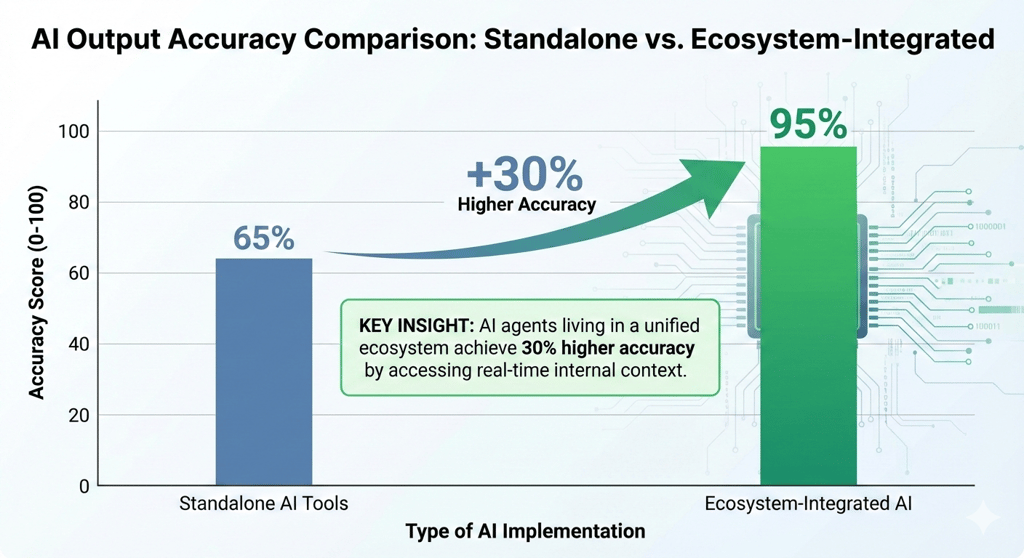
Integrated AI solutions are 30% more accurate than standalone tools because they use real-time internal context.
Using too many separate apps creates a "fragmentation tax" that wastes time and money on unused software licenses.
Unified ecosystems provide better security by keeping sensitive data within a controlled, compliant environment.
Connecting AI to a single data "nervous system" eliminates silos and allows for faster, automated workflows.
Consolidating tools reduces "shadow IT" risks and helps businesses scale AI agents more quickly.
Actionable takeaway: Audit your current software stack to identify fragmented tools and begin consolidating your data into a single ecosystem like Microsoft 365 or Google Workspace.
The race to adopt artificial intelligence (AI) is no longer about finding the single best tool. It is about where that tool lives. For years, businesses have collected specialized software for every task. They have one app for emails, another for project management, and a third for data analysis. While these individual tools work well, they often create a "fragmented stack" that makes AI less effective.
At Exology, we have found that AI and automation solutions built within an ecosystem work significantly better. They are more accurate, faster to deploy, and more secure. When an AI agent lives inside a unified environment like Microsoft 365 or Google Workspace, it does not have to jump over digital walls to find information. It is already "home."
What is an AI automation ecosystem?
An AI automation ecosystem is a collection of tools and data that live on a single, integrated platform. Instead of using a standalone AI bot that requires you to copy and paste data, an ecosystem AI is part of the infrastructure. It has native access to your files, emails, calendars, and chats.
In a fragmented setup, you might use a separate AI tool to summarize a meeting. You have to download the transcript, upload it to the AI, and then manually copy the summary into your project management app. In an ecosystem, the AI agent "attends" the meeting, writes the summary, and automatically updates your task list because all those apps are connected.
According to Gartner, the market is shifting from task-specific assistants to agentic ecosystems. By 2026, 40% of enterprise applications will feature task-specific AI agents. This shift happens because businesses realize that disconnected tools cannot scale.
Why does integration improve AI accuracy?
Accuracy in AI is entirely dependent on context. If you ask an AI to "write a follow-up email to the client," a standalone tool has no idea who the client is or what you discussed. An AI agent in an ecosystem, however, can see the previous three emails, the shared contract in your cloud storage, and the notes from your last call.
Automation solutions that are deeply integrated into an ecosystem are up to 30% more accurate in their outputs than standalone counterparts. This is because they do not rely on "hallucination" to fill in gaps. They have the real data right in front of them.
How does "frictionless" data sharing help?
In a unified ecosystem, data flows through a single "nervous system." For Microsoft, this is the Microsoft Graph. For Google, it is the Workspace API. When an AI agent needs a piece of information, it does not need a new API key or special permission for every file. It uses the permissions you have already set. This reduces the "latency" of the AI. It can process a request in seconds because the data is already in a readable format.
Why is context the secret weapon of AI?
Context is the background information that gives a request meaning. McKinsey research suggests that generative AI could increase productivity by up to 40% across various sectors. However, this gain is only possible if the AI understands the workflow. An agent that knows your company’s specific tone, your project deadlines, and your team hierarchy provides value that a generic tool cannot match.
How do Microsoft and Google platforms lead the way?
Microsoft and Google have built the most robust AI automation ecosystems to date. They are not just adding "chatbots" to their software. They are rebuilding the software around AI.
Microsoft Copilot: This agent leverages the Microsoft Graph to connect every corner of the Office 365 suite. A Forrester study found that small and medium businesses can see an ROI of up to 353% by deploying Microsoft 365 Copilot. The value comes from the AI’s ability to "read" your entire workspace to solve complex problems.
Google Gemini: Google integrates AI directly into Workspace, allowing Gemini to pull data from Gmail, Docs, and Drive seamlessly. Because Google controls the search and cloud infrastructure, their agents are exceptionally fast at finding and organizing information.
When businesses choose these ecosystems, they are buying a pre-built infrastructure. They do not have to spend months building "bridges" between different apps.
What is the "fragmentation tax" of standalone tools?
Using a "best-of-breed" strategy, where you buy the best tool for every individual task, often leads to a hidden cost called the fragmentation tax. This tax manifests as wasted time, redundant subscriptions, and security risks.
Research shows that the average business uses over 100 SaaS applications. Shockingly, about 49% of SaaS licenses go unused. When you add AI on top of a fragmented stack, you are paying for multiple AI subscriptions that cannot talk to each other.
The Time Tax
Managing multiple tools costs users an average of 2.3 hours per month in maintenance alone. This includes re-authenticating logins, updating settings, and moving data manually. AI is supposed to save you time, but if you spend your day acting as a "human bridge" between AI tools, you lose the productivity gains.
The Accuracy Gap
Standalone AI tools often result in "data silos." Marketing has its AI, and Sales has its own. If the Marketing AI does not know what the Sales AI is doing, your customer experience suffers. Ecosystems break these silos by allowing one central AI agent to see the entire journey.
How do unified systems enhance security?
Security is the biggest concern for companies adopting AI today. Standalone AI tools often require you to upload sensitive company data to external servers that may not follow your security standards.
In a unified ecosystem, the AI agent follows the same rules as the rest of your platform. If a file is "confidential" in Microsoft Teams, Copilot will respect that. It will not show that data to someone who does not have permission to see it.
Using an ecosystem provides:
Centralized Governance: You manage all AI permissions from one dashboard.
Compliance: Major ecosystems like Microsoft and Google are already compliant with global standards like GDPR.
Data Sovereignty: Your data stays within your tenant. It is not used to train the public AI models that your competitors might use.
Can my business transition to an ecosystem model easily?
The transition is a strategic shift, not just a technical one. Many businesses start by auditing their current software stack. They look for "shadow IT," which are unauthorized apps used by employees. In 2025, shadow IT accounts for nearly 48% of app usage in some companies.
By consolidating these apps into a single ecosystem, you reduce your attack surface and lower your costs. The next step is "Data Cleanup." AI agents are only as good as the data they read. If your files are disorganized, the AI will be too. Once your data is structured within an ecosystem, deploying custom AI agents becomes a matter of days, not months.
How Exology Helps
Exology specializes in turning fragmented data into powerful, unified AI systems. We have seen firsthand that an ecosystem-first approach is the only way to scale effectively. Our team provides the strategic and technical expertise needed to modernize your operations.
Our authority is backed by a track record of global success:
Proven Scale: We have delivered over 150 projects worldwide and worked in over 20 countries.
Deep Expertise: Our team of 5 professional consultants utilizes 34+ in-house tools to solve complex data challenges.
Direct Impact: We once saved a client $130,000 in a single day by optimizing their data flows.
Massive Efficiency: In 2025 alone, we saved our clients over 5,000 hours of manual work and processed 10 million+ data rows.
Specialized Solutions: We have deployed 2 custom AI agents and manage over 40 live dashboards that empower businesses across 10 key industries.
Educational Authority: We provided over 4,000 hours of professional training in 2025 to help teams master BI and AI.
Whether you are in Egypt, across the MENA region, or operating internationally, Exology ensures your AI agents are accurate, secure, and fully integrated. We help you move from scattered tools to a high-performance data ecosystem.
Read More
Contact us
Whether you have a request, a query, or want to work with us, use the form below to get in touch with our team.