

Overcoming the Biggest Barriers to Digital Transformation
Discover why digital projects stall and how to overcome the biggest barriers to digital transformation in traditional businesses with data-driven strategy.
DIGITAL TRANSFORMATION
Key Points
Digital transformation often fails because companies buy software without a clear business strategy.
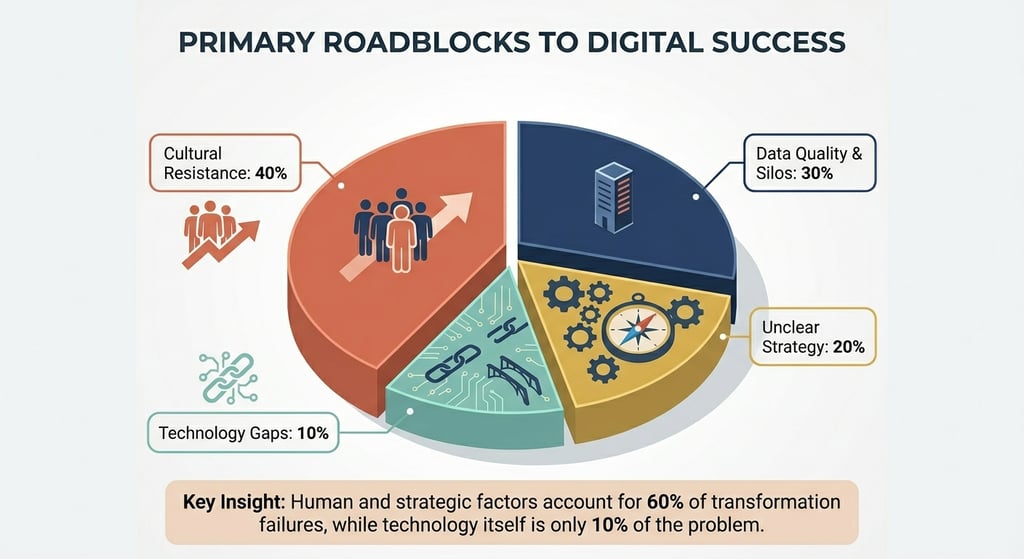
The biggest barriers to success are human factors, such as cultural resistance and a lack of leadership support.
Legacy systems and data silos trap information, making it impossible to achieve a real-time view of business performance.
Clean and centralized data is a mandatory requirement before a company can effectively deploy AI agents.
Global IT spending is rising, yet only 48% of digital initiatives currently meet their intended business outcomes.
A phased approach using small pilot projects is more financially sustainable than attempting to change everything at once.
Actionable takeaway: Audit your current data for errors and inconsistencies before investing in new AI or automation tools.
Many traditional businesses are fully aware that they need to modernize. They see the rapid shift toward cloud tools, automated workflows, and high-level digital presence. Yet, for many, the actual progress is slow or completely stalled. It feels like a constant uphill battle against invisible forces.
The challenge is rarely just about the technology itself. You might buy the best software in the world and still see no change in your bottom line. This is because transformation is a fundamental shift in how a business operates. If the foundation is not ready, the new tools will simply fail.
Understanding these obstacles is the first step toward a real solution. If you feel like your company is stuck, you are not alone. Most leaders find that the hardest part of the journey is not the code. It is the strategy, the people, and the legacy of how things used to be done.
Why do most digital projects stall in traditional businesses?
The primary reason for failure is the lack of a clear digital transformation strategy. Many companies approach modernization as a series of quick fixes. They buy an app to fix one problem and a subscription to fix another. This creates a fragmented system that does not communicate.
The trap of "Technology-First" thinking
When a business puts the tool before the goal, it creates confusion. Employees find themselves using five different platforms that do not sync. This leads to a massive waste of time and money. According to a recent Gartner survey, only 48% of digital initiatives actually meet or exceed their business outcome targets.
Lack of clear success metrics
Without specific goals, it is impossible to know if the transformation is working. Many businesses start these projects without defining what "better" looks like. Is the goal to save time, reduce costs, or improve customer service? Without these markers, the project loses momentum and eventually dies out.
Is the biggest barrier human or technical?
While technology is the visible part of the change, the human element is the most significant barrier. Technology is predictable. Human behavior is not. In traditional businesses, deep-rooted habits often prevent progress more than old hardware does.
Internal resistance to change
Many employees view new technology as a threat rather than a tool. They worry that automation or AI agents will replace their jobs. This fear leads to passive resistance. People might continue using their old spreadsheets in secret or refuse to input data into the new system. According to insights from McKinsey, around 70% of complex, large-scale change programs fail to reach their stated goals, often due to employee resistance and lack of management support.
The leadership gap
Digital transformation must start from the top. If executives do not use the new tools or champion the change, the rest of the company will not either. Leadership must move beyond just approving the budget. They must actively lead the cultural shift required to become a data-driven organization.
How do legacy systems and data silos hold you back?
Traditional businesses are often built on years of "legacy" processes. These include old software, paper-based records, and disconnected departments. These systems create data silos where information is trapped and inaccessible.
The hidden cost of data silos
When your sales data cannot "talk" to your inventory system, you lose the ability to make real-time decisions. You end up relying on guesses instead of facts. This lack of integration is a major roadblock to growth. Legacy system modernization is not just about replacing old computers. It is about connecting every part of the business so data flows freely.
The difficulty of integration
Older software was often built in a "closed" way. It does not easily connect with modern cloud platforms or AI agents. Trying to force these old systems to work with new technology can lead to constant errors and downtime. This technical debt makes many leaders afraid to start the transformation process at all.
How can a business ensure its data is ready for AI?
Everyone wants to use AI to boost productivity, but AI requires high-quality data. If your data is messy, incomplete, or disorganized, an AI agent will give you wrong answers. You cannot build a modern AI strategy on a broken data foundation.
Cleaning the data foundation
Before you can automate, you must audit your data. This means removing duplicates, fixing errors, and ensuring your records are updated. Many businesses discover that their "digital records" are actually just scanned PDFs that a computer cannot read. Transforming this into structured data is a vital step.
Centralizing information
For AI to be effective, it needs access to information from across the company. You must move away from individual spreadsheets and toward a centralized system, such as a modern ERP or a Business Intelligence dashboard. This allows the AI to see patterns that a human might miss.
Managing the financial investment of transformation
The cost of modernization is a valid concern for any business owner. It is easy to spend a fortune on digital tools without seeing a clear return. However, the cost of doing nothing is often much higher.
Avoiding the "All-at-Once" trap
One of the biggest financial mistakes is trying to change everything in a single month. This overwhelms the staff and drains the budget. Successful companies often start with small, high-impact pilot projects. They prove the value in one department before moving to the next.
Understanding the ROI
Global spending on digital transformation is reaching record levels. According to Statista, spending is projected to reach nearly 4 trillion dollars by 2027. This investment is driven by the fact that digital leaders consistently outperform their peers in revenue and efficiency.
The roadmap for traditional businesses to modernize
If you want to move past these barriers, you need a structured approach. You cannot simply buy your way out of the problem. You must build a path that respects your current business while preparing for the future.
Step 1: Honest assessment
Look at your current processes without any ego. Where are people wasting the most time? Which systems cause the most frustration? Identifying these "pain points" gives you a starting point for your digital transformation strategy.
Step 2: Choosing the right partners
Do not try to do everything alone. Traditional businesses often lack the internal expertise to manage complex data migrations or AI deployments. Partner with experts who understand how to bridge the gap between old-school operations and modern technology.
Step 3: Focusing ERP Integration
For many businesses, the solution is a unified platform like Odoo, Oracle or SAP. Instead of having ten different apps, you have one system that manages everything from HR to sales. This eliminates silos and ensures everyone is looking at the same data.
Step 4: Continuous training
The transformation does not end when the software is installed. You must provide ongoing training to your team. As the technology evolves, your staff’s skills must evolve too. This reduces fear and keeps the company moving forward.
Exology is an expert in data, business intelligence, software, and AI. We have completed over 200+ projects for 150+ businesses in 20+ countries across 10+ key industries. This experience allows us to see exactly where the bottlenecks are and how to remove them efficiently.
How Exology Helps
Exology helps traditional businesses move from stalled progress to high-speed growth. We specialize in turning messy data into clear, actionable insights. We understand the unique challenges of bridging the gap between legacy operations and the modern digital world.
Custom BI Solutions: We design dashboards that break down your data silos, allowing you to see your entire business in one view.
Ongoing Support (BIaaS): You get continuous expert help and dashboard updates without the high cost of hiring an internal data team.
Strategic Consulting: We help you build a roadmap that addresses your specific barriers to digital transformation, ensuring your investment pays off.
Proven Financial Impact: We focus on the bottom line. For example, Exology has been able to save our client $130k in one day by identifying critical data discrepancies.
Time-Saving Automation: We implement tools that give your team their time back. Our solutions led to 5,000+ hours of manual work saved in 2025.
Global Authority: With a history of 200+ successful projects, we bring world-class expertise to every company we partner with.
We work with companies around the globe to modernize their operations and create a data-driven future.
Read More
Contact us
Whether you have a request, a query, or want to work with us, use the form below to get in touch with our team.