

If You Can't See Your "Committed" Funds in Real-Time, You Need a Budget Control System
Manual overspending is a trap for growing businesses. Learn how a budget control system uses commitment accounting and automated workflows to secure your finances.
BUSINESS APPLICATIONS
Key Points
Manual spreadsheets create "invisible overspending" by ignoring funds already promised to future invoices.
Relying solely on bank balances leads to poor decisions because it fails to show "committed" funds.
Commitment accounting protects your bottom line by "locking" funds the moment a purchase is approved.
Automated approval workflows speed up procurement and remove manual bottlenecks in the finance department.
Digital audit trails provide full transparency and significantly reduce the time and cost of financial compliance.
Real-time data visualization allows leadership to spot spending trends and adjust budgets proactively before overspending occurs.
Actionable takeaway: Review your current financial process to ensure you are tracking "committed" funds separately from paid invoices to avoid surprise year-end deficits.
Many business leaders wake up to a sudden realization: they do not actually know how much money they have left to spend. You might look at your bank balance and see a healthy number, but that number is a lie. It does not account for the purchase orders sent yesterday, the contracts signed last week, or the monthly retainers due tomorrow. This gap between your bank balance and your legal obligations is where "invisible overspending" happens.
If you are constantly surprised by expenses that "came out of nowhere," you are facing a manual overspending trap. In a global economy where data volume is expected to reach 181 zettabytes by 2025, relying on manual tracking is no longer a viable strategy. You need a dedicated budget control system to turn your financial data into a shield for your company’s growth.
What is "invisible spending" and why is it dangerous?
Why does a healthy bank balance lead to bad decisions?
The most common mistake in financial management is confusing "cash on hand" with "available budget." Cash on hand only tells you what has already been paid out. It ignores "commitments," which are funds you have already promised to vendors or projects but have not yet transferred.
When managers see a large bank balance, they feel confident enough to approve new requests. However, if those funds were already "reserved" for an upcoming invoice, the company inadvertently overspends. This lack of visibility creates a cycle of emergency budget cuts and stalled projects. A professional system ensures that "Committed" funds are subtracted from the total budget the moment a request is approved.
How does manual tracking fail during rapid growth?
In the early stages of a business, a spreadsheet might work. But as you scale to 150+ employees or handle hundreds of monthly transactions, manual entry becomes a liability. Human error is the primary driver of financial inaccuracies. Research from Gartner shows that 18% of accountants make financial errors at least daily.
When your financial data is scattered across emails, chat messages, and different spreadsheet versions, it is impossible to maintain an audit trail. A single typo in a manual cell can result in thousands of dollars in losses. A budget control system removes this risk by centralizing all transactions in a single, secure environment.
How does a budget control system solve the "Actuals vs. Commitments" gap?
What are the three stages of budget tracking?
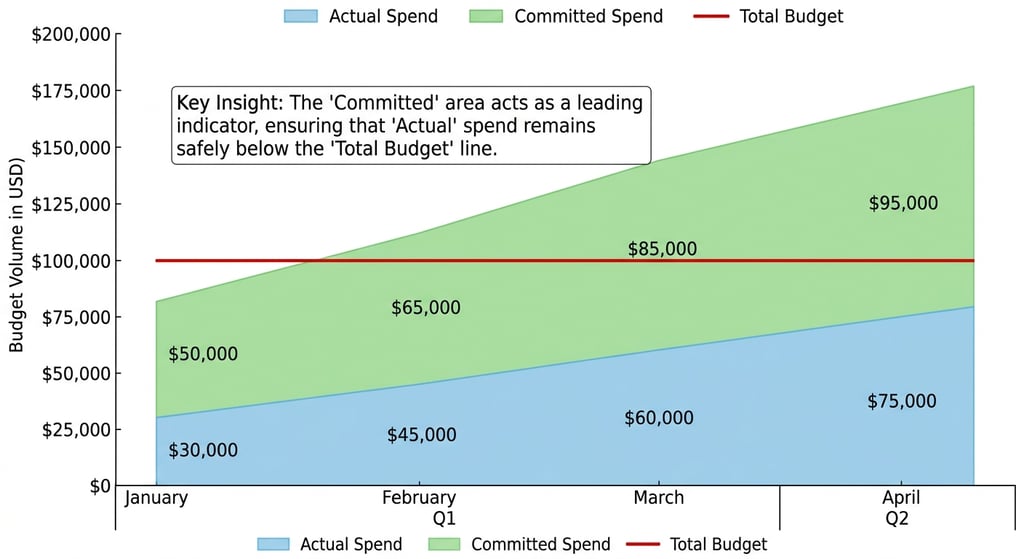
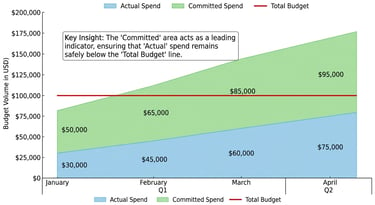
A robust system should track every dollar through three distinct phases: Allocated, Committed, and Executed.
Allocated: This is your total starting budget for the year or month.
Committed (or Reserved): These are funds that are "locked" because a purchase request or contract has been approved. You cannot spend this money elsewhere.
Executed: This is the actual money that has left your account after an invoice is paid.
By separating these three, you gain a "live" view of your true financial health. You can see exactly how much "available" budget remains at any given second. This prevents the "double-spending" trap that occurs when two different departments think they have access to the same pool of funds.
Why is "real-time" tracking better than monthly reports?
Monthly reports are essentially a financial autopsy. They tell you what went wrong after it is too late to fix it. In a fast-moving market, waiting 30 days for a report means you are always reacting to old data.
A budget control system provides real-time financial tracking. The moment a procurement officer clicks "approve," the budget updates for everyone in the company. This level of transparency allows for proactive management. If a department is spending too fast in the first week of the month, you can intervene immediately.
What features should you look for in a professional budget system?
Does the system include a configurable approval engine?
Not every purchase needs the CEO's signature. A high-quality system should allow you to build custom, automated approval workflows. For example, you can set rules where requests under $1,000 are approved by a department head, while larger amounts are automatically routed to the CFO.
These workflows should also support "conditional" routing. If a request is for IT equipment, the system should send it to the IT director first. This prevents bottlenecks and ensures that the right experts are reviewing the right expenses.
Can it handle multi-currency transactions and FX volatility?
Global businesses often deal with a "base currency" for their main budget and "transaction currencies" for international vendors. If your budget is in USD but you pay a vendor in Euro, manual calculations can lead to significant discrepancies due to exchange rate changes.
A suggested feature for any modern system is an automated FX conversion tool. It should fetch live exchange rates and apply them at the moment of commitment. This ensures that your budget remains accurate regardless of market fluctuations.
Is the fiscal year management flexible?
Many regions use different dates for their fiscal years. For example, some companies operate on a July 1 to June 30 cycle. Your system should be able to derive the correct fiscal year automatically based on the transaction date.
It should also include "Open Period" controls. This allows administrators to lock past months to prevent any accidental changes to closed books while keeping the current month open for active spending.
Is security integrated via Single Sign-On (SSO)?
Security is paramount when dealing with financial data. You should look for systems that integrate with enterprise identity providers like Microsoft Entra ID (Azure AD). This ensures that only authorized employees can access the system and that their permissions are automatically updated if they change roles or leave the company.
How can automated workflows protect your bottom line?
How do "guardrails" prevent unauthorized spending?
A budget control system acts as a digital gatekeeper. If a manager tries to approve a request that exceeds the remaining available budget, the system can block the action. This is a "hard control" that prevents overspending before it happens.
Without these guardrails, you rely entirely on the memory and diligence of your staff. Automated systems never "forget" the budget limit. They provide a consistent, unbiased enforcement of your company’s financial policies.
How does traceability improve the audit process?
In a manual system, finding out who authorized a $5,000 payment six months ago can take days of searching through archives. A digital system creates a permanent, unchangeable audit trail. Every attachment, every comment, and every approval timestamp is saved in one place.
This traceability is essential for compliance and internal accountability. It allows you to generate "Audit PDFs" for any request instantly. This level of organization significantly reduces the time and cost of external audits.
Why is data visualization vital for financial leadership?
Reports filled with rows and columns of numbers are difficult to digest. To make fast, accurate decisions, leaders need intuitive visuals. A modern budget control system turns raw data into interactive dashboards.
Visualizations help you spot trends that numbers alone might hide. You might see that a specific project has a high "Commitment-to-Execution" lag time, indicating that vendors are slow to invoice. Or you might notice that one department consistently requests budget reallocations every quarter. These insights allow you to optimize your cash flow and resource allocation for 2025 and beyond.
How Exology Helps
Exology understands the complexity of financial transformation. We do not just build software; we create the digital infrastructure that allows businesses to scale without losing control. Our team has completed 200+ projects for 150+ businesses across 20+ countries, giving us a unique perspective on global financial challenges.
We help you replace manual chaos with a customized budget control system designed for your specific needs:
Expert Consulting: Our 5 professional consultants work with you to map your approval flows and financial rules, ensuring the system fits your unique business logic perfectly.
Proven Financial Results: We have successfully helped our clients save $130k in a single day by identifying and stopping inefficient spending patterns through data-driven insights.
Automated Efficiency: In 2025 alone, our solutions have saved our clients over 5,000 hours of manual work by automating repetitive tasks like budget tracking and approval routing.
Advanced Data Visualization: With over 1,340 visualizations created for our clients, we turn your complex financial data into clear, actionable dashboards that empower your leadership team.
Global Scalability: Having worked in 10+ key industries and 20+ countries, we ensure your budget system handles multi-currency and international compliance requirements natively.
Exology works with companies in Egypt, across the MENA region, and internationally to turn information into action.
Read More
Contact us
Whether you have a request, a query, or want to work with us, use the form below to get in touch with our team.