

Building a Data-Driven Culture in the AI Era: A Complete Guide
Learn how to build a strong data-driven culture in the AI era. Discover expert insights, recent data, and steps to boost productivity and growth globally.
DATA-DRIVEN CULTURE
Key Points
A data-driven culture combines factual decision-making with a trust-based partnership between employees and AI tools.
Most AI projects fail due to low data literacy and a lack of trust in automated outputs rather than technical flaws.
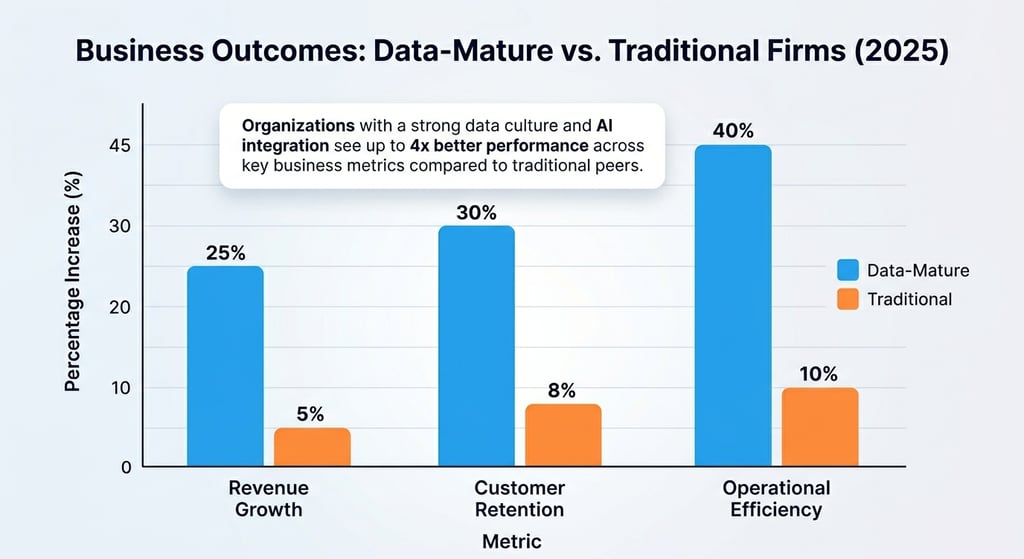
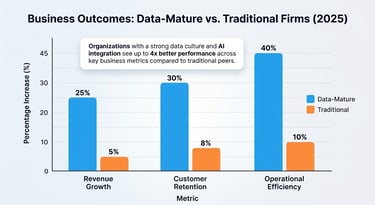
Data-mature organizations achieve significantly higher revenue growth and customer retention compared to traditional firms.
Automation reduces weekly reporting time by up to 80%, allowing teams to focus on strategic growth rather than manual data entry.
Successful cultural change requires leadership to lead by example and provide data training for all staff levels.
Data democratization gives every employee real-time access to clean, visual insights to speed up daily decision-making.
Actionable takeaway: Identify one specific operational bottleneck in your department and implement an automated dashboard to solve it as a high-impact "quick win."
What exactly is a data-driven culture in the AI era?
A data-driven culture is a workplace environment where everyone uses facts to make decisions. In the AI era, this means more than just looking at a few reports. It involves a deep trust in data and a willingness to let AI assist in daily tasks.
Most companies think they are data-driven because they have dashboards. However, a true culture means data is the first thing people check before starting a project. It is about a mindset change where intuition is balanced with real-time evidence.
In this new age, AI acts as a partner. It processes millions of rows of information in seconds. A healthy culture ensures that employees know how to ask AI the right questions. It also ensures they know when to verify the results.
Building this culture is not about buying the most expensive software. It is about how people interact with that software. When every team member feels comfortable using data, the whole organization moves faster.
Why do most AI projects fail without a strong data culture?
Many businesses spend millions on AI tools only to see them fail. The problem is rarely the technology itself. Most often, the issue is a lack of trust and understanding among the staff.
According to research from Gartner, data literacy remains one of the biggest barriers to success. If employees do not understand the data, they will not use the AI that relies on it. They may even see the technology as a threat to their jobs.
A weak culture leads to "symbolic adoption." This is when a company buys a tool but nobody actually uses it to change how they work. Without a culture of curiosity and transparency, AI models become "black boxes." People do not trust what they cannot explain.
McKinsey reports that while 88% of organizations use AI in some way, many struggle to scale it. This is because their internal processes are still stuck in old ways of thinking. Success requires a shift from "we have always done it this way" to "what does the data suggest we do now?"
What are the main benefits of being a data-mature organization?
Companies that master their data see massive gains in efficiency and profit. These organizations do not just survive. They lead their industries by predicting changes before they happen.
The Founders Forum Group notes that the global AI market is valued at $391 billion in 2025. This growth is driven by companies that have integrated data into their DNA. These firms can spot market trends, reduce waste, and find new revenue streams much faster than their competitors.
Data-mature companies also have happier employees. When data is clear, there is less arguing over who is right. Decisions are made based on logic, which reduces office politics. It also allows employees to focus on creative work instead of manual data entry.
Furthermore, high-performing organizations use AI to drive innovation. McKinsey found that companies seeing the most value from AI often set growth as a primary goal. They use data to create new products and reach new customers, rather than just cutting costs.
How can a business start building a data-driven culture today?
Building a data-driven culture takes time, but the steps are clear. It starts with leadership but must reach every person in the company.
Is leadership commitment necessary?
Yes. If the CEO does not use data to make decisions, the rest of the company will not either. Leaders must lead by example by asking for data in every meeting. They must show that they value evidence over opinion.
How important is data literacy training?
Training is essential. You cannot expect employees to be data-driven if they do not know how to read a chart. Basic training on how to interpret data and how AI works can remove fear. It empowers everyone to contribute to the company's goals.
Should we start small or big?
It is usually better to start small. Choose one department or one specific problem to solve. Once the team sees a "quick win," they will be more excited about bigger projects. This builds momentum and proves that data really works.
What is the role of data democratization in an AI-powered workplace?
Data democratization means giving everyone in the company access to the information they need. In the past, only the IT department could see the data. This created bottlenecks and slowed down decision-making.
In the AI era, this old model no longer works. Modern tools allow sales teams, marketing managers, and factory workers to see real-time insights. When everyone has access, the company becomes more agile.
However, access alone is not enough. Data must also be clean and easy to understand. This is where Business Intelligence (BI) comes in. Good BI tools turn raw numbers into simple visuals that anyone can use.
When data is democratized, innovation happens everywhere. A warehouse worker might spot a pattern in shipping delays that a manager missed. AI agents can then help that worker suggest a solution based on that data.
How does automation help build trust in data?
Trust is the foundation of a data-driven culture. If people think the numbers are wrong, they will ignore them. Human error in manual spreadsheets is one of the fastest ways to kill trust.
Automation removes the risk of human error. By connecting your systems directly to AI and BI tools, you ensure the data is always accurate. When reports are consistent and reliable every day, employees start to trust them.
Automation also provides speed. In the modern business world, an answer that takes a week to find is often useless. Automated systems provide answers in seconds. This speed reinforces the habit of checking data before acting.
Trust also grows when people see AI handling the "boring" work. When a tool saves someone hours of manual entry, they see the value of the technology. This makes them more open to using data for more complex strategic tasks later on.
What are the most common challenges in this transformation?
Resistance to change is the most common challenge. People are often afraid that AI will replace them or that they are not "tech-savvy" enough. It is important to address these fears directly.
Another challenge is data silos. This happens when different departments use different tools that do not talk to each other. This creates a fragmented view of the company. Breaking down these silos is a technical task that requires a cultural shift toward collaboration.
Finally, many companies struggle with poor data quality. If the input is bad, the AI output will also be bad. Improving data culture often means improving how data is collected and stored from the very beginning.
How Exology Helps
Exology is a global leader in turning data into a competitive advantage. We have completed over 200 projects for 150 businesses across 20 countries and 10 key industries. We understand that technology is only half the battle. The other half is building the culture that uses it.
We help organizations worldwide build a data-driven foundation through these core strengths:
Expert Consulting: Our team of professional consultants guides you through every step of your digital transformation. We have made over 150 consultations to help leaders align their strategy with data reality.
Proven Impact: We don't just talk about results. Exology has been able to save our client $130k in one day by identifying and fixing data inefficiencies.
Operational Excellence: In 2025 alone, we achieved 5,000+ hours of manual work saved for our clients through intelligent automation and AI agents.
Global Reach: Whether you are in Egypt, the MENA region, or anywhere else, we bring international expertise. We have successfully delivered over 150 projects worldwide.
Scalable Solutions: From BIaaS to custom Odoo implementations, we ensure your data ecosystem is ready for the AI era.
We make data your bread and butter so you can focus on growth.
Read More
Contact us
Whether you have a request, a query, or want to work with us, use the form below to get in touch with our team.