

The Business Guide to Data Literacy: Why Your Entire Team Needs Training in 2026
Discover why data literacy training for businesses is essential in 2026. Learn how to train every department to use data for better growth and productivity.
DATA-DRIVEN CULTURE
Key Points
Data literacy is the ability to read, understand, and communicate insights from data
Having data is not enough without the skills to interpret and explain it
Data literacy is required across all departments, not only IT or data teams
Sales, marketing, operations, HR, and finance all rely on data to make better decisions
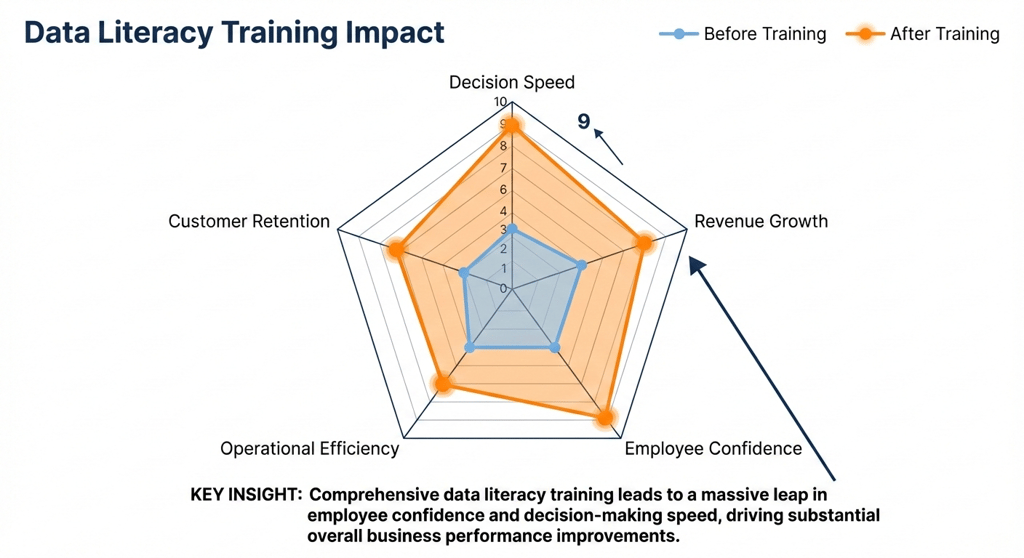
A data-literate workforce improves decision making, productivity, and profitability
Leadership and culture are critical to building strong data literacy skills
Actionable takeaway: Assess your team’s current data skills and invest in targeted training that matches real business needs
In 2026, data is the new language of business. Most companies in Egypt and across the MENA region already have plenty of data. They have sales records, customer lists, and website traffic stats. However, having data is not the same as understanding it.
Data literacy is the ability to read, understand, and communicate using data. If your team cannot do this, they are effectively silent in a world that speaks in numbers. Training your staff to be data-literate is the most important investment you can make this year.
What is data literacy and why does it matter now?
Data literacy means your employees can look at a report and know exactly what it means for the company. It is no longer just a skill for the IT department. Every person in your office needs to know how to spot a trend or find an error in a chart.
Without these skills, your company makes decisions based on guesses. In a fast-moving market like Egypt, guessing is dangerous. Data literacy training for businesses ensures that every person in the room can back up their ideas with hard evidence.
Why should every department receive data literacy training?
Many leaders think only "data people" need training. This is a mistake that slows down growth. Every department uses information to reach its goals.
Why Sales and Marketing need data
Marketing teams need to know which ads are actually making money. If they cannot read an attribution report, they might waste your budget on the wrong channels. Sales teams use data to predict which customers are likely to buy again. Training helps them focus their energy where it matters most.
Why Operations and Supply Chain need data
For companies in the MENA region, supply chains can be complex. Operations managers need to track shipping times and inventory levels in real time. Data training allows them to fix bottlenecks before they cause a delay. This keeps your customers happy and your costs low.
Why HR and Finance need data
Finance teams are usually comfortable with numbers, but they need to learn how to visualize that data for others. HR teams use data to track employee performance and happiness. A data-literate HR manager can predict when a top employee might leave and take steps to keep them.
What are the main benefits of a data-literate workforce?
Investing in training leads to measurable results. Organizations that prioritize data skills see a clear boost in their market value and efficiency.
Better Decision Making: According to McKinsey, data-driven organizations are 23 times more likely to acquire customers.
Increased Productivity: Research from Accenture shows that employees who are confident with data are more productive. They spend less time being confused and more time taking action.
Higher Profitability: A study by the Wharton School found that data-literate companies see a 3% to 5% higher market value.
Reduced Stress: Many employees feel "data-stressed." Training gives them the confidence to use tools without fear.
How can businesses start the journey toward data literacy?
Building a data-driven culture starts at the top. Leaders must show that they value evidence over opinions. You can start by asking for data to support every new proposal in your meetings.
Next, you need to assess where your team stands. Do they know how to use your current dashboards? Do they understand basic statistics? Once you know the gaps, you can bring in experts for specialized training and consulting. Professional guidance ensures you do not waste time on skills your team does not need.
Why is professional consulting better than DIY training?
It is tempting to just buy a software subscription and hope for the best. However, Gartner reports that a lack of data literacy is the number one barrier to getting value from business intelligence.
Consultants do more than just teach software. They look at your specific business goals in Egypt or the MENA region. They help you build a custom roadmap. This ensures that your training matches your actual business processes, making the learning stick.
How Exology Helps
Exology specializes in making the complex world of data simple for everyone. We work with companies in Egypt, across the MENA region, and internationally to turn information into a powerful tool for growth. We help you succeed through:
Expert Training Programs: We offer tailored training programs that empower your team to read and use data with confidence.
Strategic Consulting: We provide a clear roadmap to help your business move from guessing to making data-driven decisions.
Experience That Matters: Exology has helped over 150 businesses successfully transform their raw data into actionable decisions.
Intuitive and Friendly Approach: We focus on making data as friendly as possible so that every employee feels comfortable using it.
High ROI Results: Our solutions are designed to boost your ROI by reducing errors and uncovering new growth opportunities.
Customized BI Solutions: We build dashboards that are easy to understand and fun to use every day.
Read More
Contact us
Whether you have a request, a query, or want to work with us, use the form below to get in touch with our team.