

Cloud BI vs On-Premise BI: Breaking Down Cost, Security, and Scalability
Compare Cloud BI vs On-Premise BI. Learn about cost, security, and scalability for global businesses and how to choose the right model for your size.
DIGITAL TRANSFORMATIONBUSINESS INTELLIGENCE
Key Points
Cloud BI is internet-hosted and vendor-managed, whereas On-Premise BI requires physical hardware and internal maintenance.
Global enterprises often prioritize On-Premise BI for total data sovereignty and physical control.
Smaller, agile companies typically prefer Cloud BI for its speed, accessibility, and lower entry costs.
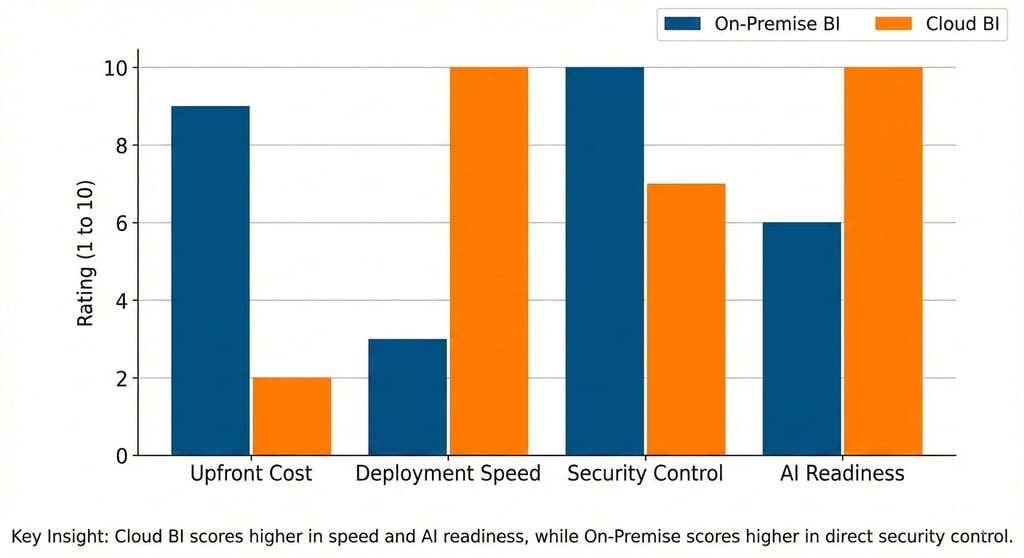
Cloud BI uses a subscription model to reduce upfront spending, while On-Premise requires high initial capital and ongoing hardware costs.
Scaling in the cloud is instant, but expanding On-Premise infrastructure can take weeks or months of hardware installation.
The 2026 shift toward AI agents and automation favors cloud infrastructure due to the high computing power required.
Actionable takeaway: Audit your current data volume and IT resources to determine if your business prioritizes rapid scalability or physical data ownership.
Every company today is trying to find the best way to handle its data. This is not just an IT choice. It is a business strategy that affects how fast you grow and how much you spend. The debate between hosting your data in the cloud or on your own physical servers has changed a lot in recent years. In 2026, the global business intelligence market is expected to reach nearly $38 billion according to Fortune Business Insights.
At Exology, we have worked on over 150 projects worldwide. We have seen that there is no single right answer for everyone. Some of our customers ask for on-premise systems because they want full control. Others want the cloud because they need to move fast. This guide will help you understand which path fits your goals.
What is the difference between Cloud BI and On-Premise BI?
Before you choose, you must understand where your data actually lives. Both systems help you see trends and make plans. The main difference is the physical location of the machines that process your information.
What is the basic setup for Cloud BI?
Cloud BI lives on the internet. A large provider like Microsoft, Amazon, or Google owns the servers. You do not buy any hardware. You access your dashboards and reports through a web browser. The provider handles all the maintenance, cooling, and security of the physical buildings. This allows you to focus purely on your data rather than the machines that hold it.
What is the basic setup for On-Premise BI?
On-Premise BI lives in your own building or a private data center you rent. You buy the servers and install the software yourself. Your own IT team is responsible for keeping the lights on. They must manage the hardware, the software updates, and the physical security of the server room. You own everything from the metal of the machine to the code on the screen.
Why do some companies prefer On-Premise while others choose the Cloud?
The choice often depends on the size and resources of the company. At Exology, we have helped companies in over 20 countries. We have noticed a pattern in how businesses make this choice.
Why do large international companies often choose On-Premise?
International companies often have the luxury of choice. They have large budgets and dedicated IT teams. For these organizations, on-premise systems offer a sense of total sovereignty. They can customize every part of the hardware to fit very specific needs. They also use it to meet strict legal rules in different countries that require data to stay on physical site.
Why is the Cloud often better for smaller companies?
Smaller companies usually need to be agile. They do not want to wait months to buy and set up a server room. The cloud allows them to start analyzing data in hours or days. It gives them access to the same powerful tools as large corporations without the massive upfront cost. For a growing business, the ability to change quickly is more valuable than having a server in the basement.
Which solution costs more in the long run?
Cost is a major factor for every leader. You must look at both the initial price and the ongoing expenses.
What are the initial costs for each model?
On-premise systems are very expensive to start. You must pay for the physical servers, the software licenses, and the labor to set it all up. Lenovo reports that high-end AI servers can cost between $50,000 and $460,000 depending on the power you need. Cloud systems have almost no entry cost. You simply pay your first monthly or yearly fee.
How do operating costs change over time?
Cloud costs are predictable but they never stop. You pay for what you use. On-premise costs seem lower after you buy the hardware, but you have hidden expenses. You have to pay for electricity, cooling, and IT staff. Also, hardware usually needs to be replaced every five years. Interestingly, Lenovo found that for very heavy workloads, on-premise systems can actually reach a breakeven point in just four months compared to renting the equivalent power in the cloud.
Is your data more secure in the cloud or on-site?
Security is the most debated topic in business intelligence. Many people assume that if they can touch the server, it is safer. However, data shows a different story in 2026.
What are the risks of Cloud BI security?
While the cloud is very safe, it is a high-profile target. Softjourn reports that 98% of businesses have experienced some kind of cloud breach in the past two years. Most of these breaches are not because the cloud itself failed. They happen because of human error or poor passwords. When you use the cloud, you are trusting another company to protect your most valuable asset.
Does On-Premise BI offer better protection?
On-premise systems are not connected to the public internet in the same way. This can make them harder for outside hackers to find. You have total control over who enters the server room. However, you are also responsible for all the security updates. If your team misses a patch, you are vulnerable. SentinelOne points out that 95% of security failures still stem from human error regardless of where the data lives.
How does each model handle business growth?
Growth is rarely a straight line. Your data system must be able to keep up with your success.
How fast can Cloud BI scale?
Cloud BI is designed for speed. If you suddenly need to process ten times more data, you just click a button. You pay a bit more, and the power is there instantly. This is vital for companies that launch new products or enter new global markets. You never have to worry about your dashboards slowing down because you ran out of memory.
What are the scaling challenges for On-Premise BI?
Scaling an on-premise system is slow. You have to order new parts, wait for them to arrive, and then have an engineer install them. This can take weeks or even months. If your business grows faster than your hardware, your data analysis will suffer. You might find yourself making decisions based on old data because your servers cannot keep up.
Which option is better for AI and automation in 2026?
Artificial Intelligence is the biggest trend in data today. By 2026, PwC expects companies to move toward "Agentic AI." These are AI agents that can do tasks for you rather than just showing you charts.
Why does the Cloud have an advantage in AI?
Most AI tools require massive amounts of computing power. Cloud providers have built special hardware just for this. They offer built-in AI tools that you can start using immediately. If you want to use the latest AI models to predict your sales or automate your reports, the cloud makes it very easy to start.
Can you run AI on-premise?
Yes, but it is a major commitment. You need very specialized servers with powerful chips. As mentioned earlier, this can be cheaper if you are using AI 24/7 for very large tasks. However, for most companies, the cloud is the faster and easier way to join the AI revolution.
How do you decide which one is right for you?
Choosing between Cloud BI and On-Premise BI requires a look at your current team and your future goals.
When should you stay On-Premise?
You should choose On-Premise BI if you already have a strong IT team and a large data center. It is also the best choice if you have very high data volumes that would be too expensive to move back and forth from the cloud. If your company handles extremely sensitive data and you want total sovereignty, on-premise is your luxury choice.
When should you move to the Cloud?
The cloud is the best choice if you want to focus on insights rather than infrastructure. It is ideal for modern, distributed teams that need to see data from anywhere in the world. If you want to use AI agents and automated workflows without managing hardware, the cloud is the clear winner. In 2026, Eurostat found that over 84% of large enterprises are already using paid cloud services to stay competitive.
How Exology Helps
Exology specializes in turning complex data into actionable plans. We have a proven track record of helping companies choose the right path for their data journey. Our experience spans over 150 projects and more than 20 countries.
Expert Guidance: With 5 professional consultants and over 150 consultations, we help you decide if cloud or on-premise fits your specific needs.
Proven Results: We have saved our clients as much as $130,000 in a single day by optimizing their data processes.
Efficiency at Scale: In 2025 alone, we saved our clients over 5,000 hours of manual work through intelligent automation.
Global Expertise: We have processed over 10 million data rows for companies in more than 10 key industries around the world.
Cutting Edge AI: We have already deployed custom AI agents in 2025 to help businesses automate their most complex workflows.
Read More
Contact us
Whether you have a request, a query, or want to work with us, use the form below to get in touch with our team.