

The State of Data Analytics in Egypt: Trends, Challenges, and Opportunities
Explore the current trends, challenges, and opportunities of data analytics in Egypt and how businesses can leverage insights to drive growth.
DATA ANALYTICS
Key Points
Data analytics is becoming essential for Egyptian businesses to improve decisions, efficiency, and customer understanding
Adoption is rising fast as the Egypt analytics market grows and localized platforms make tools more accessible
SMEs are joining large enterprises in using analytics across sectors like retail, telecom, healthcare, logistics, and finance
Key challenges include scattered data, limited data skills, resistance to change, and high infrastructure costs
Opportunities include higher ROI, stronger efficiency, better customer insights, and affordable local analytics solutions
Companies can overcome challenges by unifying data, starting with pilots, improving data literacy, and using scalable tools
Actionable takeaway: Start with one focused analytics project to prove value and build momentum for wider adoption
What is Data Analytics and Why Is It Important in Egypt?
Definition and core components
Data analytics refers to the process of collecting, cleaning, analyzing, and visualizing data to uncover patterns, insights, and trends. It includes descriptive analytics (what happened), diagnostic analytics (why it happened), predictive analytics (what might happen), and prescriptive analytics (what to do).
For businesses, analytics turns raw data into actionable intelligence. It helps decision makers move beyond intuition to evidence based choices.
Role of data analytics in modern Egyptian businesses
In Egypt, businesses are increasingly seeking ways to operate more efficiently, reduce waste, and understand customer behavior. Data analytics supports these goals by enabling deeper insights into operations, customers, and market dynamics.
For example, retailers can track buying patterns, logistics firms can optimize routes, financial institutions can manage risks, and healthcare providers can monitor operational efficiency. These capabilities drive productivity and competitiveness.
How analytics supports data-driven decision making
By using analytics, companies in Egypt can:
Make faster, informed strategic decisions
Detect inefficiencies or opportunities early
Forecast trends and demand
Tailor services and products to customer needs
This shift from gut-feel to data-driven decision making helps companies stay agile in a dynamic market.
Current Trends in Data Analytics in Egypt
Growing market and rising adoption
The market for business intelligence and analytics software in Egypt is growing rapidly. According to market research forecasts, the Egypt analytics software market is expected to grow at a compound annual growth rate (CAGR) of 13.7% between 2025 and 2031
As businesses generate more data from digital channels such as online sales, e-commerce, mobile usage, and customer interactions, they increasingly see analytics as essential for competitiveness
Emergence of localized analytics platforms
Local innovation is on the rise. New platforms tailored to Egyptian and regional needs are launching to address market demands. One example is a homegrown tool described by a local tech publication as bridging the gap for startups, SMEs, researchers, and policy makers.
These localized solutions make analytics more accessible and adaptable to businesses facing regional data, regulatory, and operational contexts.
Expansion beyond large enterprises, SMEs are joining in
While large firms such as banks, telecoms, and major retailers often lead analytics adoption, small and medium enterprises (SMEs) in Egypt are also gradually embracing BI solutions.
Use of analytics across diverse sectors
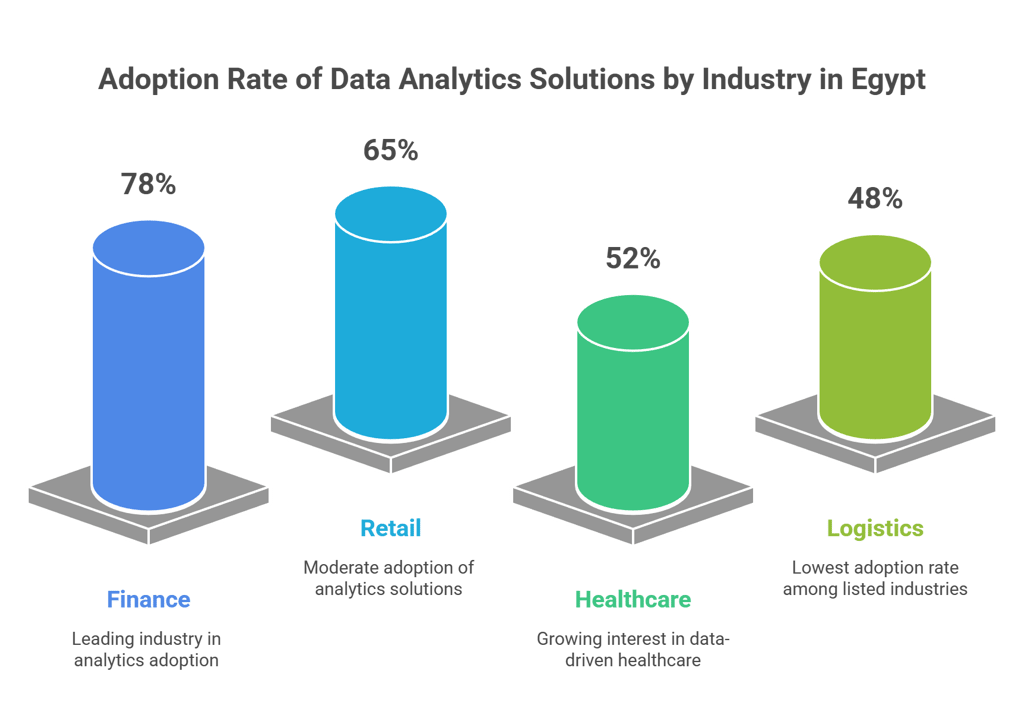
Analytics use in Egypt is expanding across sectors like retail, logistics, telecommunications, healthcare, and finance. For example:
In corporate operations, recent research showed a statistically significant relationship between big data analytics adoption and productivity efficiency in a major Egyptian telecom company.
These developments suggest data analytics is no longer confined to large enterprises, it is becoming a core tool for businesses across the economy.
Challenges Facing Egyptian Companies in Implementing Data Analytics
Fragmented and scattered data across systems
Without proper integration, analytics outputs can be incomplete, inconsistent, or misleading
Skills gap and limited data literacy
A common barrier is shortage of local talent trained in data analytics, data engineering, and BI. Many companies lack staff who can interpret data reliably or build analytics pipelines
This talent gap slows adoption and reduces the value organizations derive from analytics tools
Resistance to change and organizational culture barriers
In sectors with traditional workflows, such as tourism, public institutions, or long-established firms, there is sometimes resistance to replacing intuition-driven decisions with data-driven ones
Moreover, limited awareness of analytics benefits can lead to under-utilized tools. A business might invest in BI software but fail to integrate analytics into daily decision processes.
Infrastructure and investment constraints
Especially for SMEs, cost of software licenses, data infrastructure, and analytics tools can feel prohibitive. Some firms hesitate to invest without clear short-term ROI.
Opportunities for Businesses Using Data Analytics in Egypt
Improving ROI from BI and analytics tools
With increasing competition, firms adopting analytics now can outperform laggards. Analytics helps optimize processes, reduce waste, and identify revenue opportunities. The expanding Egypt analytics market shows growing recognition of this value.
Enhancing operational efficiency and productivity
Studies show a positive link between big data analytics adoption and operational efficiency in Egyptian firms. One recent study on an Egyptian telecom company found a statistically significant relationship between analytics usage and productivity gains.
Analytics can also help companies streamline workflows, manage supply chains, and respond faster to market changes
Unlocking better customer insights and business strategies
Scaling with affordable, localized analytics solutions
The rise of domestic and regional platforms reduces reliance on expensive global tools. This lowers the barrier for SMEs and midsize companies to adopt analytics.
As awareness grows and talent develops, Egypt’s businesses can leverage analytics for long-term strategic advantage
Case Insights from Leading Industries
Financial services and risk management
Many banks and financial institutions in Egypt are beginning to adopt analytics for risk assessment, customer segmentation, fraud detection, and financial forecasting. This shift supports better decision making and regulatory compliance.
Retail analytics: customer behavior and inventory optimization
Healthcare, logistics, and operations efficiency
How Can Companies Overcome Common Analytics Challenges?
1. Unify data across systems with robust integration
Companies should invest in ETL (extract, transform, load) pipelines or data warehousing to bring data from ERPs, spreadsheets, CRMs, and other sources into one unified platform. This ensures analytics outputs are accurate and reliable
2. Start small, pilot projects and proof of concept
Rather than rolling out analytics across the entire organization, businesses can begin with a pilot, for example a specific department or use case. Early wins build confidence, justify further investment, and demonstrate value to stakeholders
3. Build internal data literacy and skills
Companies should invest in training existing staff or hiring analytics skilled professionals. Data literacy helps ensure analytics tools are used effectively and insights are correctly interpreted
4. Adopt scalable and cost effective analytics solutions
Using cloud-based or subscription-based analytics tools helps lower upfront costs. This is especially useful for SMEs with limited budgets. Local solutions tailored to regional needs also reduce dependency on expensive global tools
5. Promote a data-driven culture and leadership buy-in
Leadership must communicate the value of analytics and embed it into decision-making processes. When decision makers trust data, analytics becomes part of the company’s DNA rather than just another tool
How Exology Helps
We design and build fully customized BI dashboards that unify data from all business systems, helping companies overcome data fragmentation
Our subscription-based BIaaS model makes powerful analytics affordable and scalable, ideal for SMEs and growing firms in Egypt, MENA, and beyond
We offer data analytics and visualization services that turn raw data into clear, actionable insights, enabling faster and smarter decisions
Through our digital transformation and AI solutions, we help businesses adopt predictive and real-time analytics to spot opportunities, optimize operations, and boost ROI
We provide hands-on consulting and training to build internal analytics skills, supporting teams to adopt a data-driven mindset
Read More
Contact us
Whether you have a request, a query, or want to work with us, use the form below to get in touch with our team.