

Why Data Analytics in MENA Is Becoming a Priority?
Discover why governments and businesses across MENA are investing in data analytics, and how better data is improving decisions, speed, and business growth.
DATA ANALYTICS
Key Points
Data analytics is becoming a strategic priority across MENA as governments and businesses accelerate digital transformation.
Organizations are investing in analytics to improve visibility, speed up decision-making, and create a single source of truth.
Government initiatives across the region are driving demand for better data management, reporting, and performance measurement.
AI adoption is increasing the need for clean, connected, and reliable data foundations.
Data governance and data quality are essential for building trust in analytics and ensuring accurate insights.
Industries such as finance, healthcare, retail, logistics, manufacturing, and government are seeing significant value from analytics investments.
Actionable takeaway: Identify your most important business KPIs, connect data from key systems, and build a trusted reporting framework before expanding into AI and automation.
Data analytics in MENA is no longer a niche topic for tech teams. It is becoming part of how governments plan services, how businesses track performance, and how leaders make faster decisions. The reason is simple, the region is generating more data, adopting more digital systems, and trying to turn both into measurable economic value. The World Bank says MENA is at an important crossroads, with broadband access advancing and data traffic rising rapidly, while legal and regulatory gaps still limit how much value organizations can unlock from data.
This shift is not only about technology. It is about speed, trust, and competitiveness. The IMF says GCC countries have accelerated digital transformation since the pandemic, with progress in digital infrastructure, GovTech maturity, and fintech activity. It also finds that further gains depend on stronger digital skills, better adoption, and more effective public sector systems.
Why Is Data Analytics in MENA Becoming a Priority?
The short answer is that the region cannot manage modern growth with manual reporting and scattered spreadsheets alone. Leaders need clear visibility into sales, operations, finance, customer behavior, and service delivery. Data analytics gives them that visibility in a way that is faster, more consistent, and easier to act on.
The longer answer is that MENA is moving toward a digital economy. Governments are digitizing services. Businesses are moving more operations online. Customers expect faster response times. That creates pressure to measure everything more accurately and to make decisions based on current data, not last month’s report.
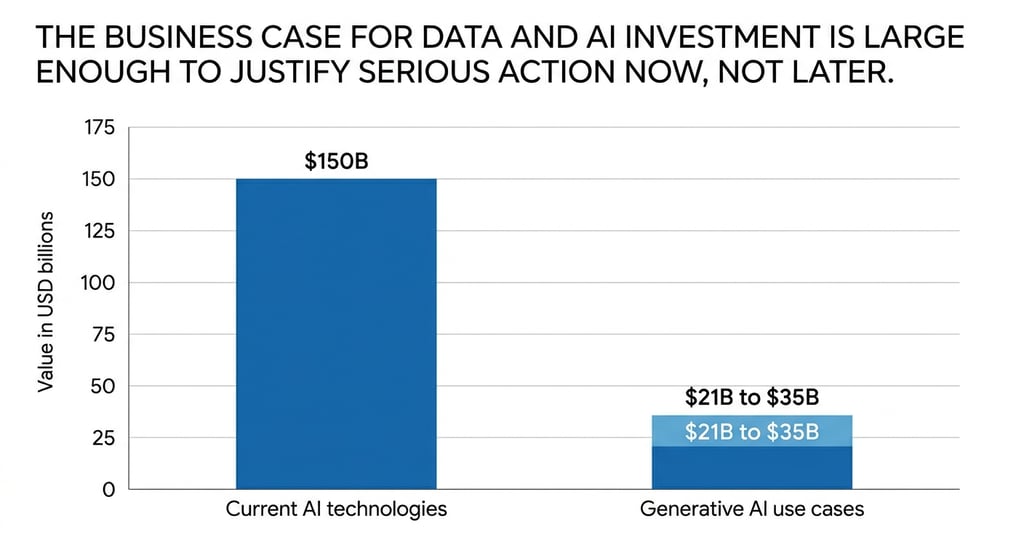
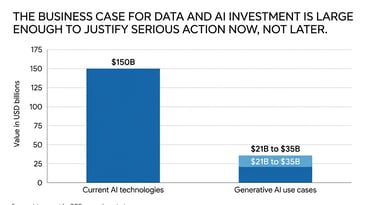
There is also a bigger economic reason. McKinsey estimated that AI could create as much as $150 billion in value across GCC economies, which is equal to 9 percent or more of their combined GDP. McKinsey also estimated that gen AI use cases in GCC countries could add another $21 billion to $35 billion a year. Those numbers matter because AI does not work well without strong data foundations, and those foundations start with analytics.
What changed across the region?
What changed is the level of digital activity. More services are online, more transactions are digital, and more systems are producing usable data. The World Bank notes that most MENA countries are more connected than ever before, but it also warns that turning that data into development value requires better legal and regulatory frameworks for data creation, use, and reuse.
That is a major signal for business leaders. Once data volume rises, the cost of slow decisions rises too. Reports become outdated faster. Teams duplicate work. Leaders lose trust in numbers that do not match across departments. Analytics becomes the tool that brings order to that complexity.
Why does this matter now?
It matters now because the region is moving from digital adoption to digital competition. That means the question is no longer, “Should we collect data?” The real question is, “Can we use it well enough to move faster than competitors?”
This is why data analytics is being treated as infrastructure, not just reporting. It helps organizations see what is happening now, not what happened weeks ago. It also helps them identify patterns, risks, bottlenecks, and opportunities before those issues become expensive.
What Is Driving the Investment in Data Analytics?
The investment in data analytics is being driven by three pressures at once. Governments want better public services. Businesses want better performance. And both sides want the data they already have to produce better results.
Why are governments pushing digital transformation?
Governments across MENA are not investing in analytics just because it sounds modern. They are doing it because digital services need measurement, coordination, and control. Egypt’s Digital Egypt framework is a strong example. The ministry says the program is designed to guide the country toward a digitally enabled economy and a modern public administration, with digitized government services, digital upskilling, and digital innovation as core pillars. It also highlights investments in connectivity infrastructure, data centers, and secure digital platforms.
That matters because public sector analytics is not just about dashboards. It helps governments track service delivery, find bottlenecks, and reduce paper-heavy processes. When a government can see where delays happen, where demand is growing, and which services are underperforming, it can improve outcomes faster.
Why are businesses investing too?
Businesses are investing because analytics directly affects revenue, cost, and customer experience. When leaders can see what is happening across sales, finance, operations, and customer support in one place, they make better decisions. They can spot underperformance earlier, move resources faster, and reduce waste.
The return case is becoming clearer as AI and advanced analytics mature. McKinsey’s estimate of $150 billion in potential AI value across GCC economies, plus the additional $21 billion to $35 billion from gen AI use cases, shows that regional leaders are no longer treating data and AI as experiments. They are treating them as strategic assets.
There is also a practical reason. Business leaders do not want more raw data. They want answers. Which products are growing? Which branch is underperforming? Which department is spending too much time on manual reporting? Analytics turns those questions into visible numbers that teams can act on.
Why Does Data Governance Matter as Much as Dashboards?
A dashboard is only useful if the data behind it is trusted. That is why data governance matters so much in MENA. Analytics does not create value by itself. It creates value when the underlying data is accurate, connected, secure, and usable.
The World Bank’s MENA analysis makes this point very clearly. It says the region lacks key data governance institutions and data protection authorities, and it adds that out of 21 countries in the region, 15 have no data governance institutions and 13 have no data protection authorities.
That is a big deal for analytics projects. If data is scattered across ERP systems, CRM tools, spreadsheets, and old databases, reports will not match. If there is no clear owner for definitions, controls, and access, teams will not trust the numbers. If leaders do not trust the numbers, they stop using the system.
Why cannot analytics work without trust?
Because data analytics is built on consistency. The same revenue figure must mean the same thing for finance, sales, and leadership. The same customer record must not appear three different ways. The same KPI must be measured the same way every month.
World Bank research on data governance in MENA argues that robust data governance frameworks are key enablers of trust in data transactions, and that trust frameworks, including personal data protection, are necessary for people and organizations to use data confidently.
For businesses, this means analytics investment should not start with fancy visuals. It should start with clean definitions, strong data flows, and agreed KPIs. Without that, dashboards become decoration.
What does this mean for companies?
It means the first win is usually not AI, it is clarity. Companies that connect their systems, clean their data, and set clear metrics often get value long before they launch advanced automation. In many cases, the best outcome is simply having one reliable view of performance across the business.
That is especially important in fast-growing organizations. Growth creates more complexity, more tools, and more reporting layers. Analytics is what keeps that complexity manageable.
How Does Data Analytics Connect to AI Growth?
AI is one of the main reasons data analytics matters more now than it did a few years ago. AI tools depend on good data. If the data is messy, incomplete, or disconnected, the output will be weak. If the data is structured and trusted, AI becomes far more useful.
That is why analytics usually comes before AI at scale. Companies need the habit of measuring, cleaning, and connecting data before they can automate decisions or deploy AI assistants with confidence. McKinsey’s estimates for GCC economies make this point stronger, because the value of AI is large enough that many organizations now see analytics as a prerequisite, not an optional extra.
Why are skills and training becoming more important?
Because data systems only work when people use them well. Egypt’s Digital Egypt framework makes digital upskilling a core pillar, and its programs are designed to expand workforce capability through training and practical digital learning.
That is a useful reminder for any business in MENA. Analytics projects are not only technology projects. They are adoption projects. Teams need to know how to read the dashboard, trust the definitions, and use the numbers in daily decisions.
Which Sectors in MENA Benefit the Most?
Some sectors tend to move faster than others because the business case is obvious. Financial services need risk visibility. Retail needs customer insight. Logistics needs operational tracking. Government needs service delivery measurement. Manufacturing needs production clarity.
The IMF report on GCC digitalization highlights progress in digital infrastructure, GovTech maturity, and fintech activities. That makes finance and public services especially strong use cases for analytics because they depend on speed, transparency, and accurate reporting.
Why do some sectors move faster than others?
Because some sectors feel the pain of poor visibility more sharply. A bank cannot afford weak risk data. A logistics company cannot afford blind spots in delivery performance. A retailer cannot wait days to know what is selling. The faster the decisions need to happen, the more valuable analytics becomes.
What do they get from analytics?
They get better forecasts, faster reporting, more reliable KPIs, and a clearer view of what is actually happening in the business. They also get the ability to act earlier. That is often where the biggest value lies.
What Does a Modern Data Analytics Strategy Look Like?
A modern analytics strategy is not just a dashboard project. It is a system that connects data, cleans data, defines KPIs, and helps people act on the results.
It usually includes four things:
Data integration from ERP, CRM, spreadsheets, and other business systems
A single source of truth for core business KPIs
Real-time or near real-time dashboards for decision makers
Training so teams know how to use the system, not just look at it
The best analytics strategy is built around business questions. What is our revenue trend? Where are costs rising? Which region is underperforming? Which customers are at risk? Which process is causing delays? When analytics is tied to those questions, it becomes useful to both technical and non-technical teams.
What Should Organizations in MENA Do Next?
The first step is not to buy more tools. The first step is to define the decisions that matter most. Once leaders know which decisions they need to improve, they can build the right reporting structure around those decisions.
A good starting point usually includes:
Identifying the top 5 to 10 KPIs the business truly cares about
Mapping where each KPI’s data comes from
Cleaning and standardizing the data definitions
Building dashboards for leadership and operational teams
Training people to use the numbers consistently
The second step is to think long term. Many analytics projects fail because they stop at the first dashboard. Real value comes when the system is maintained, adopted, and connected to business workflows.
Frequently Asked Questions
Why is MENA investing in data analytics now?
Because the region is producing more data, using more digital systems, and facing stronger pressure to make better decisions faster. The World Bank, IMF, and McKinsey all point to stronger digitalization, more connected economies, and rising AI value as major reasons for this shift.
Is data analytics only for large companies?
No. Small and mid-sized businesses often benefit quickly because they feel reporting pain earlier. Even a simple dashboard can save time, improve visibility, and reduce errors.
How does analytics support AI adoption?
Analytics creates the clean, structured data that AI needs. Without that foundation, AI is harder to trust and scale. That is why analytics is often the first step before automation and AI agents.
What is the biggest barrier to better analytics?
Usually, it is not the software. It is fragmented data, unclear ownership, and low trust in the numbers. The World Bank’s MENA research shows why data governance and trust are essential for data value creation.
How Exology Helps
Exology helps organizations turn data into decisions, not just reports.
We connect data from multiple systems into one reporting view, so leaders can stop chasing numbers across spreadsheets and platforms.
We build dashboards that show the KPIs that matter most, so teams can see performance clearly and act faster.
We automate repetitive reporting work, so staff spend less time collecting data and more time using it.
We help companies build the data foundations they need before moving into AI, automation, or smarter internal systems.
We train teams to read, trust, and use data in daily work, which is often what turns a dashboard into a real business tool.
Exology has completed 200+ projects for 150+ businesses across 20+ countries and 10+ key industries, so we understand how to adapt analytics work to different business models and markets.
Read More
Contact us
Whether you have a request, a query, or want to work with us, use the form below to get in touch with our team.