

Why Data is Your Greatest Asset not a liability: A Guide to Data Analytics
Stop paying for data storage and start profiting from it. Learn how data analytics turns raw information into a strategic asset for global businesses.
DATA ANALYTICS
Key Points
Businesses are shifting from viewing data as a storage cost to treating it as a strategic growth asset.
Unused "dark data" and disconnected data silos create financial liabilities and lead to poor decision-making.
Data analytics improves profit margins by identifying operational leaks and pricing errors in real time.
Predictive analytics provides a competitive edge by forecasting market trends before they happen.
Real-time data visualization replaces slow, manual reporting to allow for faster business pivots.
By 2026, most successful organizations will rely on AI-driven platforms to manage and scale their data.
Actionable takeaway: Start your transition by picking one specific department, such as sales or inventory, and use existing data to answer one critical business question.
Many business owners feel like they are drowning in information. Every sale, every website click, and every social media like creates a new digital footprint. For years, companies viewed this pile of information as a burden. They saw it as something to store, protect, and eventually delete. However, the world has changed. By 2026, global spending on technology and data is expected to reach $4 trillion, according to IDC. This massive investment is happening because the smartest leaders no longer see data as digital clutter. They see it as an asset.
At Exology, we have seen this shift first hand. We have completed over 200 projects for more than 150 businesses. Our work spans across 20 countries and 10 key industries. We have helped companies move from guessing to knowing. We have seen how data analytics can be the specific tool that takes a business above its competitors. This post will answer the most common questions about why your data should be working for you, not against you.
Why do most businesses treat data as a liability?
Is the cost of storage outweighing the value?
For a long time, data felt like a tax. You had to pay for servers and cloud space just to keep records. If you do not have a plan to use that information, it is a liability. It sits there, costing you money every month without providing a return. Many companies collect data because they think they should, but they never look at it. This is called "dark data." When you store dark data, you are paying for a library that nobody ever enters.
How do data silos create hidden costs?
Data silos happen when one department has information that another department cannot see. For example, your sales team might know what customers want, but your production team never gets that memo. This lack of communication leads to waste. You might produce items that do not sell or miss out on items that are in high demand. These silos make data a liability because the information is incomplete. Incomplete information leads to bad decisions. Bad decisions lead to lost revenue.
Are security and compliance fears holding you back?
Security is a major concern in 2026. A data breach is expensive. According to the 2025 IBM Cost of a Data Breach Report, the average global cost of a breach is $4.44 million. Because of this, many leaders are afraid of their data. They worry that the more they have, the more they have to lose. However, this fear often leads to a "do nothing" approach. When you ignore your data out of fear, you lose the ability to use it for growth. You are essentially leaving your most valuable resource in the basement because you are afraid someone might steal it.
How does data analytics transform raw information into a business asset?
Can data improve your profit margins?
Data analytics allows you to see exactly where your money is going. It can find small errors that add up to big losses. For instance, a simple error in pricing or a leak in a supply chain can cost thousands of dollars a day. When you use Business Intelligence (BI) solutions, these leaks appear on a dashboard immediately. Instead of waiting for a monthly report, you see the problem now. Fixing a problem today instead of thirty days from now directly improves your profit margins.
How does predictive analytics give you a competitive edge?
Predictive analytics is like having a weather forecast for your business. It uses past data to predict future trends. If you know that a specific product will be popular in three months, you can prepare now. Your competitors who are still looking at last month's sales will be behind. McKinsey notes that companies that embed data into every decision are far more likely to beat the market. They don't just react to the world; they prepare for it.
Why is real-time visualization better than manual reports?
Manual reports are slow and prone to human error. By the time a person finishes a spreadsheet, the data is often old. Real-time visualization turns that data into a live story. You can see your sales, your inventory, and your customer satisfaction levels as they happen. This speed allows you to be agile. If a marketing campaign is failing, you can stop it in an hour. If a product is flying off the shelves, you can order more instantly.
What is the risk of ignoring your data in the modern market?
How are your competitors using data to win?
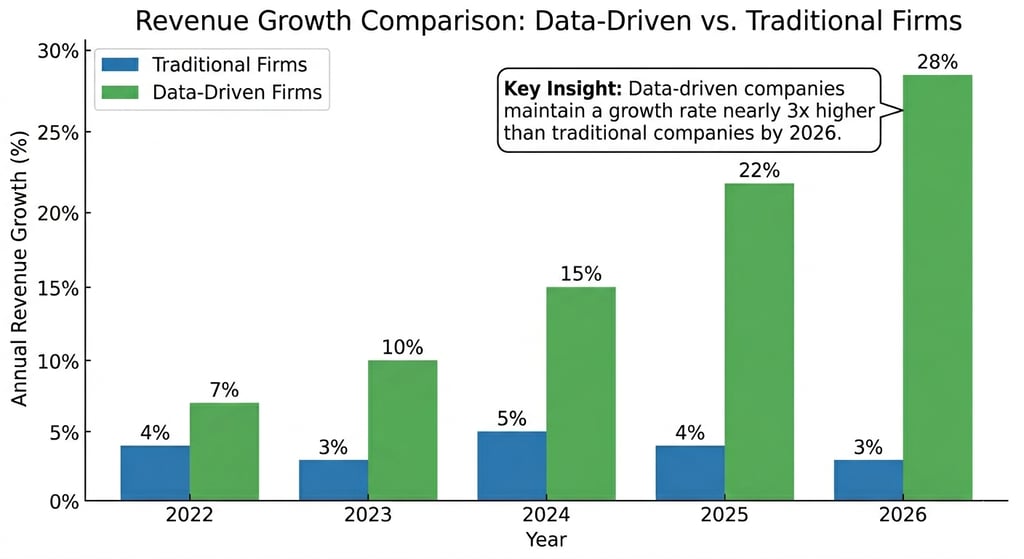
Your competitors are likely already using data analytics to find your weaknesses. They are using it to offer better prices, faster shipping, and more personal service. If they know their customers better than you know yours, they will win. Gartner predicts that by 2026, over 70% of successful organizations will use AI-driven platforms to manage their data. If you are not part of that group, you are giving your competitors a massive head start.
Why is "gut-feeling" decision-making no longer enough?
In the past, a great manager could run a business on intuition. While experience is still important, the market moves too fast for gut feelings alone. The world is more complex than it was twenty years ago. There are too many variables for one human mind to track. Data analytics does not replace your intuition; it supports it. It provides the evidence you need to confirm your feelings or show you where you might be wrong. Moving from "I think" to "I know" reduces the risk of expensive mistakes.
How can you start treating your data like an investment?
What are the first steps toward a data-driven culture?
Turning data into an asset starts with a change in mindset. You must stop seeing it as a technical problem and start seeing it as a business strategy. Start small. Pick one area of your business, like sales or inventory, and look at the data you already have. Ask yourself what question you want to answer. Once you see the value in one area, it is easier to expand to the rest of the company.
Should you build an internal team or use BIaaS?
Building an internal data team is very expensive. You need to hire analysts, engineers, and managers. For many businesses, Business Intelligence as a Service (BIaaS) is a better choice. It gives you access to expert tools and professionals for a set monthly fee. This allows you to get the benefits of high-level analytics without the overhead of a large department. It turns a large capital expense into a manageable operating cost.
How Exology Helps
Exology understands that data is the lifeblood of your growth. We don't just provide charts; we provide a clear path to action. We have worked with businesses across the globe to turn their data into a powerful asset. Whether you are in retail, manufacturing, or services, we tailor our solutions to your specific goals.
Financial Protection: We help you find and stop financial leaks. In one instance, Exology was able to save a client $130,000 in a single day by identifying a critical error through real-time monitoring.
Operational Efficiency: We eliminate the heavy lifting of manual work. In 2025 alone, we saved our clients over 5,000 hours of manual labor by automating their data workflows and reporting.
Scalable Insights: No matter how much data you have, we can handle it. Last year, our systems processed over 10 million rows of data to give our clients the clarity they needed to scale.
Global Expertise: We bring insights from over 20 countries directly to your business. We know what works in different markets and how to apply those lessons to your unique situation.
Actionable Dashboards: Our Business Intelligence solutions move you past static reports. We create live, intuitive visuals that let you make decisions in minutes, not days.
Read More
Contact us
Whether you have a request, a query, or want to work with us, use the form below to get in touch with our team.