

2026: Why Data Driven Culture Is the Only Way to Survive
2026 is the year of "data or dust." Learn why a data driven culture is essential for AI agents, business intelligence, and avoiding costly AI hallucinations.
DATA-DRIVEN CULTURE
Key Points
2026 is the year of "data or dust": Companies without a data-driven culture will fall behind as market speed and AI adoption accelerate.
Significant financial growth: Global spending on big data and analytics is projected to reach nearly $450 billion in 2026.
The cost of messy data: Poor data quality costs organizations millions annually and forces teams to waste 40% of their time fixing errors.
Fueling AI and automation: High-quality data is essential to prevent AI agents from "hallucinating" and making costly business mistakes.
Streamlined integration: A data-first mindset reduces the "integration tax," making it faster to deploy tools like Odoo or real-time dashboards.
High ROI on analytics: Every $1 invested in business intelligence can return an average of $8.71 when supported by a strong data culture.
Actionable takeaway: Conduct a data literacy audit across your departments to identify where manual processes or poor data habits are blocking AI and automation readiness.
What does "data driven culture" really look like in 2026?
In 2026, a data driven culture is no longer just a buzzword for large tech firms. It is the heartbeat of every successful company. This culture means that facts, not feelings, guide every decision from the top floor to the front line. It is an environment where every employee knows how to read, work with, and question data to find better ways to serve customers.
Today, the global big data and analytics market has reached a massive $449.52 billion in 2026. This spending shows that leaders are moving away from old habits. Instead of guessing what might happen next month, they use real-time insights to act right now. A data driven culture is the foundation that makes these modern tools actually work.
At Exology, we have worked on over 150 projects worldwide. We have seen firsthand that a culture of data literacy is the biggest predictor of success. When a team values information, they naturally create high-quality data. This makes it much easier for us to build powerful dashboards and automation systems that deliver immediate results.
Why is 2026 the tipping point for this shift?
For years, companies could get by with messy files and manual reports. That era is over. In 2026, the speed of business is too fast for slow, manual processes. Customers expect instant answers and personalized service. Without a data-first mindset, you simply cannot move fast enough to keep up.
Research from Gartner shows that by 2027, 50% of business decisions will be supported or automated by AI agents. These agents require a constant stream of accurate information. If your company still treats data as a "side project," you will find it impossible to use these new technologies effectively.
Why are companies without a data-first mindset being left in the dust?
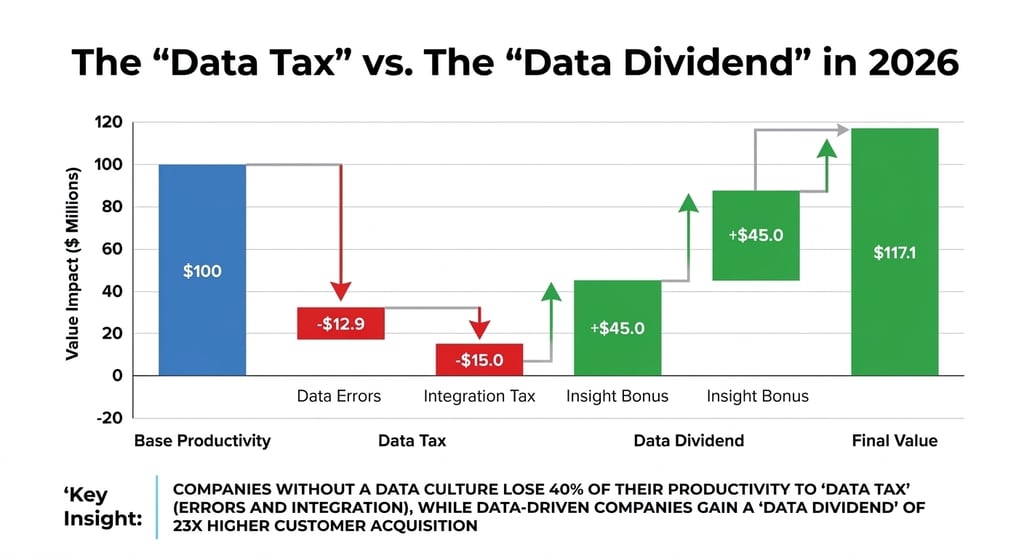
The gap between data-driven companies and their competitors has become a canyon. Organizations that use data to guide their strategy are 23 times more likely to gain new customers. They are also much more profitable because they don't waste money on things that don't work.
Companies that ignore this shift face a "data tax." This tax is paid in wasted hours, missed sales, and bad decisions. When you don't have a data driven culture, your team spends 40% of their time just fixing data errors instead of growing the business. In 2026, no company can afford that kind of waste.
What are the real costs of "messy" data?
Bad data is not just an IT problem. It is a financial disaster. Gartner reports that poor data quality costs organizations an average of $12.9 million per year. This money is lost through supply chain errors, failed marketing campaigns, and wrong inventory levels.
In our experience at Exology, we see that companies with "messy" data habits struggle to scale. They try to launch new AI automation solutions but find that the machines can't read their files. A data driven culture prevents these roadblocks. It ensures that your information is clean, organized, and ready to be turned into profit.
How does high quality data stop AI agents from "hallucinating"?
AI agents and AI automation solutions are the stars of 2026, but they have a major weakness. They are only as smart as the data they consume. When an AI is given incorrect or messy information, it can "hallucinate." This means it makes up facts that sound true but are actually wrong.
The BARC Trend Monitor 2026 notes that data quality management has reclaimed the number one spot as the most important trend. This is because businesses have learned the hard way that "bad data in equals bad AI out." High-quality data acts as a guardrail that keeps your AI agents accurate and reliable.
Why do AI projects often fail?
Many companies rush to buy AI tools without fixing their data culture first. This is a recipe for failure. If your team doesn't care about the accuracy of the numbers they enter, the AI will learn from those mistakes. This leads to biased predictions and faulty recommendations that can damage your reputation.
At Exology, we focus on grounding AI in reality. We know that behind every great AI agent is a foundation of high-quality data. Companies that have already built a data driven culture are much easier to work with. They provide the necessary steps to give us high-quality data, which means their AI solutions never "lose the plot."
Can data literacy prevent AI errors?
Yes. When your employees understand data, they become the first line of defense against AI mistakes. They can spot when a number doesn't look right or when an AI suggestion seems off. This human-in-the-loop approach is a key part of a data driven culture in 2026. It ensures that technology helps people instead of replacing their common sense.
Why is it easier to integrate modern tools in a data-driven environment?
One of the biggest headaches for any manager is getting different software systems to talk to each other. This is often called the "integration tax." In 2026, companies with a data driven culture pay a much lower tax. Because their information is already structured and standardized, connecting new business intelligence solutions is fast and simple.
Fivetran research shows that data teams spend 40% of their time just on integration work when the data culture is weak. That is nearly half of your talent's time gone. In a data-driven company, this time is spent on strategy and growth instead.
Why do data-driven companies get real-time insights faster?
Real-time insights are the "holy grail" of business in 2026. You need to know exactly what is happening as it happens. Organizations that value data have the infrastructure to support real-time feeds. They don't have to wait for a weekly sync or a manual spreadsheet.
We have seen this at Exology through our 150+ global projects. When a client has a strong data culture, we can plug in our visualization tools and show them their "live" business in days, not months. This speed allows them to outmaneuver competitors who are still waiting for yesterday's reports.
What is the actual ROI of building a data driven culture?
Building a new culture takes effort, but the financial rewards are undeniable. For every $1 invested in analytics and BI, companies can see a return of $8.71 on average. This is one of the highest returns on investment in the business world today.
Furthermore, companies that focus on AI literacy for their executives see 20% higher financial performance than those that do not. In 2026, being "data-literate" is as important as being able to read a balance sheet. It is the key to unlocking growth and innovation.
How does Exology see this ROI in practice?
In our work, we have seen data-driven decisions save companies massive amounts of money instantly. For example, we were able to save one of our clients $130,000 in just one day by identifying a critical leak in their operational data. That is the power of having the right data culture and the right tools in place.
We also helped our clients save over 5,000 hours of manual work in 2025 alone. This was possible because their teams were ready to embrace automation. They understood that data wasn't a burden, but a tool to set them free from repetitive tasks.
How Exology Helps
Exology helps businesses turn information into action through data-driven solutions. We work with companies in Egypt, across the MENA region, and internationally to ensure they are not "left in the dust" in 2026.
Custom Business Intelligence: we build project-based dashboards tailored to your unique data ecosystem, giving you a clear view of your business.
Data Analysis & Visualization: we turn raw numbers into actionable stories. Our team has made over 1,340 visualizations to empower decision-makers.
AI Automation & Agents: we deploy intelligent AI agents that are grounded in your data, preventing hallucinations and ensuring high accuracy.
Data Literacy Program: we provide expert training to help your team build a strong data culture. In 2025, we delivered over 4,000 hours of professional training.
Proven Efficiency: our solutions helped clients save over 5,000 hours of manual work in 2025, allowing them to focus on high-value tasks.
Global Authority: with over 150 projects delivered worldwide, we have the experience to modernize your operations and boost productivity.
Read More
Contact us
Whether you have a request, a query, or want to work with us, use the form below to get in touch with our team.