

Data-Driven Egypt: Why the Country Is Moving Toward a Data-Driven Future
Egypt is moving toward a data-driven future. See what is driving the shift, what it means for businesses, and how companies should respond.
DATA-DRIVEN CULTURE
Key Points
Egypt is becoming data-driven due to rapid internet growth and digital adoption
Government initiatives like Digital Egypt are building a strong data and technology foundation
Businesses face challenges from scattered data, slow reporting, and unclear insights
Data-driven companies perform better with faster decisions and improved profitability
Cloud and AI are making data more accessible, scalable, and useful for daily operations
Companies that adopt real-time dashboards and clear reporting gain a strong competitive advantage
Actionable takeaway: Start by centralizing your data into one clear dashboard to improve visibility and make faster, more confident decisions
Why is Egypt moving toward a data-driven future?
What is driving the shift?
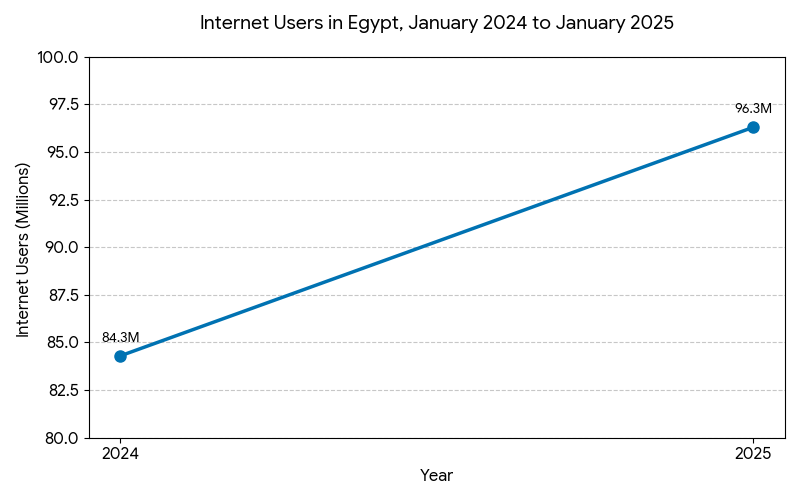
Egypt is moving toward a data-driven future because the country now has more digital activity, more online users, and a stronger push toward modern government and business systems. At the start of 2025, Egypt had 96.3 million internet users and 81.9 percent internet penetration. That is a major base for data growth because more online activity means more customer behavior, more transactions, and more measurable business patterns. The same report says Egypt added 12 million internet users in one year, which shows how quickly the digital market is expanding.
Why does digital access matter?
Digital access matters because data only becomes useful when enough people and organizations are online. Egypt is not just adding users. It is building the conditions for a digital economy. The government’s ICT 2030 Strategy says Egypt is developing Digital Egypt through stronger infrastructure, digital inclusion, innovation, cybersecurity, and a knowledge-based economy. That is important because it shows the shift is national, not just commercial. It means companies will keep operating in an environment that rewards better data use.
When more of the country is connected, businesses can collect cleaner data, serve customers faster, and measure performance more accurately. That is why data-driven planning is becoming less optional and more necessary.
What is pushing businesses in Egypt to use more data?
Why are scattered systems a problem?
A big reason companies are becoming more data driven is that old ways of working are too slow. Many businesses still keep sales, finance, operations, and customer information in separate systems. That creates gaps, delays, and confusion. Leaders end up asking simple questions like, “What is really happening right now?” and getting too many different answers.
This is where analytics starts to matter. McKinsey found that intensive users of customer analytics are 23 times more likely to outperform competitors in new customer acquisition and almost 19 times more likely to achieve above-average profitability. PwC also reports that companies using big data and analytics in their operations outperform peers by 5 percent in productivity and 6 percent in profitability. These are not small gains. They are the kind of gains that change how a business competes.
Why does faster decision-making matter?
Faster decision-making matters because markets move faster than monthly reports. In a data-driven company, leaders do not wait for a long reporting cycle to see what is working. They use dashboards and clear metrics to act early.
For Egyptian businesses, this is especially relevant because more customers are already online and generating more signals every day. When decision-makers cannot see performance clearly, they react late. When they can see it clearly, they can adjust pricing, sales, inventory, service, and hiring with more confidence. That is one of the main reasons the move toward business intelligence is accelerating.
Why are cloud and AI becoming part of the shift?
How does cloud support data use?
Cloud makes data easier to access, store, and share. Without cloud, many companies stay stuck with old systems that are hard to connect. With cloud, teams can work from one source of truth and scale faster.
Egypt’s Cloud First Policy says government entities should use public cloud as the first option for digital services and should support secure migration from legacy systems. The policy also says the goal is to create a secure environment for AI and IoT applications while attracting cloud providers to Egypt. That is a strong signal that cloud is not just a technical choice. It is part of the country’s digital direction.
The OECD also reported that Egypt invested around USD 1.9 billion in ICT infrastructure and deployed fiber optic networks in 4,500 villages. It also said reliable internet access reached 58 percent of the population. These are the kinds of infrastructure changes that make data work at scale.
How does AI strengthen the trend?
AI strengthens the trend because it helps businesses do more with the data they already have. Instead of only reporting what happened, AI can help teams detect patterns, automate routine work, and support quicker decisions.
The OECD’s Artificial Intelligence Review of Egypt says the National AI Strategy is a key catalyst for the country’s digital transformation and supports Egypt’s development agenda. That matters because it shows AI is being treated as part of the broader economy, not as a side experiment. The result is a market where companies are more likely to adopt automation, analytics, and smarter workflows in the years ahead.
What proof shows this change is already happening?
What is happening in public services?
Egypt already has real examples of data-driven digital adoption. The OECD reported that the Digital Egypt platform had more than 7.5 million users by the end of 2022 and that more than 170 government services had been launched on it. It also said e-signature transactions rose by 142 percent in 2022, reaching 375 million. That is strong evidence that digital behavior is spreading quickly.your main system.
What does this mean for businesses?
It means customers, suppliers, and institutions are already getting used to digital processes. Once that happens, companies that still rely on manual tracking and delayed reporting start to fall behind. The market begins to expect speed, visibility, and clarity. That expectation spreads from government services into business operations.
The World Bank’s Egypt Digital Economy Country Assessment also describes Egypt as being at a turning point for government digital transformation and a more data-driven economy. This fits the wider picture. The country is not only expanding access. It is changing how information moves through the economy.
What should companies do next?
How should leaders use data differently?
Leaders should stop treating data as a report that arrives at the end of the month. Data should be part of daily decision-making. The most useful questions are often the simplest ones: Which channel is performing best? Where is revenue slowing? Which team needs support? Which numbers do we trust?
A company does not need more reports. It needs the right view of the business. That means bringing data together, cleaning it, and making it visible in a way leaders can act on quickly.
What should they build first?
The first thing to build is clarity. That usually means a dashboard or reporting system that shows the key business numbers in one place. After that, companies can improve the flow of information, reduce manual work, and add automation where it matters most.
This is why the next few years in Egypt will favor companies that invest in data foundations now. The businesses that understand their numbers early will react faster, plan better, and make stronger decisions.
How Exology Helps
Exology helps companies turn scattered data into a clear business view, which is essential when leaders need faster decisions and cleaner reporting.
With 150+ data-related projects, 20+ countries, and 10+ key industries, Exology has seen firsthand how data affects daily decisions, growth, and operational control across different markets.
That experience matters in a topic like data-driven Egypt, because the real challenge is not collecting more data. It is making the data useful for leadership, teams, and strategy.
Exology builds customized BI solutions that help businesses connect the numbers that matter, reduce reporting delays, and move from guesswork to action.
Exology also supports companies in Egypt, across MENA, and internationally with data analytics, digital transformation, and AI solutions that fit real business needs.
Read More
Contact us
Whether you have a request, a query, or want to work with us, use the form below to get in touch with our team.