

Why you should work with Data-Driven Odoo Implementation Experts
Discover how a data-driven Odoo implementation delivers better insights, higher efficiency, and stronger ROI while showing why expert guidance is essential for long-term success.
ERP
Key Points
Data-driven Odoo implementation starts with clean, structured data instead of only installing modules
Unified data across departments improves reporting accuracy and real-time visibility
BI integration enables faster reporting, real-time dashboards, and smarter decisions
Unified historical and real-time data supports better forecasting and planning
Data-driven ERP reduces manual work, improves efficiency, and lowers operational costs
Expert-led implementation increases success rates and ROI compared to standard ERP setups
Actionable takeaway: Start by cleaning and consolidating your data before any Odoo implementation to ensure stronger reporting, forecasting, and system performance
What Does “Data-Driven Odoo Implementation” Mean?
Defining a Data-Driven Approach vs Standard ERP Setup
A standard ERP implementation often focuses on installing modules, configuring workflows, and migrating legacy systems. A data-driven approach goes further. It begins by cleaning, consolidating, and structuring your business data. It then builds the system around that clean data, designs custom workflows and modules if needed, and layers analytics and dashboards from day one. With this approach your Odoo installation becomes more than software. It becomes a live data platform that supports decision making.
How Data Integration Impacts Business Operations
When ERP is implemented with data integration in mind, all business areas such as finance, inventory, sales, and operations feed into a unified data model. This unified model supports real-time reporting, cross-department visibility, and analytics. That makes it easier for decision-makers to spot issues, forecast demand or cash flow, and align operations with strategy. The result is a stronger foundation for growth and transformation.
Key Advantages of Working with Data-Driven Odoo Experts
Unified Data and Reliable Cross-Department Insights
Integrating ERP and business intelligence gives organizations a single source of truth. According to a leading ERP-BI integration guide, integration helps consolidate data from many modules, including finance, inventory, HR, and sales, into a coherent view.
This improves data quality and consistency. Data-driven implementations help eliminate duplicated records, mismatched formats, and manual reconciliation errors that are common when data stays fragmented.
Faster Reporting, Real-Time Dashboards, and Smarter Decisions
With BI layered on top of ERP, reports that once took days or weeks can become real-time dashboards. This significantly reduces decision lag. Integration of ERP with BI tools enables automated reporting and real-time data access rather than manual exports and spreadsheets.
This speed helps leaders respond to changes quickly. Whether inventory fluctuations, sales swings, or cash-flow shifts, that agility provides a competitive edge.
Better Forecasting and Operational Planning
When historical and real-time data are both available in unified dashboards, businesses can forecast demand, sales, inventory needs, and cash flow with greater accuracy. BI-ERP integration supports predictive modeling, helping teams anticipate future trends instead of just reacting.
That forecasting helps resource planning, procurement, inventory optimization, and budgeting. These functions are critical for companies aiming to scale or grow.
Reduced Operational Costs and Increased Efficiency
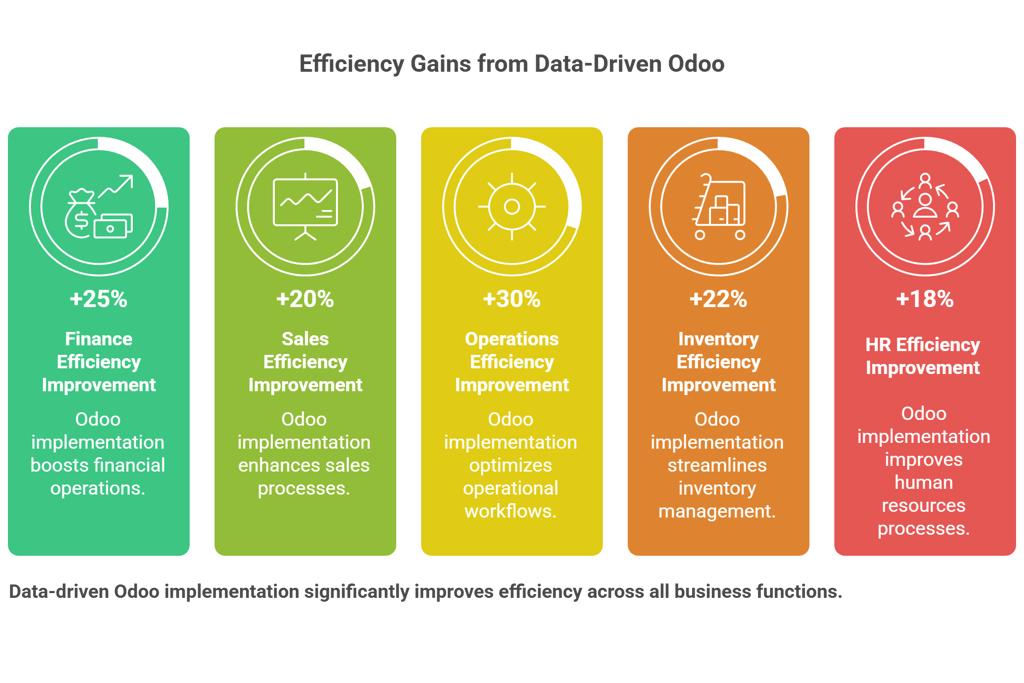
Data-driven ERP reduces time spent on manual data entry, reconciliation, and report consolidation. BI integration automates those tasks. Many businesses see major efficiency gains. Studies note that BI and ERP together improve overall operational efficiency, allowing teams to focus on analysis and strategic work rather than administrative tasks.
In some cases, companies report up to 30 percent efficiency improvement when analytics tools are combined with ERP systems.
Higher Success Rates and ROI When Implementation is Done Expertly
Implementing ERP is complex, and many projects face delays or cost overruns. According to industry data, about 50 percent of ERP projects experience delays or budget overruns.
On the other hand, organizations that implement ERP with proper planning, data integration, and expert support dramatically increase their chance of success. A contemporary survey showed that businesses using consultants or expert integrators had implementation success rates around 85 percent.
Data-driven implementation helps mitigate risk because it ensures data integrity, custom alignment with business processes, and long-term support for analytics and reporting.
What Happens When Data Is Ignored in Odoo Implementation
When teams ignore data and treat ERP installation as a software project only, multiple issues arise:
Data remains siloed across departments. This leads to inconsistent reports and lack of visibility.
Reporting remains manual, slow, and error-prone, delaying insights and impacting decision speed.
The ERP delivers little strategic value. It handles transactions but does not inform strategy, forecasting, or long-term planning.
Over time, lack of analytics and dashboards reduces ROI. Without insights into operations, companies miss opportunities for improvement and growth.
Many firms that skip data integration end up under-utilizing ERP, with limited adoption by teams and low value realization.
Why Data-Driven Implementation Matters for Companies in Egypt and MENA
Companies in Egypt and across MENA are increasingly embracing digital transformation. As businesses scale and diversify operations, they accumulate data from multiple sources, including sales, accounting, and inventory. A data-driven ERP like Odoo helps unify this data, giving management a clear overview of the business.
A regional academic study on cloud ERP and BI integration found a positive link between predictive analytics, ERP-BI integration, and improved financial and operational performance among industrial firms in Egypt.
For companies operating in dynamic markets, data-driven ERP implementation supports growth, agility, and informed decision-making.
How Exology Helps
Exology implements Odoo with a data-driven mindset. We design the system around your data, cleaning and structuring it before migration.
We build custom modules that align with your unique operations and business logic. This ensures Odoo fits your business, not the other way around.
With every implementation, we include a free dashboard that gives you real-time visibility into operations, finance, inventory, and other key metrics.
We integrate business intelligence and analytics, ensuring you can generate reports, forecast demand, monitor KPIs, and drive strategic decisions.
We support clients across Egypt, the MENA region, and internationally, enabling companies of different sizes and industries to adopt data-driven ERP and reap its benefits.
Read More
Contact us
Whether you have a request, a query, or want to work with us, use the form below to get in touch with our team.