

5 Data Modeling Best Practices to Improve Your Company Dashboards
Discover 5 data modeling best practices to boost business intelligence dashboard's speed and accuracy. Learn how Exology helps businesses in Egypt and MENA scale with data.
DATA ANALYTICS
Key Points
Data modeling is the essential foundation for Business Intelligence that turns raw information into a clear map for your company.
Poor data models lead to slow dashboards and conflicting numbers that hurt your ability to make fast decisions.
A Star Schema structure improves dashboard performance by separating business facts from categories like time and location.
Cleaning and standardizing data ensures that your reports stay accurate across different regional systems and languages.
Advanced data modeling allows companies in Egypt and the MENA region to automate complex tasks like currency conversions and regional reporting.
Effective data structures save businesses money by reducing manual work and preventing the high costs of poor data quality.
Actionable takeaway: Start your next BI project by identifying three key business questions to ensure your data model stays focused and efficient.
Many businesses in Egypt and the MENA region invest in modern Business Intelligence tools only to find their reports are slow. Often, the software is not the problem. The issue is usually a poorly designed data model. Think of a data model as the foundation of a building. If the foundation is weak, the entire structure will eventually crack.
What is data modeling and why does it matter for your business?
Data modeling is the process of organizing your business information so a computer can understand it quickly. It involves defining how different pieces of data, like a customer name and a sales total, relate to each other. When done correctly, it turns a mess of spreadsheets into a clear map for your company.
Is data modeling different from just storing data?
Yes, it is very different. Storing data is simply putting information into a database. Data modeling is about designing how that information is structured for analysis. Without a model, your data is just a pile of bricks. With a model, those bricks become a sturdy house.
Why do dashboards fail without a solid data model?
Dashboards fail when they try to process too much messy information at once. Without a model, your BI tool has to do the heavy lifting every time you click a filter. This leads to long loading times. Even worse, it can lead to conflicting numbers in different reports.
How does data modeling impact businesses?
Companies in our region are growing fast and often use many different systems for sales, HR, and inventory. Professional data modeling brings these different sources together. It ensures that a manager in Cairo and a partner in Riyadh are looking at the same single version of the truth.
What are the 5 data modeling best practices for better dashboards?
Improving your dashboards does not always require buying new software. Often, it just requires better organization. Here are five ways to improve your data structure for better performance.
1. Start with the business question, not the database
Many technical teams make the mistake of looking at what data is available first. Instead, you should ask what questions the business needs to answer. Do you need to know which products are most profitable in the MENA region? Knowing the goal helps you build a model that only includes what truly matters.
2. Use a Star Schema for faster reporting
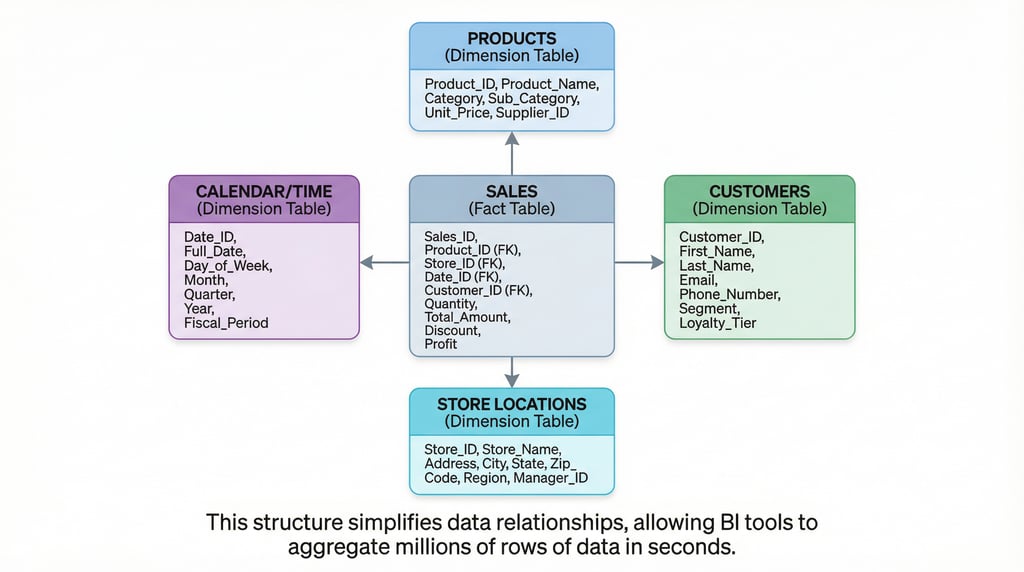
The Star Schema is a classic data modeling technique that remains the gold standard for BI. It places your main business facts, like sales transactions, in a central table. Then, it surrounds that table with dimension tables like dates, locations, and product categories. This structure is very easy for BI tools to read. It makes your dashboards move much faster.
3. Keep your data clean and consistent
Garbage in results in garbage out. If your system records Egypt, EGY, and Arab Republic of Egypt as three different things, your reports will be wrong. A best practice is to clean and standardize these names during the modeling phase. This ensures your analytics are accurate every time you open your dashboard.
4. Avoid flat files for complex analysis
A flat file is one giant spreadsheet with dozens of columns. While they are easy to create, they are hard for BI systems to manage as they grow. Instead, break your data into smaller, related tables. This reduces redundancy and makes it easier to update your information without breaking your existing reports.
5. Document your model for future growth
As your company grows, new people will join your data team. If the data model is only in one person’s head, your business is at risk. Create a simple data dictionary that explains what each table and column represents. This makes it easier to scale your digital transformation efforts later on.
How does professional data modeling impact the bottom line?
Investing in high quality data modeling is a financial decision, not just a technical one. In fact, poor data quality costs organizations an average of $12.9 million per year. By following data modeling best practices, you reduce the time your staff spends manually fixing errors.
Can good data modeling save money?
Yes, it can save a significant amount of money by preventing bad decisions. Experts estimate that data driven organizations are 23 times more likely to acquire customers than their peers. When your data is structured correctly, you can see where you are wasting money and where you should invest more.
How does it improve decision speed?
In the fast-moving MENA market, speed is everything. Global data creation is expected to grow significantly, with the volume of data created worldwide reaching over 147 zettabytes in 2024. A clean data model allows you to process this massive amount of information in seconds. This means you can react to market changes before your competitors do.
What are the unique challenges for companies in Egypt and MENA?
Businesses in our region face specific hurdles when it comes to data. We often deal with multiple currencies and different regional regulations. A strong data model can handle these complexities automatically. It allows you to convert currencies in real time and group data by specific regional territories without manual work.
How Exology Helps
Exology does not just build charts. We build the data architecture that powers your entire business. Our team of 5 professional consultants focuses on creating clean, scalable data models that turn raw information into profit. We use 34+ in-house tools to ensure your data is accurate, fast, and secure.
Our approach to data modeling and Business Intelligence is designed for growth:
In 2025, we successfully processed 10M+ data rows to provide deep insights for our clients.
Our data modeling and automation solutions saved 5,000+ hours of manual work in 2025.
We currently have 40+ dashboards live and empowering businesses across Egypt, the MENA region, and internationally.
We work with companies of all sizes to modernize their operations and adopt data driven processes. Whether you need a custom BI dashboard or a full Odoo implementation, we ensure your data model is built for the future.
Read More
Contact us
Whether you have a request, a query, or want to work with us, use the form below to get in touch with our team.