

How Data Source Quality Directly Impacts Business Intelligence Dashboards and Automation
Discover how the quality of data sources impacts business intelligence dashboards, AI and automation, and decision-making with proven research and best practices.
DATA ANALYTICS
Key Points
High-quality data sources are critical for accurate and reliable business intelligence dashboards
Real-time and consistent data improves decision-making speed and operational responsiveness
Diverse data sources include internal systems, databases, APIs, files, and streaming feeds
Poor data quality increases errors, inefficiencies, and reduces trust in BI and automation
Best practices for external data access include NDAs, secure API access, and clear documentation
Evaluate data sources for accuracy, completeness, consistency, timeliness, and scalability before integration
Actionable takeaway: Establish rigorous data quality checks and secure, well-documented access to all sources before building BI dashboards or automation workflows
What Are Data Sources in Business Intelligence?
What is a data source in the context of BI dashboards?
A data source is any system that feeds information into a business intelligence (BI) dashboard, automation pipeline, or analytics engine. This could be an operational database, CRM system, cloud app, IoT feed, or third-party data provider. The quality, structure, and timeliness of these sources determine whether dashboards truly reflect business reality.
Why data sources are the foundation of every BI solution
BI dashboards are visual interfaces that represent decisions. But regardless of how attractive a chart looks; it is only as accurate as the data it’s based on. Faulty or incomplete sources lead to misleading insights and poor outcomes because the foundational inputs are not trustworthy.
What Types of Data Sources Are Commonly Used in BI?
Internal operational systems
Enterprise systems like CRM tools, ERP (such as Odoo), finance, HR, or inventory systems contain structured records of transactions, customers, and operations.
Databases and data warehouses
Datasets stored in relational or cloud-based data warehouses often serve as consolidated sources for BI projects. These are key to unifying disparate operational data.
APIs and system integrations
APIs enable real-time or near real-time data transfer between systems such as customer support tools, marketing automation platforms, and sales databases.
Files and manual sources
Spreadsheets, CSV exports, or manual uploads introduce risks because they may lack governance, validation, or consistency.
Real-time and streaming data sources
Live sensors, logs, event streams, or transaction feeds enable dashboards to reflect current states, improving responsiveness and automation workflows.
Why Data Source Quality Matters More Than the Dashboard Itself
Accuracy and reliability of insights
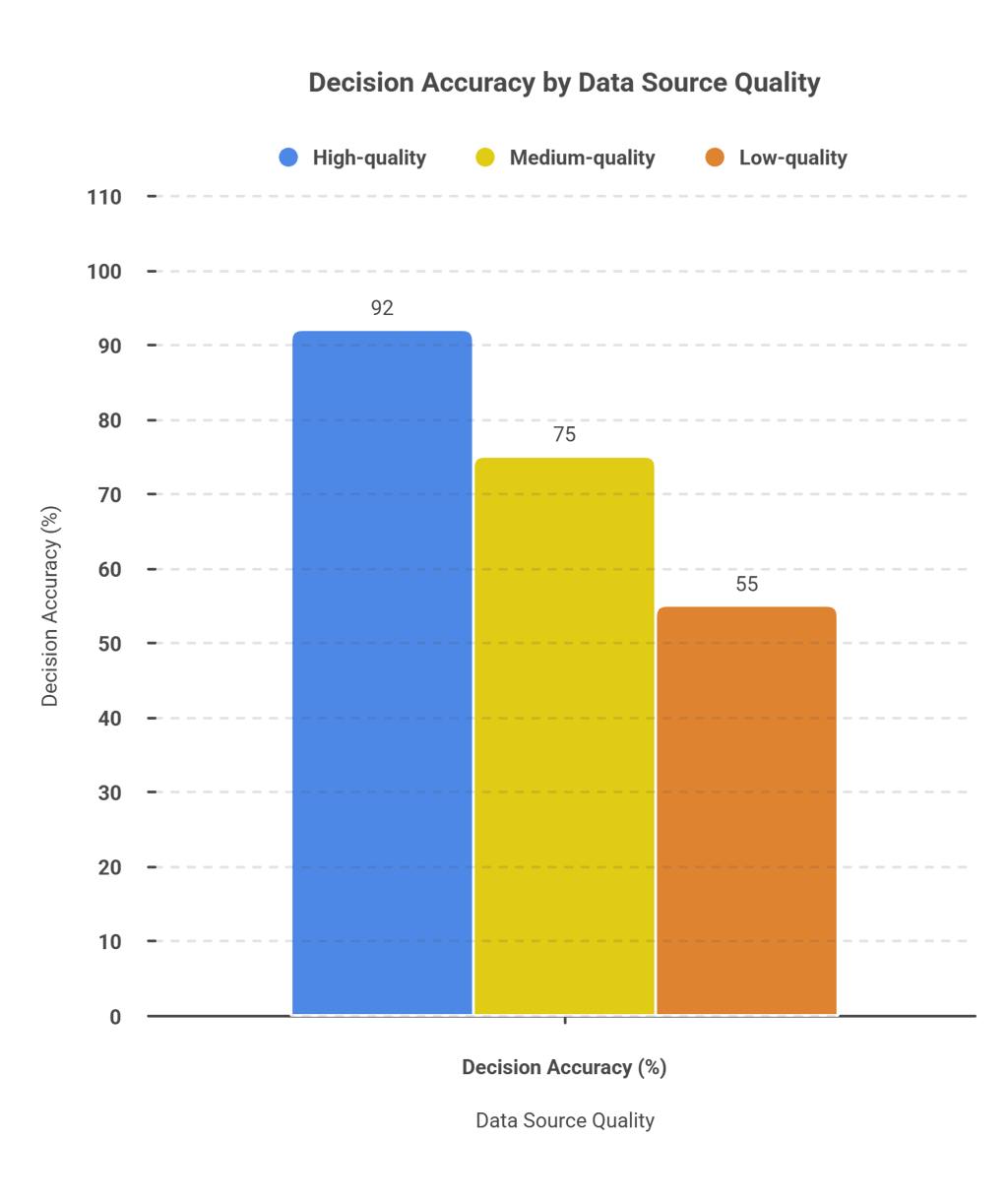
High-quality data ensures that analytical outputs align with reality. Research shows that BI tools become significantly more effective when the underlying information is accurate and consistent rather than erroneous or incomplete.
Consistency across reports and teams
Data inconsistency across systems, different interpretations, formats, or values creates trust issues and conflicting reports. Unified, well-validated sources eliminate confusion and ensure that all teams work from the same numbers.
Completeness and context
Missing fields or incomplete datasets reduce the depth and reliability of analysis. Ensuring required data fields and dimensional context increases confidence in BI insights and strategic forecasting.
How Data Source Quality Affects Real-Time Dashboards
What real-time data actually means
Real-time data refers to information that is accessible with minimal delay, allowing stakeholders to react quickly. Data that refreshes every minute or hour enables immediate operational decisions, unlike static weekly reports.
When real-time data adds business value
Real-time dashboards are critical in logistics, customer experience monitoring, sales pipelines, and operations because they decrease decision latency, helping teams act faster. A recent industry overview shows that organizations with advanced BI maturity achieve 2.5 times faster decision-making compared to less mature peers.
Risks of pretending data is real-time when it is not
Mislabeling batch-updated feeds as real-time adds risk because stakeholders may assume analyses are current when they are stale. This can misdirect actions, compromise automation triggers, and erode trust in data-driven systems.
The Direct Impact of Data Sources on Automation and AI
Automated dashboards and reporting
Automation workflows depend on reliable data feeds. Alerts, scheduled reports, and automated summaries fail if source data is inconsistent, inaccurate, or delayed.
Alerts, workflows, and triggers
Automated notifications tied to key events require timely, structured data. When data quality is poor, alerts may trigger erroneously or not at all, reducing operational responsiveness.
AI and advanced analytics
Machine learning models rely on clean, consistent input data. Research shows that high information quality, timely, complete, and relevant data enhances user trust and analytical performance for BI systems.
Poor data quality limits the value of AI models because the algorithms draw patterns from flawed inputs, resulting in inaccurate forecasts or decisions.
Real-World Examples of Data Source Impact on BI
CRM-connected dashboards vs manual sales reports
Dashboards that connect directly to CRM systems provide accurate, up-to-date visibility into sales pipelines. In contrast, manual spreadsheets can contain outdated figures, duplicates, or missing entries, leading to misleading forecasts.
Operations dashboards using live system data
Manufacturing and logistics dashboards driven by real-time operational data improve responsiveness, identify bottlenecks early, and support automation. For example, companies using real-time dashboards can reduce stockout incidents and cut manual reporting time dramatically. One case study shows inventory dashboards reduced manual reporting from 40 hours to 4 hours weekly and cut stockouts by 60%.
Finance dashboards using delayed or fragmented sources
Finance teams relying on outdated or fragmented systems face delays in budgeting, forecasting, and variance analysis. These delays directly affect strategic agility and resource allocation.
Best Practices for Giving External Partners Access to Data Sources
Legal and governance foundations
Establish NDA contracts that define confidentiality and permitted use of information
Clearly define data ownership, retention policies, and usage restrictions
Align expectations on update frequency and refresh schedules
Access control and security
Provide role-based and read-only access to sensitive systems
Use secure API tokens rather than shared credentials
Encrypt data flows and monitor access logs
Technical best practices
Connect through documented APIs and standardized interfaces
Avoid direct database access, when possible, use intermediary data layers
Centralize access management for easier auditing
Documentation and alignment
Share data dictionaries with clear definitions
Communicate refresh frequencies and dependencies
Describe known limitations or data gaps so partners understand context
How to Evaluate Whether a Data Source Is Ready for BI and Automation
Key quality checks
Evaluate accuracy, completeness, consistency, timeliness, and relevance before integrating a data source. Tools and validation check help measure these attributes and flag quality issues early.
Stability and scalability
Reliable sources maintain consistent availability and support growth without frequent failures. This stability is essential when dashboards feed automation and AI processes.
Long-term maintainability
Systems evolve, and data sources must adapt to changes in structure, schema, or business logic. Evaluate how a source will continue to support BI and automation over time.
Common Mistakes Companies Make with Data Sources
Treating dashboards as the problem instead of the data
Only redesigning visuals does not fix poor data sources. The underlying data must be accurate and consistent before visuals become meaningful.
Relying on manual or fragmented sources
Manual processes increase errors and reduce trust in dashboards. Automating data ingestion and cleansing enhances reliability.
Delaying governance until problems appear
Data governance should be established early to prevent confusion, conflicting reports, and lost confidence in systems.
How Exology Helps
We have worked with over 150 different businesses across Egypt, the MENA region, and internationally, handling a wide range of internal and external data sources for BI and AI initiatives
We integrate diverse data sources into customizable BI and AI solutions that ensure accurate, timely, and actionable insights
We design secure, controlled access mechanisms, including NDA governance, API connectivity, and data dictionaries, for reliable integration
Our team cleans, consolidates, and standardizes data before dashboards and automation workflows are built so insights are trustworthy and decision-ready
We help businesses unlock faster, more confident decision-making by enabling reliable real-time data flows and predictive analytics
Read More
Contact us
Whether you have a request, a query, or want to work with us, use the form below to get in touch with our team.