

Digitization, Digitalization, and Digital Transformation: What They Really Mean for Businesses
Discover the difference between digitization, digitalization, and Digital Transformation, and how business intelligence drives real growth. Learn how Exology helps companies achieve successful digital transformation with consulting and data-driven solutions. (updated 2/2/2026)
DIGITAL TRANSFORMATION
Key Points
Digitization converts analog information into digital data, creating a foundation for future insights.
Digitalization improves business processes using technology, increasing efficiency and reducing errors.
Digital transformation is a strategic reinvention that combines technology, data, and operations for growth.
Business intelligence dashboards unify scattered data, enabling real-time, evidence-based decision-making.
Common pitfalls include focusing only on tools, ignoring strategy, and poor data integration.
Exology helps organizations implement digital transformation through consulting, BI, dashboards, and automation.
Actionable takeaway: Assess your current digital maturity, identify gaps in data or processes, and implement BI solutions to enable informed, fast decision-making.
In today’s fast-evolving business landscape, the terms digitization, digitalization, and digital transformation are often used interchangeably. Many companies claim they are digitally transforming when in reality, they are only digitizing documents or automating a few processes. Understanding the differences between these stages is crucial for creating real business impact. Each stage builds on the previous one, and using business intelligence strategically ensures measurable growth.
Organizations that fail to differentiate these concepts often face scattered data, slow reporting, and low returns on technology investments. Knowing where your company stands and what comes next can prevent wasted resources and accelerate decision-making.
What is Digitization and Why It Matters
Digitization is the process of converting analog information into digital form. It is the foundation of all digital initiatives but does not change how a business operates. Digitization creates data, which later enables process optimization and strategic transformation.
Examples of digitization include:
Scanning paper documents into a digital database
Storing customer records electronically
Replacing paper invoices with PDFs
The benefits of digitization are clear. It allows organizations to centralize information, reduce physical storage needs, and lay the groundwork for business intelligence. Without digitization, there is no data to analyze. However, digitization alone does not increase efficiency or improve decision-making.
Limitations of digitization:
Data often remains siloed and disconnected between departments
Reporting can still be slow and manual
No improvement in business processes or workflows
Digitization is a critical first step, but companies must progress beyond it to see measurable growth.
How Digitalization Optimizes Business Processes
Digitalization uses technology to improve how work is done. Unlike digitization, which focuses on data conversion, digitalization focuses on process optimization and efficiency.
Examples include:
Automating invoice approvals and purchase workflows
Using software to manage inventory, logistics, and supply chains
Implementing customer and supplier portals for self-service interactions
The impact of digitalization is tangible: faster operations, reduced errors, and smoother workflows. Employees can focus on strategic work instead of repetitive tasks, and businesses achieve cost savings.
However, digitalization has limits. While processes improve, the core business model often remains unchanged. Companies may see efficiency gains but still struggle with fragmented data or slow decision-making.
Challenges of digitalization:
Each department may adopt separate tools, creating silos
Reporting may still rely on manual exports or spreadsheets
Leadership lacks a single source of truth for strategic decisions
Business intelligence is essential at this stage to unify data and provide real-time visibility across operations.
Digital Transformation: Redefining the Business
Digital transformation goes beyond tools and automation. It is a strategic reinvention of how a company operates, serves customers, and competes in the market. Transformation combines technology, data, and business strategy to create lasting value.
Key components of digital transformation include:
Unified data systems for consistent insights across the organization
Business intelligence dashboards for real-time decision-making
AI and automation to optimize workflows and reduce operational bottlenecks
New digital revenue models that create value in innovative ways
Personalized customer experiences delivered at scale
The result is faster, data-driven decisions and a stronger competitive position.
Common pitfalls to avoid:
Focusing solely on technology instead of aligning with business strategy
Treating digital transformation as an IT project rather than a company-wide initiative
Ignoring data quality, integration, and governance
According to Gartner 2025, organizations that integrate business intelligence into transformation efforts are 2.5 times more likely to achieve measurable growth than those that adopt tools without strategy.
The Role of Business Intelligence in Digital Transformation
Business intelligence (BI) is the backbone of digital transformation. It turns scattered data into actionable insights, enabling companies to make confident decisions quickly.
Benefits of BI include:
Centralized, unified data accessible across departments
Real-time performance monitoring
Early identification of trends, risks, and opportunities
Alignment of teams around a single source of truth
Companies using BI dashboards report significantly faster decision-making and improved operational efficiency. For example, McKinsey 2025 found that businesses adopting BI solutions saw a 30–40% increase in productivity across operational units within the first year.
Examples of BI in action:
Sales and marketing dashboards highlighting customer trends
Operational performance tracking for manufacturing or logistics
Financial reporting and forecasting that reduces errors and accelerates planning
Without BI, digital transformation efforts can become fragmented and difficult to measure.
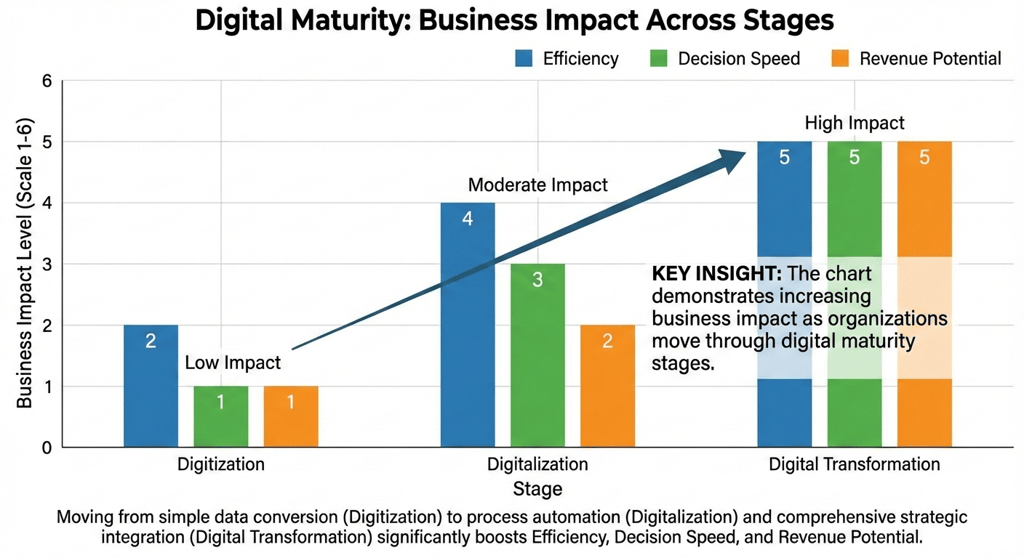
Business Impact Across Stages
The progression from digitization to digital transformation produces measurable improvements across efficiency, decision speed, and revenue potential. A simple representation of the impact is illustrated below.
How Exology Helps
Exology supports organizations in turning digital initiatives into measurable business impact. Our approach ensures that companies move from digitization and digitalization to full digital transformation with confidence.
Digital Transformation Consulting: Our 5 professional consultants guide organizations through the right transformation roadmap, helping prioritize initiatives that create real business value.
Business Intelligence and Analytics: With over 50 companies served through our data analysis services, we unify scattered data into actionable dashboards for faster, data-driven decisions.
Efficiency and Automation: In 2025 alone, Exology has saved clients over 5,000 hours of manual work, freeing teams to focus on strategic priorities and increasing overall productivity.
Interactive Dashboards and Visualizations: Over 1,340 visualizations have been delivered to empower leaders with real-time insights across operations, finance, and customer engagement.
Read More
Contact us
Whether you have a request, a query, or want to work with us, use the form below to get in touch with our team.