

Domain over Data: Why Context Matters More Than Numbers in Data Analytics
Learn why domain expertise is the secret to a successful data analytics strategy in 2026. Discover how context turns raw numbers into actionable data insights.
DATA ANALYTICS
Key Points
Domain over Data: Industry-specific knowledge is the most important factor in turning raw numbers into useful business strategies.
Context is King: Raw data lacks inherent value until it is filtered through an understanding of market trends and customer behavior.
Avoid Project Failure: Most analytics projects fail because they prioritize technical tools over clear business goals and industry context.
Filter the Noise: Expertise allows leaders to ignore "vanity metrics" and focus on the small percentage of data that actually drives profit.
Human-Led AI: Artificial intelligence in 2026 requires human oversight to ensure that automated patterns reflect real-world business logic.
Data Literacy: Successful companies build a culture where employees at every level can interpret data and use it to solve daily problems.
Actionable takeaway: Start every data project by defining a specific business problem you need to solve before you collect any data or select any analytics tools.
Imagine you are standing in a control room. Every wall is covered in screens. Millions of green numbers are scrolling past your eyes at lightning speed. To an outsider, this looks like progress. It looks like "Big Data" in action. But for the person in the chair, the only question that matters is: "What do I do next?"
In 2026, we are producing more information than ever before. Projections show that global data creation will reach nearly 240 zettabytes this year, which is a staggering amount of noise. Yet, despite this flood of information, many businesses are still starving for wisdom. They have the data, but they lack the context.
This is the core of the "Domain over Data" philosophy. It is the belief that a successful data analytics strategy must be led by industry expertise, not just technical ability. At Exology, we have lived this reality through more than 150 projects worldwide. We have served over 10 key industries, and if there is one thing we have learned, it is this: numbers are useless if you do not know the "why" behind them.
What is the true meaning of the "Domain over Data" concept?
To build a winning data analytics strategy, you must understand that data is a tool, while the "domain" is the map. Without the map, the tool can actually lead you in the wrong direction.
Defining Domain Expertise in Modern Analytics
Domain expertise is the deep, specialized knowledge of a specific industry. It includes understanding market cycles, customer psychology, and the hidden rules of a particular sector. When we talk about "Domain over Data," we mean that your industry knowledge should dictate which data you collect and how you interpret it.
In the past, companies tried to hire "generalist" data scientists who could jump from a retail project to a healthcare project without skipping a beat. But in 2026, the market has shifted. Gartner now lists Domain-Specific Language Models (DSLMs) as a top strategic trend because generic models simply do not have the depth required for high-stakes business decisions.
Why Raw Numbers Lack Inherent Value
A number on a spreadsheet has no intrinsic meaning. For example, if your report shows "500," that could be excellent or catastrophic. If it represents 500 new high-value clients, you celebrate. If it represents 500 seconds of downtime for a critical server, you are in a crisis.
Context is what transforms raw data into actionable data insights. Without it, you are just performing "data theatre," which is the act of looking busy with charts without actually moving the needle for your business.
Why do most data analytics strategy projects fail without context?
The statistics for data projects are historically grim. Research shows that roughly 85% of big data projects fail to reach their goals. When you dig into why these projects fail, the answer is rarely "the math was wrong." Instead, the answer is usually "the context was missing."
The Cost of Measuring the Wrong Metrics
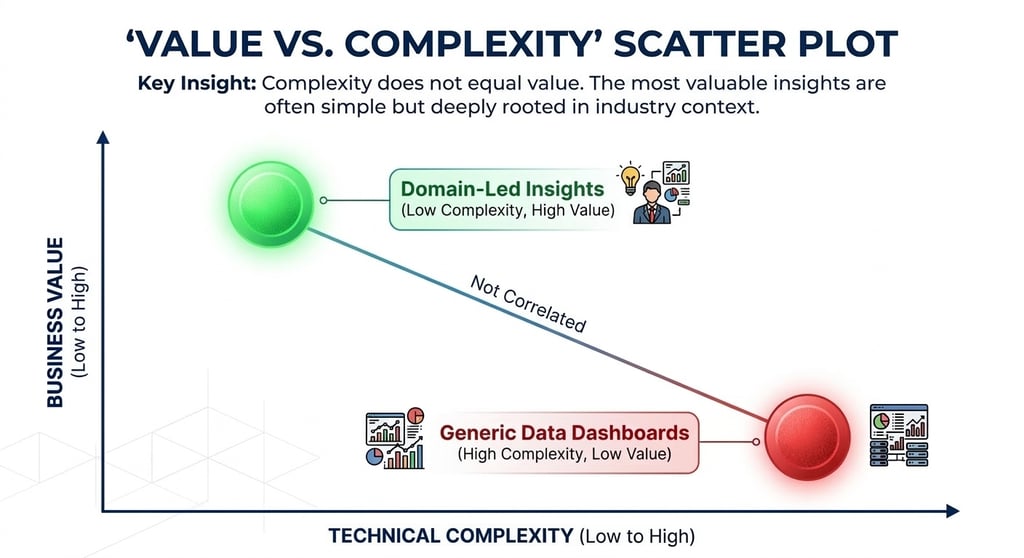
One of the biggest mistakes a company can make is focusing on "vanity metrics." These are numbers that look good on paper but do not relate to your bottom line. A data team without domain expertise might spend months optimizing website "time on page." However, a domain expert might know that for your specific industry, a shorter "time on page" is better because it means users are finding what they need faster.
Organizations lose an average of $9.7 million to $15 million every year because of operational inefficiencies caused by poor data context and flawed decision-making. When you measure the wrong thing, you are not just wasting time; you are actively hurting your profitability.
How Misinterpretation Leads to Strategic Errors
Data can be a very convincing liar. If you see a correlation between two numbers, it is tempting to assume one causes the other. This is a classic trap. A National Bureau of Economic Research study from February 2026 highlighted that 90% of firms found no measurable productivity impact from their AI and data investments.
This happens because the "patterns" the machines find are often coincidental or irrelevant to the business reality. Without a human domain expert to say, "Wait, that doesn't make sense in our market," companies end up making massive strategic pivots based on ghosts in the machine.
How does industry expertise create actionable data insights?
The goal of any data analytics strategy is to produce "Actionable Insights." These are the rare gems that tell you exactly what to do to grow your business. You cannot find these gems with code alone.
Filtering Noise from Meaningful Signals
We live in an age of "Information Overload." Every day, the world generates over 400 million terabytes of data. In this ocean of noise, the most valuable skill is the ability to ignore 99% of what you see.
Industry expertise allows you to know what is "normal" and what is "signal." For example, in a retail environment, a 5% drop in sales during a specific week might be a normal seasonal trend. A generalist analyst might panic and suggest a price cut. But a domain expert will look at the calendar and realize it is a holiday week where people are traveling, not shopping. They save the company from a needless discount that would have destroyed their margins.
Turning Past Reports into Future Predictions
Most companies use data to look in the rearview mirror. They look at what happened last month or last quarter. This is "Descriptive Analytics." While it is useful, it is not competitive.
True value comes from "Predictive Analytics," which is using the past to guess the future. But you cannot predict the future with math alone. You need to understand the "levers" of your industry. Gartner predicts that by 2026, organizations will abandon 60% of their AI and analytics projects if they are not supported by high-quality, context-ready data. At Exology, we have seen that the most accurate predictions come when we combine our processing power with the deep industry knowledge of our 10+ target sectors.
Can AI agents replace human domain experts in 2026?
With the rise of "Multiagent Systems" and autonomous AI, there is a common fear that human expertise is becoming obsolete. But the reality is the exact opposite. As AI becomes more common, the value of a human expert who can "verify" the machine increases.
The Limits of Pattern Recognition without Understanding
AI is a "pattern matching" machine. It is incredibly good at finding a needle in a haystack. But it has no idea what a needle is, or why you would want one. It does not understand "consequence."
McKinsey’s State of AI 2025 report notes that while usage of AI is up to 65% across organizations, value at scale remains "elusive." This is because businesses are trying to "bolt on" AI to their data without rewriting their workflows or adding human-in-the-loop oversight. Without a human to guide it, an AI agent might suggest a "perfect" logistical route that is technically fast but physically impossible due to local road conditions it does not "know" about.
Bridging the "Actionability Gap" with Human Oversight
We often talk about the "Actionability Gap." This is the space between "I have a report" and "I have made a decision." Only 39% of leaders feel their organizations are fully ready to handle the upcoming changes in technology and work.
Bridging this gap requires "Decision Intelligence." This is a new discipline that combines data science with social science and managerial expertise. It is the practice of looking at a data insight and asking, "Is this ethical? Is it feasible? Is it right for our brand?" These are human questions that no algorithm can answer.
How can your business adopt a domain-first approach?
If you want to stop drowning in numbers and start driving growth, you need to pivot your strategy. You need to put the domain back in the driver's seat.
Building a Culture of Data Literacy
Data literacy is not just for the IT department. In 2026, data literacy is a foundational skill for every employee, from the front desk to the boardroom. It means giving your team the confidence to "argue with data."
When a team is data-literate, they do not just accept a dashboard at face value. They ask where the data came from, what it is missing, and how it relates to their daily goals. Coursera’s 2026 Guide to Data Literacy highlights that companies with high literacy see better innovation and faster growth because decisions are made closer to the "front line" of the business.
Partnering with Experts Who Understand Your Industry
Do not just hire a "tech firm." Hire a partner who has been in the trenches of your specific industry. Experience is the only thing that cannot be automated.
At Exology, we do not just provide software; we provide perspective. We have delivered over 150 projects worldwide, and each one has added to our "knowledge library." When we look at your data, we are not just seeing 1s and 0s. We are seeing the patterns of over a decade of business history.
FAQ
Why is domain knowledge suddenly so important in 2026?
Because data has become a commodity. Anyone can collect it. The competitive advantage is no longer "having" data; it is "understanding" it better than your rivals. As AI makes generic analysis free, specialized industry knowledge becomes priceless.
Can a data scientist succeed without domain knowledge?
A data scientist can build a model, but they cannot tell you if the model is useful. For a project to succeed, the "technical" person must be paired with a "domain" person, or they must strive to learn the business themselves.
How do I know if my data analytics strategy is failing?
If you are producing reports that no one reads, or if your "insights" do not lead to a change in behavior, your strategy is failing. A successful strategy results in a clear "Yes" or "No" to a business question.
What is the first step to becoming "Domain-First"?
Stop looking at your data for a week. Instead, talk to your customers and your staff. Find the three biggest roadblocks in your operation. Only once you have those clearly defined should you turn your data tools back on to look for the solution.
How Exology Helps
Exology is not just a technology provider. we are a bridge between your raw data and your next big business move. We have seen what works and what does not through over 150 projects across the globe. Our first-hand experience allows us to skip the "learning curve" and go straight to the results.
Diverse Industry Reach: We have been able to serve over 10 key industries, meaning we bring a world of "cross-pollinated" ideas to your specific business problem.
Proven Global Experience: Exology has delivered over 150 projects worldwide, helping companies turn messy data into clear, strategic roadmaps.
Tangible Business Impact: Our context-first approach works. In one case, our understanding of operational bottlenecks helped us save our client $130,000 in just one day.
Read More
Contact us
Whether you have a request, a query, or want to work with us, use the form below to get in touch with our team.