
The Executive Guide to Data Types: Structured vs. Unstructured Data
Master the three critical data types for business to drive growth in 2026. Learn how to turn structured and unstructured data into high-value assets.
DATA ANALYTICS
Key Points
Business data is categorized into three main types: structured, semi-structured, and unstructured.
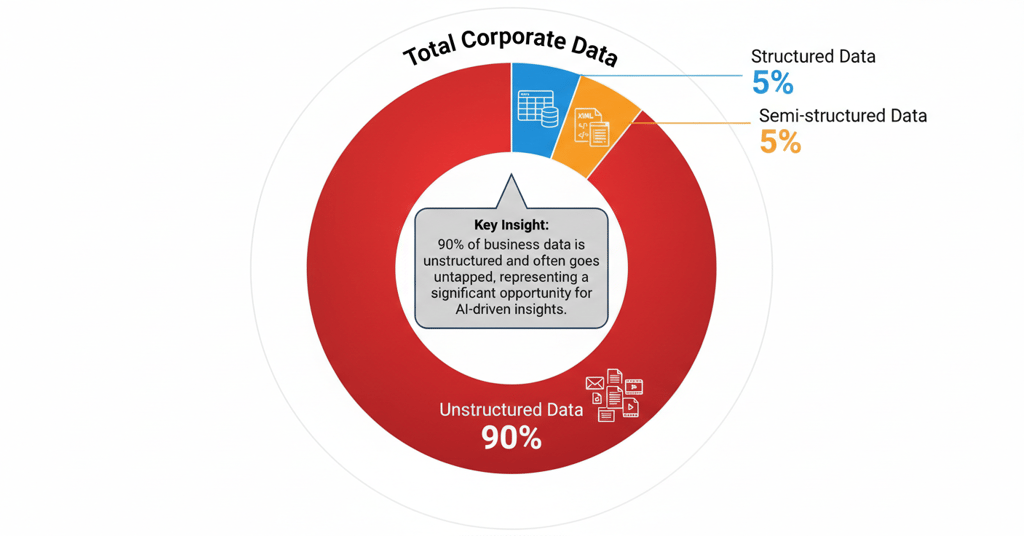
Unstructured data represents 90% of all information but often remains unused by most companies.
Poor data management leads to significant financial losses and costs organizations millions of dollars every year.
AI agents and intelligent automation are required to turn "dark data" into useful business insights.
Modern data architecture like the Lakehouse model helps businesses store and analyze all data types in one unified system.
Automated Business Intelligence solutions increase productivity by removing manual reporting tasks and human error.
Actionable takeaway: Perform a data audit to identify unstructured "dark data" in your company that can be automated through AI agents.
In 2026, data has become the most valuable currency for global organizations. However, most leaders only utilize a small fraction of the information they collect. Many businesses focus on the clear numbers in their spreadsheets while ignoring the massive amount of information hidden in emails, PDFs, and customer recordings.
Understanding the various data types for business is the first step toward better decision making. If you want to improve productivity and stay ahead of global competitors, you must know how to turn every piece of information into a clear action plan. Companies that fail to manage their data effectively often face rising costs and missed opportunities.
What are the three main types of data used in business?
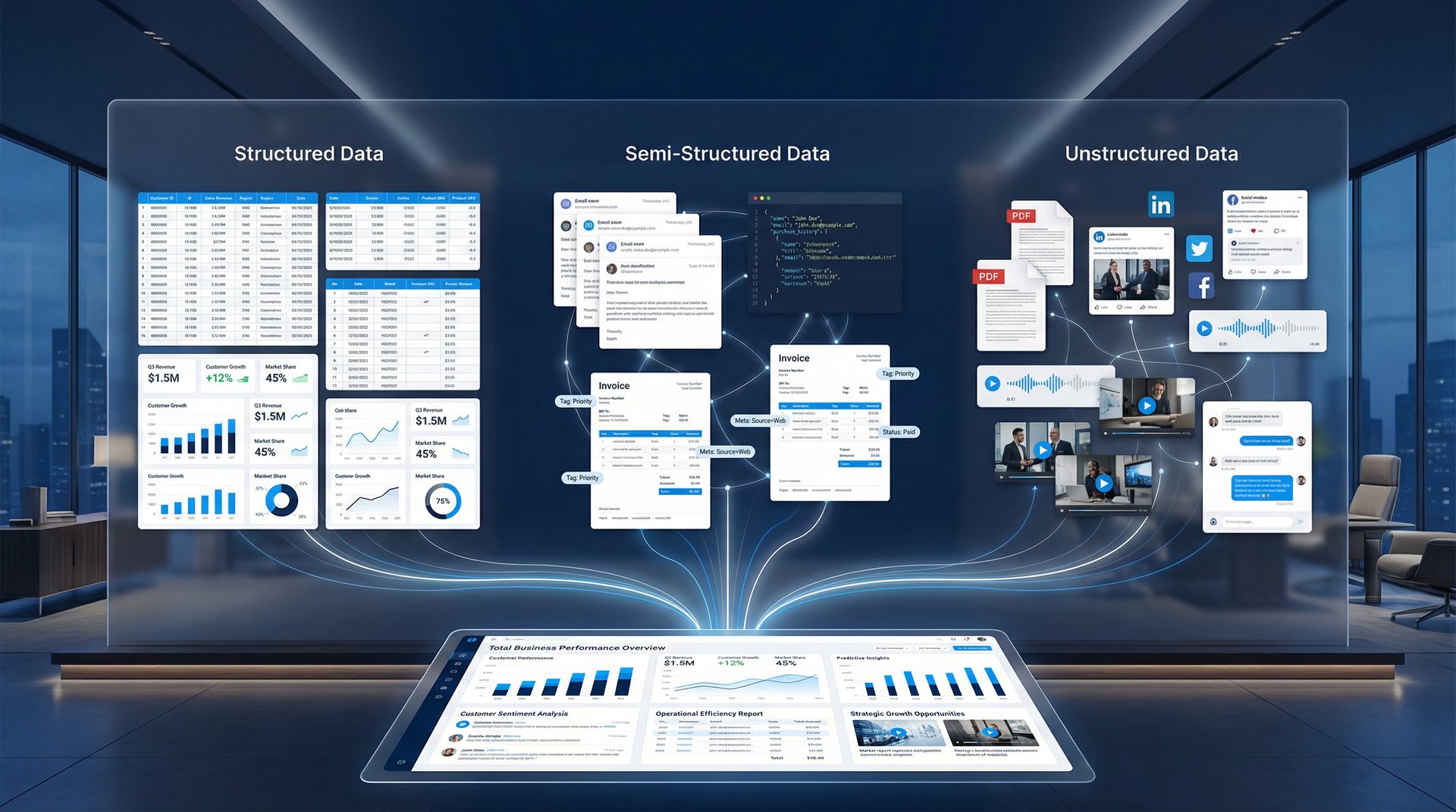
Most business information falls into three distinct categories. These are structured, semi-structured, and unstructured data. Each type serves a different purpose and requires specific tools for management.
What is structured data?
Structured data is highly organized information that fits perfectly into tables. It follows a strict format and is easy to search or analyze. When you look at an Excel sheet or a traditional database, you are seeing structured data.
This type of data is the backbone of most business operations. It includes quantitative information like sales figures, inventory counts, and customer names. Because it is pre-defined, it is simple for software to process without human intervention.
What is semi-structured data?
Semi-structured data does not fit into a rigid table, but it still has some markers to help you organize it. It contains tags or metadata that describe the content. This makes it easier to process than raw text but more flexible than a traditional database.
Common examples include emails or digital invoices. While the body of an email is free-form text, the "Subject" and "Date" fields give it a basic structure. Modern web formats like JSON and XML also fall into this category.
What is unstructured data?
Unstructured data is everything else. It includes videos, social media posts, voice notes, and lengthy PDF documents. It does not follow a specific format, which makes it very difficult for traditional software to understand.
By 2026, the volume of this data is exploding. Recent reports show that 90% of the data worldwide is unstructured. For a long time, this was called dark data because it was collected but never used.
Why is structured data considered the foundation of Business Intelligence?
Structured data is the easiest to use for creating dashboards and reports. It allows you to track Key Performance Indicators (KPIs) and see immediate trends in your business. Without clean, structured data, your digital transformation efforts will likely fail.
How does structured data improve decision making?
When your data is structured, you can perform complex calculations instantly. You can compare year-over-year growth or identify which products are performing best. This clarity allows leaders to move away from "gut feelings" and toward facts.
Consistent data formats also ensure that every department is looking at the same information. This creates a "single source of truth" for the entire company. It reduces the time spent arguing about whose spreadsheet is correct.
What are common examples of structured data in ERP systems?
Most ERP systems, like Odoo, SAP and Oracle thrive on structured data. Examples include financial transactions, employee payroll records, and shipping dates. These data points are essential for daily operations and logistics management.
Because this data is already organized, it is the perfect fuel for Business Intelligence solutions. It allows for the creation of real-time dashboards that update as soon as a sale is made or a shipment is received.
What makes unstructured data the biggest challenge for modern companies?
While structured data is useful, it only represents about 10% of your potential insights. The real challenge and opportunity, lies in the massive piles of unstructured information your company generates every day.
Why is 90% of your data currently hidden?
Most companies do not have the tools to analyze unstructured data. Information stays trapped in call logs, meeting notes, and internal chat messages. This data is often messy and lacks a consistent format.
Ignoring this data means you are missing out on deep customer insights. For example, a spreadsheet might tell you that sales are down, but the unstructured text in customer emails will tell you why they are unhappy.
Can AI agents turn unstructured data into actionable insights?
In the past, analyzing unstructured data required thousands of manual hours. In 2026, this has changed. Intelligent AI agents can now "read" and "summarize" thousands of documents in seconds.
These agents use natural language processing to extract themes and sentiments from raw text. This allows businesses to turn random comments into structured data points that can be visualized on a dashboard. By 2026, global spending on big data and analytics is expected to reach $420 billion.
How does semi-structured data bridge the gap between files and databases?
Semi-structured data is the middle ground. It provides the flexibility of unstructured data with just enough organization for a computer to read it effectively.
Why are digital invoices and emails semi-structured?
A digital invoice is a perfect example of semi-structured data. While the layout might vary, the file usually contains hidden tags for the price, tax, and vendor name. These tags allow different software systems to communicate with each other.
Emails are similar because they combine fixed fields, like the sender’s address, with unstructured content, like the message body. Understanding this distinction helps companies build better automation workflows.
How do modern BI tools process semi-structured information?
Modern Business Intelligence solutions are designed to handle more than just tables. They can ingest JSON files and social media feeds directly. They parse the tags to organize the information before it reaches your dashboard.
This capability is essential for companies that rely on web data or e-commerce platforms. It allows you to track real-time changes in market sentiment or competitor pricing across the web.
What is the financial cost of poor data management?
Bad data is more than just a headache. It is an expensive problem that quietly drains revenue from your company every day. If your team cannot trust your data, they will spend more time fixing errors than they do making sales.
How much money do companies lose to bad data quality?
Poor data quality is estimated to cost organizations an average of $12.9 million annually. This loss comes from wasted resources, lost sales opportunities, and incorrect strategic moves.
When data is messy, it leads to "garbage in, garbage out" results. No matter how advanced your AI agents are, they cannot produce good results if they are trained on flawed information.
How does automated reporting increase operational ROI?
Automating your data collection saves significant time. Manual reporting is slow and prone to human error. By automating these tasks, you allow your team to focus on high-value work.
Studies show that AI and automation can improve employee productivity by as much as 40%. This shift not only saves money but also improves employee morale by removing repetitive, boring tasks.
Preparing your data architecture for the AI-driven future
To thrive in 2026, you must build a data ecosystem that can handle the diversity of information. This requires a shift in how you think about your company’s digital backbone.
What steps can you take to modernize your data ecosystem?
The first step is to conduct a data audit. Identify where your structured, semi-structured, and unstructured data lives. Once you know what you have, you can begin to integrate these sources into a unified platform.
Many global leaders are moving toward a "Data Lakehouse" model. This architecture allows you to store raw, unstructured files alongside clean, structured tables. It provides the perfect foundation for both Business Intelligence and AI agent training.
Why is a "Data-First" culture essential for global growth?
Technology alone is not enough. Your team must value data accuracy at every level. A data-first culture ensures that information is captured correctly from the start.
When every employee understands the value of data, the entire organization becomes more agile. You can pivot your strategy based on real-time insights rather than outdated reports. This agility is what separates market leaders from those who fall behind.
How Exology Helps
Exology turns information into action. We help organizations worldwide move beyond simple spreadsheets and embrace a truly data-driven future. Our team specializes in bridging the gap between raw data and profitable decisions.
Integrated Business Intelligence Solutions: We build fully customized dashboards that unify your structured ERP data with unstructured insights. This gives you a complete view of your global operations in real time.
AI Agent Automation: We develop and integrate custom AI agents into your workflows. These agents can process and analyze unstructured data, such as customer feedback or legal documents, to find trends your team might miss.
Proven Global Impact: We have successfully delivered over 150 projects worldwide across more than 20 countries. Our solutions are designed to scale with your business, no matter where you are located.
Massive Productivity Gains: In 2025 alone, our automation and data strategies saved our clients over 5,000+ hours of manual work. We focus on removing the "hidden tax" of manual data entry so your team can focus on innovation.
Direct Financial Value: Our data-driven approach delivers immediate results. We once helped a client save $130,000 in a single day by identifying and fixing deep-seated data inaccuracies in their pricing model.
Modernizing Your Infrastructure: We help you adopt advanced data architectures that are ready for the AI era. Whether you are implementing Odoo or building a custom BI platform, we ensure your data is your greatest asset.
Read More
Contact us
Whether you have a request, a query, or want to work with us, use the form below to get in touch with our team.