

How do you influence data-driven culture in your company?
Learn how to influence data-driven culture and drive growth. Discover why data is a gold mine for saving time and money through insights and professional BI solutions.
DATA-DRIVEN CULTURE
Key Points
Building a data-driven culture requires changing human mindsets rather than just purchasing new software.
Many leaders view digital transformation as a high expense instead of a strategic investment that saves money.
Data silos lead to inaccurate information and can cost companies a significant percentage of their total revenue.
Automated alerts and clear visualizations provide immediate value and build trust with managers who fear change.
A strong data culture provides the necessary foundation for successful AI and automation integration.
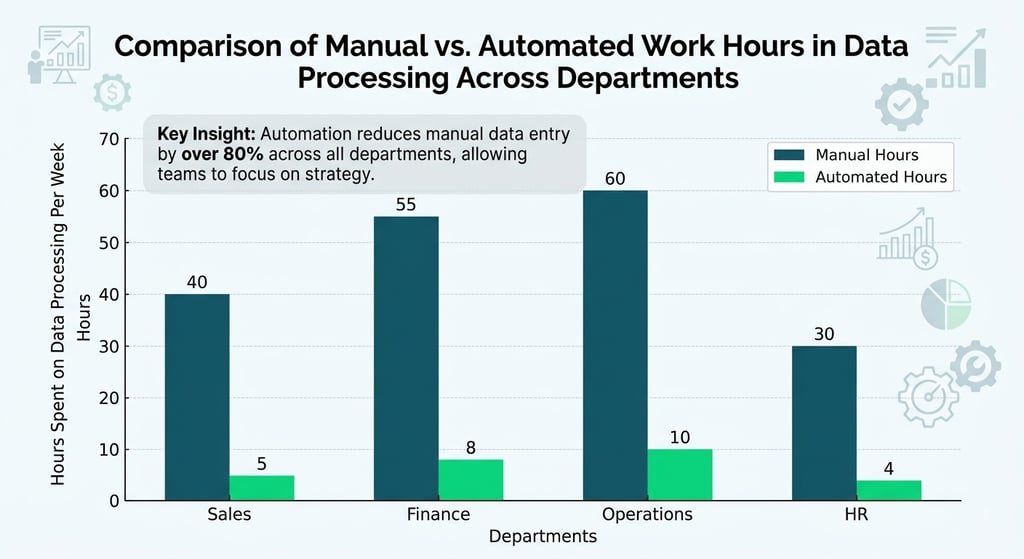
Professional Business Intelligence solutions can eliminate thousands of hours of manual work and prevent costly financial errors.
Actionable takeaway: Identify one repetitive manual reporting task in a single department and replace it with an automated data alert to demonstrate immediate ROI and build trust.
What is a data-driven culture and why is it so hard to build?
A data-driven culture is a workplace where everyone uses facts to make decisions. In these companies, people do not rely on "gut feelings" or who has the most experience. Instead, they look at dashboards and models before they finalize any strategy. They use data to find risks and discover ways to work much faster.
Building this culture is difficult because it requires a change in human behavior. Technology is often the easy part of the puzzle. You can buy a new dashboard or a database, but you cannot buy a new mindset. According to a 2026 McKinsey report, 72% of leaders say their organizations are not ready for the changes needed for a full digital transformation. People are often afraid of what the data will show. They might fear that the data will prove their past decisions were wrong. This fear creates a big wall between the business teams and the data experts.
To influence this culture, you must show people that data is a partner and not a judge. You need to prove that data makes their daily lives easier. When a team sees that an automated alert can save them four hours of manual checking, they start to value the data. This is how the real shift begins.
Why are leaders often reluctant to invest in data projects?
Many CEOs and directors see data projects as a high cost. They focus on the price of software, consultants, and training. They often view it as an "IT expense" rather than a strategic investment for the future. This happens because the return on investment is not always clear at the very beginning.
Is the cost of data really too high?
The truth is that data is a gold mine for saving time and money. When a company lacks a data-driven culture, it often suffers from "invisible" losses. These are costs that do not show up on a normal balance sheet. For example, Gartner research shows that poor data quality costs organizations an average of $12.9 million every year.
Exology has seen this firsthand. We have worked with over 150 businesses across 20 countries. We often meet managers who think digital transformation is too expensive. We show them that manual work is actually the bigger expense. In 2025 alone, Exology helped clients save over 5,000 hours of manual work. We even helped one client save $130,000 in a single day just by identifying a massive error through data. When leaders see these numbers, their fear turns into excitement.
How do "invisible" losses affect the bottom line?
When you don't have good data, you make mistakes that cost money. You might buy too much stock or miss a deadline. You might spend hours on tasks that could be done in seconds by a machine. Without visibility, these losses happen every single day. Professional BI solutions provide the "eyes" a company needs to stop these leaks and grow faster.
How do data silos hurt a company's ability to grow?
A data silo happens when one department has information that another department cannot see. For example, the sales team might use one system while the finance team uses another. If these systems do not talk to each other, the data becomes inaccurate. You cannot make good decisions with data that is not up to date.
Why does inaccurate data lead to wasted time?
When data is trapped in silos, employees spend hours manually moving data from one sheet to another. This is a waste of human talent. Research from the IBM Institute for Business Value found that 43% of chief operations officers say data quality is their top priority. Without a unified data culture, these silos remain. This leads to a loss of revenue and high frustration for the staff.
What is the real cost of poor data quality?
Some studies from MIT Sloan suggest companies lose 15% to 25% of their revenue due to poor data quality. Breaking these silos is not just a technical task. It is a cultural one that requires everyone to agree on a single source of truth. You cannot save money with data that is not accurate.
What practical steps can I take to start changing the culture?
You do not need to change the whole company in one day. You can start small and build momentum. Here are some steps to influence change effectively.
Can I use automated alerts to build trust?
Yes. One of the fastest ways to show value is through automation. When a manager receives an automated alert that a stock level is low or a budget is exceeded, they see immediate value. They did not have to look for the information. The information found them. This builds deep trust in the system.
Should I focus on one department first?
Focusing on a "champion" department is a great strategy. Find a team that is already open to technology. Help them create a dashboard that solves a specific pain point. When other departments see that team succeeding and saving time, they will want the same results. This creates a natural demand for data products.
How do I make the data easy to understand?
Data should be visual and simple. Avoid complex jargon that confuses people. Use clear charts that answer one question at a time. At Exology, we have created over 1,340 visualizations to help leaders see their business clearly. If a CEO can understand a chart in five seconds, they are more likely to support your next big project.
How do you prove the ROI of a data culture?
Proving the value of culture is about showing the "before and after" results. You need to track specific metrics like time saved and errors avoided.
Why are technology budgets increasing in 2026?
In 2026, companies are increasing their digital budgets significantly. Deloitte reports that technology budgets are rising because companies are finally seeing the real ROI. They are moving away from manual spreadsheets and toward intelligent automation.
How does accuracy ensure long-term savings?
When you have a strong data culture, your data is accurate and up to date. This allows you to catch errors before they become expensive problems. It also allows you to use AI and automation more effectively. By fixing the culture, you ensure that every dollar spent on technology returns value to the business.
How do you handle managers who are afraid of change?
Resistance to change is normal. Many managers feel that "the old way" worked fine for years. To influence them, you must speak their language. Instead of talking about technical terms, talk about "growth," "efficiency," and "saving money."
Why is the "old way" of doing things a risk?
The world is moving faster than ever. If you rely on old manual processes, you will fall behind your competitors. PwC's 2025 CEO Survey shows that CEOs are prioritizing efficiency through technology. The "old way" is often a hidden risk that leads to high costs and slow responses.
How can data give leaders "superpowers"?
Exology has completed over 200 projects in 10 key industries. We have helped leaders in manufacturing, retail, and finance move from messy spreadsheets to intelligent systems. We emphasize that data is not there to replace them. It is there to give them the "superpowers" they need to make better decisions. When a manager realizes that data can prevent a $100,000 mistake, their fear of change disappears quickly.
What is the role of AI and automation in data culture?
AI and automation are the engines of a modern data culture. However, they only work if the culture is ready to support them.
Why is good data necessary for AI agents?
If you put an AI agent on top of bad data, you will get bad results faster. You must have clean, accurate data before you can use the latest AI tools. A data-driven culture ensures that the foundation is strong so the AI can do its job correctly.
How does automation drive human productivity?
Intelligent automation takes the boring work away from humans. This leaves people with more time to think about big ideas. A strong data culture encourages employees to look for these automation opportunities. They start to ask how they can work smarter, not harder. This mindset leads to massive productivity gains across the whole company.
How Exology Helps
Exology helps businesses turn information into action through data-driven solutions. We work with companies in Egypt, across the MENA region, and internationally to build a culture where data drives results. We have completed 200+ projects for over 150+ businesses in 20+ countries for 10+ key industries. Our projects include dashboards, BI solutions, data analytics, AI and automation, and custom software development.
Here is how we can help you influence your company's data culture:
Massive Financial Impact: We help you find the gold mine in your data. Exology has been able to save our client $130k in one day just from data insights alone.
Extreme Time Savings: We eliminate the burden of manual reporting. Exology has saved 5,000+ Hours of Manual Work in 2025 alone.
Proven Scalability: We handle complex data environments with ease. Exology has processed over 10M+ Data Rows in 2025 to ensure our clients have the most accurate insights possible.
Read More
Contact us
Whether you have a request, a query, or want to work with us, use the form below to get in touch with our team.