
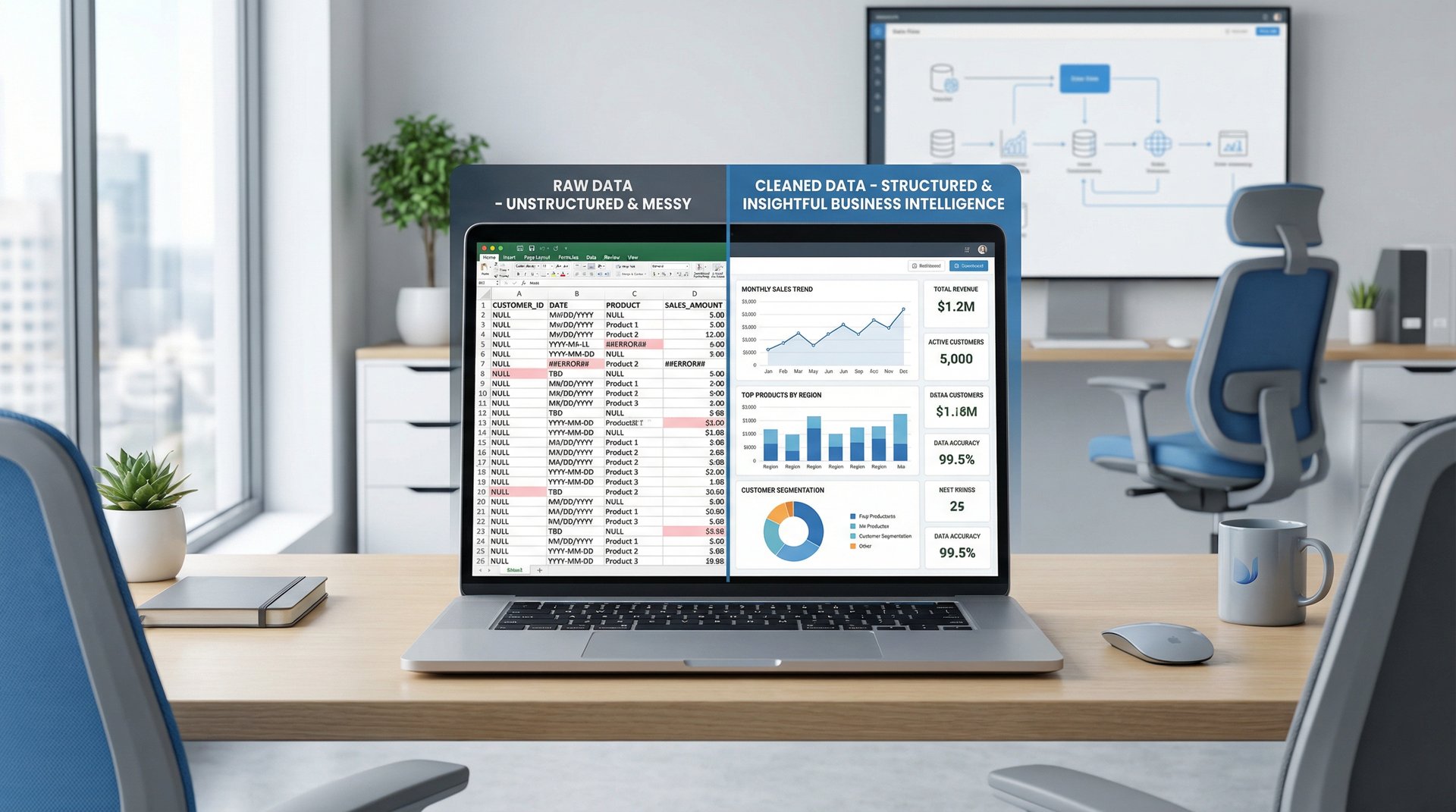
The Importance of Data Cleaning for Accurate Business Intelligence
Discover why the importance of data cleaning is critical for Business Intelligence accuracy and better decision-making, with practical steps and real data examples.
DATA ANALYTICS
Key Points
Data cleaning is the foundation of accurate business intelligence and reliable decision making
Poor data quality leads to misleading dashboards, incorrect KPIs, and low trust in BI tools
Core data cleaning steps include profiling, standardization, deduplication, and handling missing values
Clean data improves BI accuracy, speeds up reporting, and increases ROI from analytics tools
Ongoing data cleaning and monitoring are required as new data sources and volumes grow
Automation improves efficiency, but human oversight is still needed for context and accuracy
Actionable takeaway: Audit your current data sources, identify quality issues, and implement continuous data cleaning before building or scaling BI dashboards
Introduction
In business intelligence (BI), dashboards and analytics tools get all the attention. Yet without properly cleaned data, even the most advanced BI tools deliver misleading or wrong insights. Data cleaning transforms raw data into a reliable foundation for analysis. It removes errors, fills gaps, and ensures consistency so BI outputs reflect reality and boost confidence in business decisions.
This post explains why data cleaning matters for BI accuracy, how it works, and how organizations benefit when they invest in clean data.
What is Data Cleaning and Why Does It Matter?
What Does Data Cleaning Mean?
Data cleaning, also known as data cleansing, is the process of identifying and correcting or removing inaccurate, incomplete, or inconsistent data in a dataset. It may include removing duplicate entries, fixing formatting issues, standardizing values, and filling missing information. Clean data is accurate, complete, consistent, timely, and relevant for analysis.
Why Cleaning Data Matters for BI
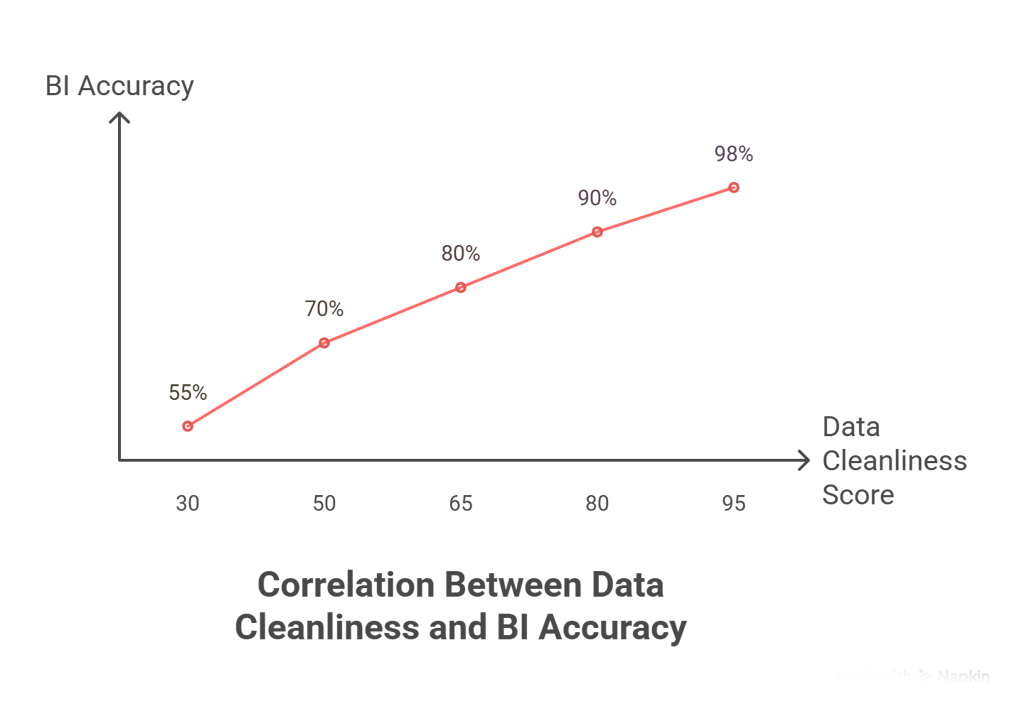
BI systems rely on data quality. If data contains errors, BI dashboards, reports, and models produce flawed outputs. Clean data ensures that analytical insights are reliable and reflect true business conditions. Decisions based on accurate data are more effective and aligned with organizational goals.
How Poor Data Affects Business Intelligence Accuracy
Errors and Misleading Insights
When data contains mistakes or inconsistencies, BI tools may miscalculate key metrics, trends, and forecasts. For example, duplicate sales data can artificially inflate revenue totals, while missing customer records may hide important segments, leading to misguided strategies.
Impact on Dashboards and Predictive Analytics
Dashboards are only as accurate as the data they visualize. Errors in the underlying data propagate into visual reports and key performance indicators (KPIs). This can erode trust in BI tools and reduce adoption across teams. Inconsistent data may cause splits in trends that are hard to interpret and result in decisions that miss the mark.
Key Steps in Effective Data Cleaning
Data Profiling and Auditing
Before cleaning begins, organizations assess the state of their data. Profiling reveals issues such as missing values, outliers, and inconsistencies. Auditing helps prioritize what needs fixing to improve BI accuracy.
Standardizing and Formatting Data
Consistent data formats are essential. For instance, standardizing date formats or units of measurement ensures that merging data from multiple sources yields meaningful results.
Removing Duplicates and Fixing Errors
Duplicate records can distort analytical results. Techniques like deduplication remove redundancies and ensure each record represents unique real-world entities.
Handling Missing Values
Missing data can bias analysis. Filling gaps with reasonable estimates or removing incomplete entries (when justified) helps analytics models work correctly.
Continuous Monitoring
Data cleaning is not a one-time task. Regular audits and automated checks help maintain quality as new data flows into systems.
Benefits of Clean Data for Business Intelligence
Improved BI Accuracy
Clean data directly improves the accuracy of BI outcomes. Insights derived from reliable data let decision-makers trust trends, forecasts, and performance reports. This leads to better operational and strategic decisions.
Faster Decision-Making
When data is already clean, teams spend less time fixing errors and more time gaining insights. This accelerates reporting cycles and allows businesses to act faster in response to market changes.
Higher ROI from BI Tools
BI systems are expensive investments. Clean data ensures these tools deliver value by producing dependable analytics that drive measurable business outcomes.
Enhanced Trust and Adoption
Users across departments are more likely to rely on BI insights when data quality is high. This fosters a data-driven culture where decisions are made with confidence.
Better Customer Insights
Clean customer data enables precise segmentation and personalization. Business leaders can tailor offerings, marketing efforts, and services to real customer behaviors and preferences.
Tools and Techniques for Data Cleaning
Software and BI Platforms
Many BI and data integration tools include built-in cleaning capabilities, such as parsing, deduplication, and formatting functions. Emerging tools also incorporate automation and machine learning to streamline cleaning tasks.
Automated vs. Manual Cleaning
Automation speeds up repetitive tasks, especially in large datasets, while human review is crucial for nuanced decision-making on ambiguous or context-specific issues.
Integration with Analytics Pipelines
Embedding data cleaning within ETL (Extract, Transform, Load) pipelines ensures that only verified data enters analytical models. This enhances the reliability of downstream dashboards and reports.
Common Challenges and How to Overcome Them
Handling Large Datasets
Big data environments often contain noisy, unstructured data. Scalable tools and automated cleaning processes are essential for maintaining quality as volume grows.
Multiple Data Sources
Combining data from different systems can introduce inconsistencies. Standardizing data formats and definitions across sources prevents analytic errors.
Balancing Automation and Oversight
Fully automated cleaning may miss context-specific issues. Combining automated cleansing with periodic human review helps retain data integrity.
How Exology Helps
Data cleaning is essential for BI accuracy, but many businesses lack the tools and expertise to execute it effectively. Exology helps organizations in Egypt, across the MENA region, and internationally build strong BI foundations.
We have helped 150+ companies transform their data into actionable decisions, improving reporting, forecasting, and operational efficiency
We assess and clean raw data to improve BI accuracy and remove duplicates, inconsistencies, and errors
We implement automated data cleaning and monitoring systems for ongoing quality assurance
We integrate clean data into custom dashboards that reflect real operational insights
We provide digital transformation consulting to embed data quality practices in your workflows
We support training and capacity building so teams understand clean data best practice
Read More
Contact us
Whether you have a request, a query, or want to work with us, use the form below to get in touch with our team.