

From Data Silos to Insights: The Role of a Lakehouse in Modern BI
Learn how a modern BI architecture using a data lakehouse eliminates data silos. Discover the benefits for your business intelligence solutions.
DATA ANALYTICS
Key Points
Data silos create conflicting reports that slow down critical business decisions.
Fragmented data can cost organizations up to 30% of their annual revenue through inefficiency.
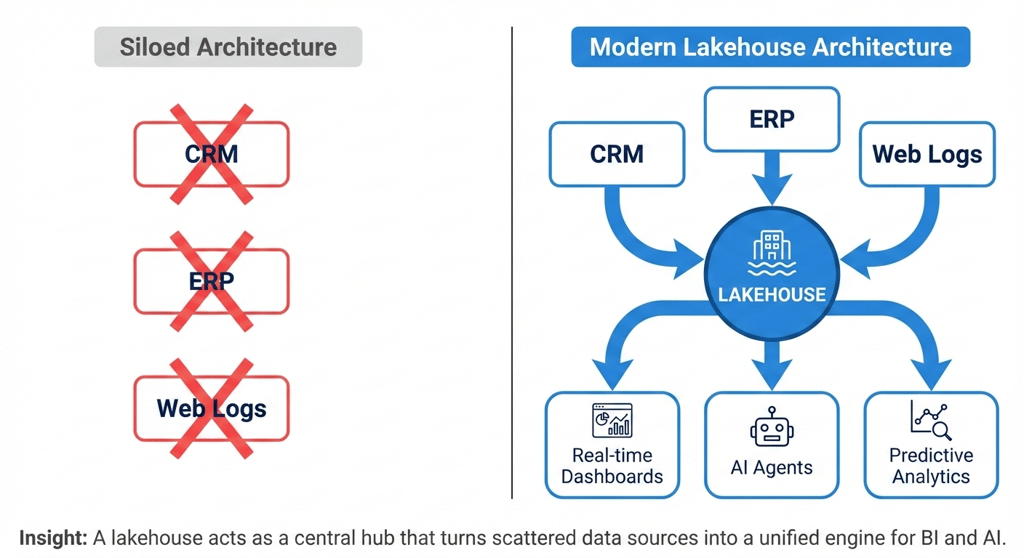
Modern BI architecture uses a data lakehouse to unify structured and unstructured information in one place.
A centralized storage layer is the essential foundation for deploying AI agents and predictive analytics.
Real-time dashboards allow managers to react instantly to market changes rather than waiting for weekly reports.
Transitioning to a unified system involves mapping data sources and moving toward open platform formats.
Actionable takeaway: Audit your current data storage locations to identify silos and begin planning a migration to a unified lakehouse architecture.
Imagine you are a CEO trying to understand your monthly sales. You ask your sales manager for a report. You ask your finance lead for the same thing. One hour later, you have two different numbers. The sales team counts orders placed. The finance team counts payments received. Neither team is wrong, but their data lives in different worlds.
These worlds are called data silos. They are the biggest hurdle to making fast decisions. In 2026, staying ahead means moving past these walls. You need a way to see everything at once. This is where a modern BI architecture comes into play. It uses a structure called a data lakehouse to bring all your information together.
What is modern BI architecture?
Modern BI architecture is the roadmap for your data. It starts where your information is born, like your CRM or ERP. It ends with the clear charts you see on your phone. In the past, this roadmap was long and bumpy. Data had to be copied and moved many times.
Today, the architecture is much flatter. It relies on a central storage layer that handles everything. This layer is often a data lakehouse. It allows your Business Intelligence solutions to reach into one pool of data. You no longer have to wait for IT to move data from one place to another.
The goal of this new design is speed. Business moves faster than ever. Global spending on big data and analytics is expected to reach $420 billion in 2026. Companies are spending this much because they need answers in seconds, not weeks. A modern architecture makes that possible by removing the middleman.
Why are data silos a problem for business intelligence solutions?
Data silos act like borders between your departments. When data is siloed, it is trapped. Your marketing team cannot see what the customer service team knows. Your warehouse team cannot see the upcoming sales goals.
This fragmentation is expensive. Research shows that siloed data can cost a company up to 30% of its annual revenue. This loss comes from wasted time and bad decisions. People spend hours cleaning data instead of analyzing it.
Silos also lead to "multiple versions of the truth." If two managers show different numbers in a meeting, the meeting stops. Instead of talking about strategy, you talk about whose spreadsheet is right. This kills productivity. It makes it impossible to build a data-driven culture.
What are the top data lakehouse benefits?
A data lakehouse is a hybrid. It takes the best parts of a data warehouse and a data lake. It gives you the organization of a warehouse. It also gives you the low cost and flexibility of a lake.
One of the biggest data lakehouse benefits is that it handles all types of data. It can store structured tables from your SQL database. It can also store unstructured files like PDFs or images. This is vital for AI. In 2025, Gartner reported that 57% of organizations felt their data was not ready for AI. A lakehouse fixes this by keeping everything in one ready-to-use format.
Another benefit is the "single source of truth." Because all data flows into one lakehouse, everyone looks at the same numbers. You don't have to copy data to a different system for reporting. This reduces errors. It also keeps your data secure because you only have one place to guard.
How does a lakehouse connect to better data visualization?
Great visuals require clean data. If your data is messy, your charts will be confusing. A lakehouse provides a "semantic layer." This is like a translator. It turns technical data into business terms.
When your Business Intelligence solutions connect to a lakehouse, they work faster. The query engine inside the lakehouse is built for speed. You can filter a chart with millions of rows and see the result instantly. This allows for real-time dashboards.
Real-time visibility is becoming the standard. By the end of 2026, 80% of employees will use insights directly inside their daily apps. They won't go to a separate BI tool. The lakehouse feeds these insights directly into your work. This makes your data visible and useful to everyone.
How do you transition to a unified data lakehouse?
Transitioning sounds like a big task, but it happens in steps. First, you must identify where your data lives. Most companies have data in at least five different places. You need to map these sources.
Second, you choose a platform. Leaders like Databricks provide the infrastructure to build these lakehouses easily. These tools help you move data without losing its meaning. They use "open formats," so you are not locked into one vendor.
Third, you build your dashboards. This is where the magic happens. You connect your BI tools to the lakehouse. Suddenly, your reports update themselves. You stop being a "data gatherer" and start being a "data user." This shift allows you to focus on growing your business.
How Exology Helps
Moving from data silos to a unified lakehouse is the key to scaling your business. Exology specializes in creating custom modern BI architecture that fits your specific goals. We don't just give you a tool: we build a system that works.
We process 10M+ data rows per year to ensure our clients have the most accurate and up-to-date insights for their Business Intelligence solutions.
We have saved our clients over 5,000 hours of manual work in 2025 by automating data pipelines and eliminating the need for manual spreadsheet merging.
We have delivered over 150 projects worldwide, helping companies in Egypt, across the MENA region, and internationally modernize their data stacks.
We design end-to-end data lakehouses that connect directly to your Odoo ERP, CRM, and other tools for a single source of truth.
We provide training and consulting to ensure your team knows how to use your new dashboards to make better, faster decisions.
Read More
Contact us
Whether you have a request, a query, or want to work with us, use the form below to get in touch with our team.