
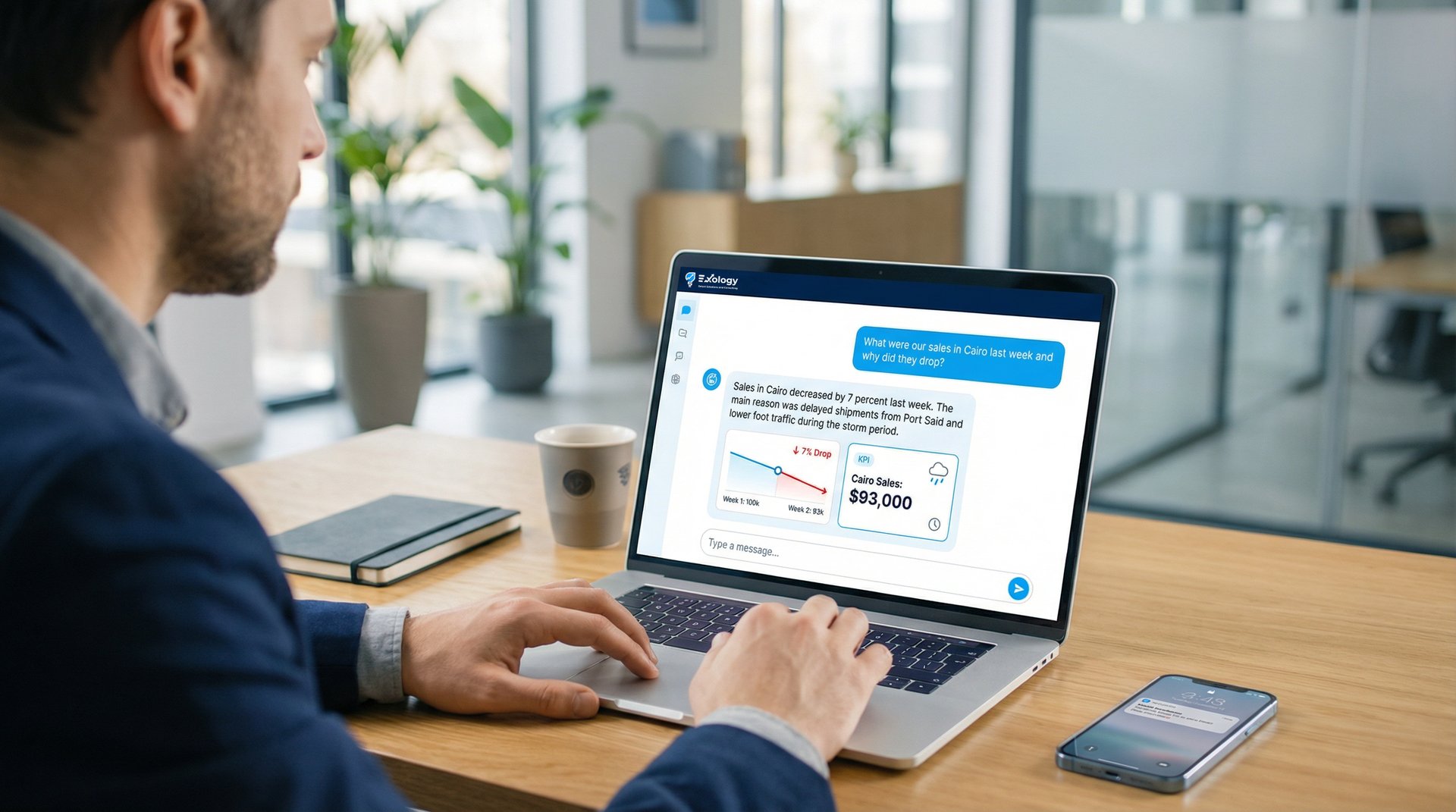
The No Dashboard Trend: Why Business Leaders Are Moving to Conversational BI
Explore why the no dashboard trend is changing how leaders work. Learn how Conversational Business intelligence provides instant answers alongside traditional visual tools.
BUSINESS INTELLIGENCE
Key Points
The No Dashboard trend focuses on accessing data through simple conversations rather than complex visual charts.
Traditional dashboards remain essential for monitoring long term trends while Conversational BI handles quick daily questions.
Chatting with data removes technical friction and allows leaders to make faster decisions during meetings.
AI powered tools democratize information by allowing non technical staff to get insights without help from IT.
Conversational interfaces reduce dashboard fatigue by providing specific answers instead of overwhelming visual noise.
Mobile teams and remote workers can access vital business data easily through standard chat applications.
Actionable takeaway: Identify the top five questions your team asks most frequently and evaluate if a conversational AI tool could provide those answers instantly.
What exactly is the No Dashboard trend?
The "No Dashboard" trend does not mean that traditional dashboards are going away. Instead, it describes a shift in how people interact with their data. For a long time, the only way to see business numbers was to look at a screen full of charts and graphs. Now, business leaders want to ask a question and get a direct answer. This trend focuses on making data accessible through simple conversations.
In many companies, dashboards have become too complex. A manager might have ten different screens to monitor sales, inventory, and staff. This can lead to "dashboard fatigue," where people stop looking at the data because it feels like too much work. The No Dashboard trend suggests that the best interface is sometimes no interface at all. It uses AI to bring the answer directly to the user in a chat or voice message.
Is the era of the visual dashboard coming to an end?
No, the visual dashboard is still a very important tool for many businesses. Dashboards are excellent for monitoring high-level trends over time. They provide a "north star" for the company. However, they are not always the best tool for quick, specific questions. If you need to know why sales dropped in a specific store yesterday, a static dashboard might not show you the answer immediately.
The No Dashboard trend is an evolution rather than a replacement. Think of it like a car. The dashboard in your car shows you your speed and fuel level. You always need those visuals. But if you want to know how to get to a specific restaurant, you ask your GPS. Conversational BI is the GPS for your business data. It works alongside your existing visuals to provide deeper, faster insights.
How does Conversational BI differ from traditional reporting?
Traditional reporting is often a one way street. A data analyst creates a report, and the business leader reads it. If the leader has a follow-up question, they have to go back to the analyst and wait for a new report. This process can take days or even weeks. It slows down the speed of the business.
Conversational BI is a two-way dialogue. It uses natural language processing to understand what you are asking. You can type "What was our best-selling product in Cairo last week?" and the system gives you the answer in seconds. This removes the "middle man" and allows leaders to be more independent. According to Gartner, the focus in 2024 and beyond is on "augmented analytics" that makes data easier for everyone to use.
Why are companies switching to Conversational BI right now?
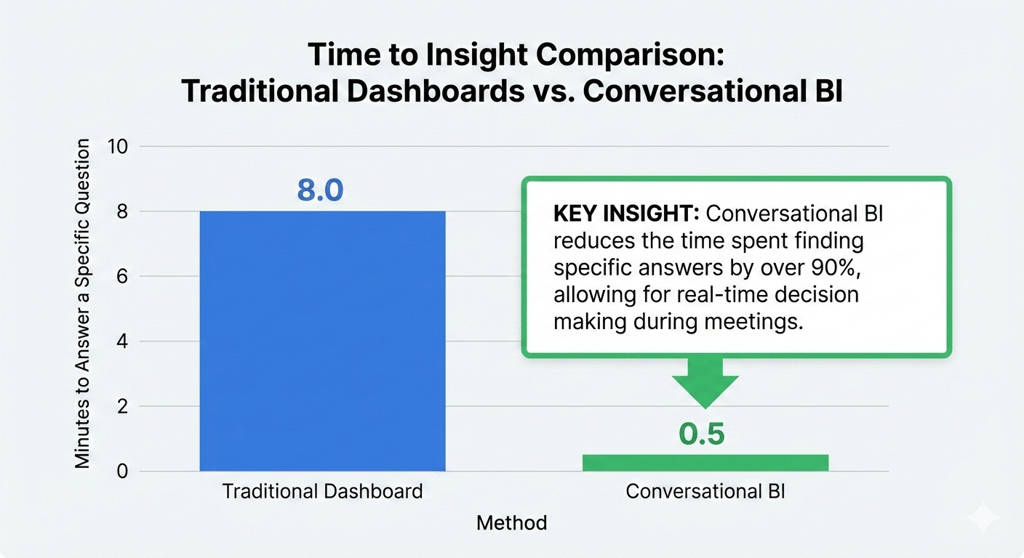
The main reason for this switch is the speed of modern business. In the past, companies could wait for monthly reports. Today, markets change in hours. Leaders need to make decisions on the fly. If you are in a meeting and need a specific number, you cannot wait for an analyst to run a query.
Another reason is the massive increase in the amount of data we collect. Statista reports that the amount of data created worldwide will reach 181 zettabytes by 2025. It is impossible to put all that data onto a single dashboard. Conversational BI allows you to search through that massive pile of information using simple words. It finds the "needle in the haystack" so you do not have to.
How does "chatting with data" speed up decision making?
Chatting with data removes the friction of navigation. To find an answer in a traditional BI tool, you usually have to log in, find the right folder, open the right dashboard, and apply three or four filters. This takes several minutes. In a conversational system, you just ask.
This speed allows for "active" decision making. When a leader gets an answer in three seconds, they can immediately ask "Why?". They can dig into the root cause of a problem while the topic is still fresh. This creates a culture of curiosity. When data is easy to get, people use it more often. McKinsey notes that data-driven organizations are much more likely to acquire and retain customers.
Can non-technical staff get insights without help from IT?
Yes, this is one of the biggest benefits of the No Dashboard trend. In the past, data was guarded by "gatekeepers" in the IT department. If a sales manager wanted a new view of the data, they had to ask IT for help. This created a bottleneck.
Conversational BI uses AI to translate human language into computer code. When you ask a question, the AI writes the SQL query for you. This means a marketing intern or a warehouse manager can get the same insights as a data scientist. It democratizes information. Everyone in the company can work from the same facts without needing to learn how to code or use complex BI software.
What are the main benefits of a "No Dashboard" strategy?
A "No Dashboard" strategy focuses on the outcome rather than the visual. The outcome is the insight that leads to action. By moving away from complex visual setups, companies can reduce the time spent on "tool training" and focus more on "strategy training."
This approach also makes data more "human." Numbers can be cold and confusing. When an AI explains that "Sales are up 10% because of the new holiday campaign," it provides context. Context is what transforms raw data into actionable intelligence. Harvard Business Review highlights that the biggest barrier to data success is often a lack of understanding, not a lack of tools.
How does this approach solve "dashboard fatigue"?
Dashboard fatigue happens when users are overwhelmed by too many charts that look the same. After a while, they stop noticing the red flags. They just see colors and lines. It becomes "noise."
Conversational BI only shows you what you asked for. It eliminates the noise. Instead of looking at a screen with 50 different metrics, you get the one metric you need right now. This keeps users focused. It also allows the system to send "proactive alerts." Instead of you checking a dashboard to see if inventory is low, the AI can send you a message saying "Inventory is low for Product X. Would you like to see the supplier list?".
Does it work better for mobile and remote teams?
Traditional dashboards are often hard to read on a phone. The charts become tiny and the filters are difficult to touch. This is a big problem for sales teams in the field or executives who travel.
Conversational BI is built for mobile. Most people are already comfortable using chat apps like WhatsApp or Slack. By putting business data into a chat interface, you make it accessible anywhere. A logistics manager can check the status of a shipment while walking through a warehouse just by speaking into their phone. This mobility ensures that data is always at the center of the business, no matter where the employees are located.
How does Conversational BI handle complex business questions?
Modern Conversational BI is very smart. It does not just look for keywords. It understands the "intent" of the question. If you ask "How are we doing compared to last year?", the AI knows you are looking for a year-over-year growth comparison. It will look at the dates, the totals, and even the external factors if it has access to them.
These systems are powered by Large Language Models (LLMs). These models have been trained on millions of examples of how humans talk and think. This allows them to handle nuances. They can even suggest the next question you should ask based on the answer they just gave.
Can it provide context behind the numbers?
Yes, and this is where the No Dashboard trend really shines. A bar chart can show you that revenue is down. But it cannot easily tell you why. A conversational AI can look at multiple data sources at once. It can see that revenue is down, but it also sees that there was a weather storm in your main market and a shipping delay from your factory.
It connects these dots automatically. It can give you a summary that says, "Revenue is down 5% this week. This is likely due to the port delays in Suez which affected 15% of our deliveries." This kind of context is invaluable for making quick adjustments to your strategy.
How does it integrate with existing tools like Odoo or Excel?
You do not have to throw away your current systems to adopt Conversational BI. Most AI agents and conversational tools are designed to sit on top of your existing data. They act as a bridge.
If your company uses Odoo ERP, the conversational tool can connect directly to the Odoo database. When you ask a question about a purchase order, the AI pulls the data from Odoo in real time. It can do the same with Excel spreadsheets, SQL databases, and even cloud storage. This means you can keep using the tools your team already knows while adding a modern, chat based layer on top.
Is the "No Dashboard" approach secure for sensitive data?
Security is a common concern when talking about AI and chat interfaces. However, conversational BI tools use the same high level security protocols as traditional BI software. The data does not "live" in the chat. The chat is just a window into the secure database.
Companies can set strict permissions. You can decide that a salesperson can only see data related to their own leads. You can ensure that HR data is only accessible to the HR Director. The AI will respect these "role-based" permissions just like a standard dashboard would.
Who controls who can ask questions?
The control remains with the business owners and IT managers. You define the "knowledge base" that the AI has access to. You can also monitor the questions people are asking. This helps you understand what information your team needs the most.
Most professional BI solutions use encrypted connections and private cloud environments. This ensures that your company's "secret sauce" never leaks out to the public. McKinsey emphasizes that robust data governance is the foundation of any successful AI implementation.
How Exology Helps
Exology turns information into action. We are experts in Business Intelligence and Data Analytics. We believe that while dashboards are the foundation of a data-driven company, Conversational BI is the future of accessibility. This is our bread and butter. We help businesses integrate AI into their data ecosystem to create seamless, chat-based interfaces that anyone can use.
We work with companies in Egypt, across the MENA region, and internationally to modernize their operations. Here is how our expertise delivers real value:
Expert Guidance: Our team of 5 professional consultants works directly with your leadership to design a data strategy that fits your unique needs.
Proven Global Success: We have delivered over 150 projects worldwide, helping organizations in 20+ countries move from manual work to automated insights.
Efficiency at Scale: In 2025 alone, we saved our clients over 5,000+ hours of manual work by implementing intelligent automation and Conversational BI.
AI Specialization: We have successfully deployed custom AI agents that allow teams to "talk to their data," ensuring that every employee has the power of a data analyst in their pocket.
Customized Solutions: Whether you need a full Odoo implementation or a BIaaS subscription, we ensure your data is accurate, secure, and easy to access.
Read More
Contact us
Whether you have a request, a query, or want to work with us, use the form below to get in touch with our team.