

7 Common Odoo Implementation Mistakes and How to Avoid Them
Avoid costly Odoo implementation mistakes. Learn how to successfully launch your Odoo ERP implementation with tips on data, training, and partner selection.
ERP
Key Points
Many Odoo projects fail due to unclear goals, weak scope definition, and poor alignment with business priorities
Over-customizing Odoo creates technical debt and makes updates, performance, and long-term scaling harder
Poor data migration leads to incorrect reports, unreliable dashboards, and failed decision-making
Lack of user training and change management causes low adoption and a return to manual work
Choosing the wrong implementation partner increases cost, risk, and compliance issues in the MENA region
Skipping testing before go-live results in operational errors that disrupt finance, sales, and inventory
Actionable takeaway: Define clear goals, clean your data, limit customization, train users early, test thoroughly, and work with an experienced Odoo partner from day one
Choosing Odoo for your business is a smart move. It is a powerful tool that can unite your sales, inventory, and accounting into one place. However, many companies struggle during the setup phase. Recent data shows that 70% of recently implemented ERP initiatives will fail to meet their original business goals by 2027.
If you are a business owner in Egypt or the MENA region, avoiding these errors is vital for your growth. This guide covers the most frequent Odoo implementation mistakes and how to fix them to ensure your investment pays off.
1. Lack of clear goals and project scope
The most frequent error is starting without clear, measurable goals. Many firms want to "automate everything" but do not define what success looks like. This lack of focus leads to a bloated system that does not solve your actual business problems.
Research shows that 75% of ERP strategies are not strongly aligned with overall business goals. This misalignment causes teams to waste money on modules they do not need. Without a roadmap, your project will likely face delays and rising costs. Scope creep is a real danger here. It happens when you keep adding new features during the build. This pushes the launch date back and makes the project much more expensive.
To avoid this, you must identify your top three pain points before you start. Is your inventory count always wrong? Are your invoices sent late? Focus on these specific issues first before adding more complexity. This approach ensures you get value from the system as quickly as possible. Clear goals act as a compass for your team and your implementation partner.
2. Over-customizing the software
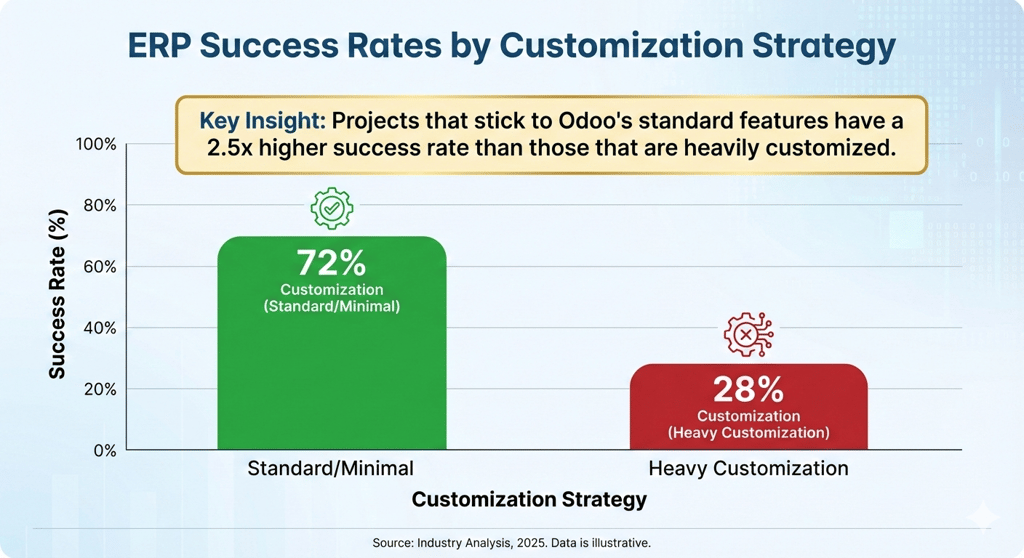
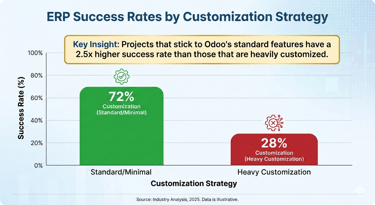
Odoo is very flexible. This is its greatest strength, but it is also a common trap. Companies often try to make Odoo mirror their old, manual processes exactly. This is a major Odoo implementation mistake because it creates "technical debt." When you change the core code of the software, you move away from the standard logic that thousands of other successful businesses use.
Over-customization makes future updates difficult and expensive. It also increases the risk of system bugs. Recent reports show that ERP projects that stick to standard features are 40% more likely to stay on budget. Experts suggest staying as close to the "standard" version of Odoo as possible.
Odoo releases new updates every year. If your system is heavily customized, these updates might break your code. By using standard features, you benefit from the latest security patches and AI tools without extra work. It keeps your system fast and reliable for the long term. If you think you need a custom feature, first ask if you can change your business process to fit the software. Often, the software's way is more efficient.
3. Poor data migration and cleaning
Your new ERP is only as good as the data you put into it. Many firms rush to move old spreadsheets into Odoo without cleaning them. This results in duplicate records, incorrect stock levels, and messy financial reports. If you start with bad data, your business intelligence dashboards will give you wrong information.
Data issues are a top reason for project failure. In fact, 33.7% of organizations that went over budget cited data issues as a primary cause. You must audit, clean, and organize your legacy data before the move. High quality data ensures that your dashboards provide accurate insights from day one.
The migration process should follow strict steps. First, delete any old or duplicate customer files. Second, ensure all product names and codes follow a standard format. Third, test a small batch of data in the new system before moving everything. This prevents "garbage in, garbage out" scenarios. This work takes time, but it is the foundation of a successful digital transformation.
4. Neglecting user training and change management
Software does not run a business; people do. A common error is assuming employees will "figure it out" on their own. When users find the system confusing, they often stop using it and go back to old spreadsheets. This creates silos and makes your investment a waste of money.
A study from 2025 found that comprehensive training can increase system acceptance by up to 60%. Training should be hands-on and specific to each department. Create "super users" within your team who can help others. This builds confidence and ensures the system is actually used to its full potential.
Do not wait until the day you launch to start training. Start your team during the testing phase. This gives them time to ask questions and get comfortable with the new interface. Ongoing training is also needed as you add new modules or hire new staff. Remember that your staff might feel scared of the new technology. Good communication helps them see Odoo as a tool that makes their jobs easier, not harder.
5. Choosing the wrong implementation partner
Picking a partner based only on the lowest price is a dangerous move. An inexperienced Odoo implementation partner in Egypt may lack the business logic needed for complex setups. They might know how to code, but they may not know how to optimize a supply chain or an accounting workflow.
In the MENA region, you need a partner who understands local regulations and tax laws. For example, the Middle East ERP market is projected to reach $10.20 billion by 2032. This growth means more partners are available, but not all have the same expertise. A low-cost partner might end up costing you more in the long run if they build a system that breaks frequently.
Ask for case studies from your specific industry. Inquire about their process for handling data migration and user training. A good partner acts as a consultant. They should challenge your ideas if they lead to over-customization or inefficiency. They should also be able to integrate Odoo with other tools like your website or your bank.
6. Skipping the testing phase
Rushing to "go-live" without thorough testing is a recipe for disaster. Small errors in tax calculations or inventory counts can stop your operations. This critical stage is called User Acceptance Testing (UAT). It is the final check to make sure the software does exactly what the business needs it to do.
Testing allows your team to find bugs in a safe environment. You should simulate real business days to see how the system handles high volume. Data from 2025 suggests that failing to align ERP initiatives with strategic testing is a top predictor of failure. Skipping this phase might save a week now, but it could cost months of repairs later.
Every department that will use Odoo must participate in testing. Accountants should check the financial reports. Warehouse staff should test the barcode scanning. Sales teams should test the quote-to-order process. This ensures every part of the business is ready. If a problem is found, fix it before the launch. It is much easier to fix a bug in a test environment than in a live system with customers waiting.
7. Ignoring post-launch support and maintenance
An Odoo ERP implementation does not end on the day you launch. Your business will grow, and your needs will change. Without ongoing support, your system can become outdated quickly. Many companies make the mistake of ending their contract with their partner the moment the system goes live.
Support involves more than just fixing bugs. It includes regular updates and performance checks. It also helps you integrate new technologies as they become available. For every $1 spent on developing a model, businesses often need to spend $3 on change management to keep it running well. A subscription-based model ensures you always have expert help available when you need to adjust your dashboards or add a new warehouse.
As you collect more data in Odoo, you will find new ways to use it. You might want to add AI agents to handle customer service or use advanced analytics to predict sales. Continuous improvement is the key to getting a high return on investment. Your Odoo system should be a living part of your business that evolves as you do.
How Exology Helps
Exology helps you unify your operations and simplify your day. If you are tired of switching between Excel sheets and disconnected tools, we move you to one smart platform built around how your business actually works. We help companies in Egypt, across the MENA region, and internationally unlock real business value through a data-driven approach.
Business Intelligence at the Core: Every Odoo implementation includes a free custom dashboard. This gives you real-time visibility across finance, sales, and operations so you can make decisions with confidence.
Data-First Implementation: Our team are experts in data analytics. We clean, structure, and migrate your data from Excel or legacy systems so Odoo runs on accurate information from day one.
Tailored Configuration: We set up the right Odoo modules (Sales, CRM, Inventory, Accounting, HR, and more) to match your specific workflows without unnecessary bloat.
Staff Onboarding and Training: We provide hands-on sessions to ensure your team adopts the system smoothly and uses it effectively.
Custom Module Development: If standard features are not enough, we build or extend modules to support your business-specific workflows and integrate third-party tools.
Ongoing Support and Consultation: We stay with you beyond launch to optimize and scale your setup as your business grows.
Read More
Contact us
Whether you have a request, a query, or want to work with us, use the form below to get in touch with our team.