

Power BI vs. Tableau vs. Qlik Sense: Which is Best for Your Business in 2026?
Compare Power BI, Tableau, and Qlik Sense in 2026. Explore in-depth AI features, pricing, and performance metrics to find the best BI tool for your business.
BUSINESS INTELLIGENCE
Key Points
Microsoft Power BI, Tableau, and Qlik Sense remain the leading business intelligence platforms in 2026.
Power BI is the most cost-effective choice for organizations heavily integrated into the Microsoft 365 ecosystem.
Tableau remains the industry standard for high-end visual storytelling and executive-level presentations.
Qlik Sense uses a unique associative engine to uncover hidden data relationships that traditional SQL tools miss.
Modern BI tools now use agentic AI to automate workflows and analyze unstructured data like PDFs and emails.
Choosing the right tool can lead to significant financial gains, including higher profitability and rapid return on investment.
Actionable takeaway: Audit your current data volume and team technical skills to choose between ecosystem integration, visual depth, or exploratory discovery.
Business Intelligence (BI) is the engine of modern growth. In 2026, the global BI market is projected to grow to $37.96 billion. This growth shows that companies are no longer guessing. They are using data to survive.
Choosing the right tool is a long-term commitment. A wrong choice can lead to wasted budgets and slow decisions. This guide deep-dives into the three most powerful platforms today: Microsoft Power BI, Tableau, and Qlik Sense.
Microsoft Power BI
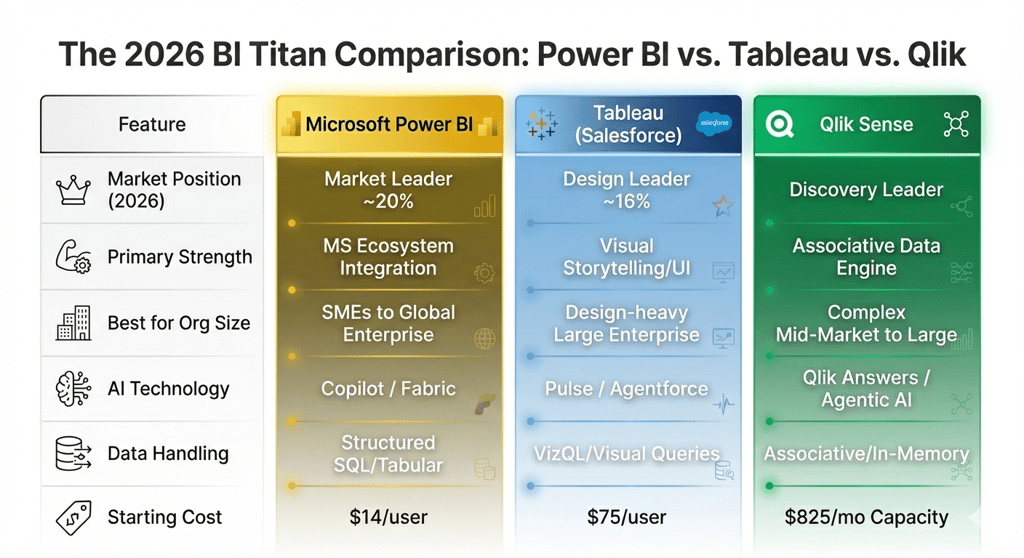
Microsoft Power BI is currently the most popular BI tool in the world. As of 2026, it holds a dominant position with approximately 20% of the total market share. It is famous for its deep integration with the Microsoft ecosystem.
What makes Power BI the top choice for 2026?
The biggest advantage of Power BI is its connection to Microsoft Fabric. Fabric is a unified platform that handles everything from data storage to AI analytics. Microsoft was recently named a leader in data fabric platforms because it integrates agentic AI and real-time data seamlessly. This allows businesses to move data faster than ever before.
How does Power BI use AI to save time?
Power BI uses an AI assistant called Copilot. This tool allows users to build entire dashboards just by typing a request in plain English. Recent updates in 2026 have introduced proactive statistics refresh. This feature automatically updates data models so that user queries run faster without waiting for manual updates.
Does Power BI work well for small teams?
Power BI is very affordable for startups and small departments. A basic Pro license costs about $14 per user. This low price point allows teams to start small and grow. However, large companies often need to buy "Fabric Capacity," which starts at $262 per month and scales up based on data usage.
Tableau (by Salesforce)
Tableau is widely considered the best tool for high-end data visualization. It holds roughly 16.99% of the market. Companies that prioritize "visual storytelling" and deep data exploration almost always choose Tableau.
Why do designers and analysts prefer Tableau?
Tableau uses a technology called VizQL. This translates your drag and drop actions into complex database queries. It allows for limitless customization of charts. You can change every color, line, and label to fit your brand exactly. This makes it perfect for executive presentations and public-facing data.
What is Tableau Pulse and how does it help managers?
Tableau Pulse is an AI tool launched to make data easier for busy people. It sends personalized and contextual insights directly to your mobile device. Instead of searching through a dashboard, Pulse tells you if a key metric is "On Track" or "Off Track" using simple red and green indicators.
Is Tableau difficult to learn for non-technical staff?
Tableau has a steeper learning curve than Power BI. It requires a better understanding of how data is structured. While it is very powerful, many organizations report a shortage of skilled professionals who can use the advanced features. This often makes Tableau more expensive in the long run because you need expert staff to manage it.
Qlik Sense
Qlik Sense is the "outsider" that often wins in complex environments. It serves over 40,000 global customers. It is best known for its "associative" data engine, which works differently than the SQL engines in Power BI and Tableau.
How does the Qlik Associative Engine find hidden insights?
Traditional BI tools force you to follow a linear path. If you filter by "Sales," you can only see things directly related to sales. Qlik's engine keeps all data connected. It highlights related data in white and unrelated data in gray. This helps users discover "dark data" or gaps in their business that other tools might hide.
What are "Qlik Answers" and AI Agents?
In 2026, Qlik introduced a major shift toward "agentic" AI. Qlik Answers is a tool that lets you ask questions about documents like PDFs and manuals. It can then combine those answers with your actual sales numbers. This allows for a single governed conversation that covers both your paperwork and your spreadsheets.
Is Qlik Sense faster than other BI tools?
Qlik is often faster for the user because it processes data "in-memory." This means the data is loaded into the computer's RAM. Research shows that Qlik provides above-average query performance compared to many competitors. Clicking through a Qlik report feels instant, even if you are analyzing millions of rows of data.
Comparison of Performance and ROI
Which tool provides the best Return on Investment (ROI)?
Investing in BI is highly profitable if done right. Studies show that data-driven organizations are 19 times more likely to be profitable than their peers. A well-implemented BI solution can result in a 127% ROI over three years. Power BI usually wins on the fastest "payback period" because it is cheaper to start. Tableau and Qlik often take longer to pay back but can offer more value in complex situations.
How do they handle security and governance?
All three tools offer enterprise-grade security. However, Power BI has an advantage because it uses Microsoft Purview for data governance. This ensures that only the right people can see sensitive information. Tableau relies on "Data Cloud" for its security, while Qlik uses a "cloud-agnostic" approach that works across different types of cloud storage.
How Exology Helps
Choosing a platform is just the beginning. At Exology, we turn technology into a tool for growth. We help businesses in Egypt, across the MENA region, and internationally make sense of their data.
Proven Global Impact: We have delivered over 150 projects worldwide across more than 20 countries.
Significant ROI: We have been able to save our client $130,000 in one day through rapid data analysis and decision-making.
Operational Efficiency: In 2025 alone, our solutions helped clients save over 5,000 hours of manual work.
Industry Expertise: We serve over 10 key industries and have provided data analysis services to 50+ companies.
Advanced AI Solutions: We have already deployed 2 custom AI agents in 2025 to automate complex business workflows.
Read More
Contact us
Whether you have a request, a query, or want to work with us, use the form below to get in touch with our team.