

Why You Cannot Build Lasting AI or BI Without a Unified Data Architecture
Learn why unified data architecture is the essential foundation for lasting AI, Business intelligence, and automation. Build a single source of truth to save time and money.
DATA ANALYTICSDATA-DRIVEN CULTURE
Key Points
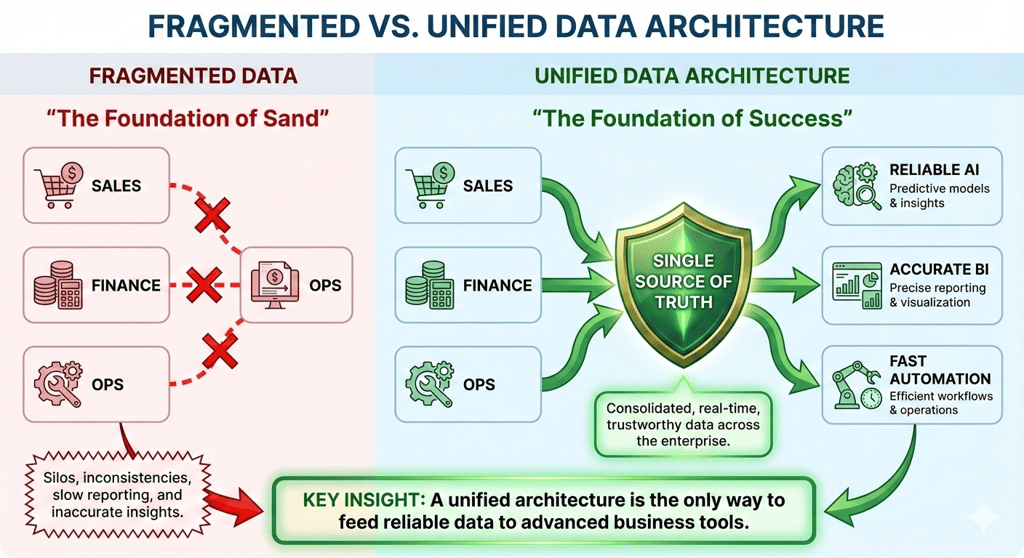
Foundation First: You cannot build reliable AI, BI, or automation tools on a fragmented data foundation without risking total system failure.
Single Source of Truth: A unified data architecture eliminates conflicting reports by ensuring every department uses the same verified information.
The Cost of Bad Data: Disconnected data silos lead to manual errors and "hallucinating" AI, costing organizations millions in lost productivity and bad decisions.
Automation Requirements: Successful workflow automation requires consistent data formats across all platforms to prevent logic breaks and constant maintenance.
Data Literacy: Beyond technical architecture, training employees to understand and respect data is essential for long-term organizational efficiency.
Proven ROI: Investing in a strong data foundation before deploying advanced tools results in faster project delivery and significant cost savings.
Actionable takeaway: Conduct a data audit to identify where your systems fail to communicate before investing in new AI or dashboard software.
Many businesses want the newest tools. They want AI agents to talk to customers. They want dashboards that show every sale in real-time. They want automation to handle the boring work. These are great goals. However, many leaders try to build these tools on top of a mess.
Building an AI agent without a unified data architecture is like building a house on sand. It might look good for a few weeks. But soon, the walls will crack. The roof will leak. Eventually, the whole thing will fall down. If your data does not talk to each other, your technology will never last.
At Exology, we see this often. Customers come to us asking for a smart chatbot or a fancy dashboard. When we look under the hood, their data is scattered. It is stuck in different files and different departments. We have found that the smoothest, most successful projects always start with a strong foundation. You must have a single source of truth before you can build something that matters.
What is a unified data architecture?
Does your data talk to each other?
Data architecture sounds like a big word. In simple terms, it is the plumbing of your business. Think about a house. You have pipes that bring water to the kitchen and the bathroom. If the pipes are not connected, you have a problem.
A unified data architecture is a system where all your information is connected. Your sales data, your inventory numbers, and your customer names all live in a way that allows them to talk to each other. When one number changes in the warehouse, the sales report updates automatically. This is what it means to have a connected system.
What is a single source of truth?
A single source of truth means there is only one place to find the right answer. In many companies, this does not exist. The finance team has one spreadsheet. The marketing team has another. When they go to a meeting, they have different numbers for the same thing.
This causes confusion and slow decisions. A unified architecture fixes this. According to a study by Gartner, poor data quality costs organizations an average of $12.9 million every year. By creating one source of truth, you stop wasting money on mistakes and arguments about which number is correct.
Why does Business Intelligence fail without a strong foundation?
Why are my reports always different?
Many leaders feel frustrated when their Business Intelligence (BI) tools show wrong information. They buy expensive software, but the charts do not make sense. This happens because the BI tool is pulling data from broken "silos."
A silo is a place where data sits alone. If your sales data is in a silo and your shipping data is in another, the BI tool cannot see the full picture. It might show that you sold 100 items. But it cannot show that 50 of them were returned. Without a unified architecture, your BI solutions are just guessing.
What is the risk of manual reporting?
When data is not unified, employees have to move it by hand. They copy numbers from one website and paste them into a spreadsheet. This takes a long time. It also leads to human error. One small typo can ruin a whole month of planning.
Research from McKinsey shows that high-performing organizations are much more likely to have a clear data architecture that supports their goals. When you invest in the foundation, you remove the need for manual work. This allows your team to focus on making decisions instead of fixing typos.
How does bad data architecture break AI and automation solutions?
Why do AI agents give wrong answers?
AI agents and chatbots are very popular right now. Everyone wants an AI that can answer customer questions. But an AI is only as smart as the data it can read. If your data is messy or disconnected, the AI will "hallucinate."
This means the AI will make up an answer that sounds real but is totally wrong. This happens because the AI does not have a clear map to follow. If your data architecture is unified, the AI can find the right facts quickly. If not, the AI is just a loud voice with no brain.
Can you automate a broken process?
Automation is meant to save time. It moves tasks from humans to machines. However, you cannot automate a process if the data is not consistent. If your CRM uses "Customer Name" and your accounting software uses "Client ID," a simple automation will break.
Machines need perfect instructions. They need data that matches. Without a unified architecture, your automation projects will stop working every time a small change occurs. You end up spending more time fixing the automation than you would have spent doing the work by hand.
What are the real-world lessons from Exology?
Why do some projects start with a struggle?
At Exology, we love solving problems. Some of our customers come to us with big dreams. They want the most advanced AI agents or real-time BI solutions. But we often find that they are missing the most important part. They do not have a good data architecture.
When a company tries to skip the foundation, the project becomes very difficult. We have to spend extra time cleaning data and finding lost files. It is like trying to paint a wall that is covered in mud. The paint will not stick. We always tell our clients that the best results come when we clean the wall first.
Why are structured projects more successful?
The smoothest projects we have ever delivered are the ones where the client had a strong data foundation. When the data is already organized and "talking," we can build amazing things very quickly.
In these cases, we can deploy a BI dashboard in a fraction of the time. The insights are clear. The AI agents are accurate. The client sees the value of their investment almost immediately. Longevity in technology is not about the tool you buy. It is about the data you give to that tool.
How does data literacy change an enterprise?
What is the Exology Data Literacy Program?
Even with a great architecture, people need to know how to use it. This is why we created our Data Literacy Program for enterprises. Data literacy is the ability to read, work with, and communicate with data.
It is not just for the IT team. Everyone from the CEO to the sales manager needs to understand the importance of data. When your team is data-literate, they understand why the architecture matters. They stop creating their own "private" spreadsheets and start using the single source of truth.
How does literacy save money and time?
Enterprises with strong data literacy and a solid foundation save massive amounts of effort. They do not waste hours looking for files. They do not make expensive guesses about the future.
A report by the World Economic Forum suggests that data-driven skills are essential for the modern workforce. When your staff understands data, they can spot trends faster. They can use the unified architecture to solve problems before they become crises. This combination of a strong foundation and a smart team is the secret to long-term growth.
What does a unified data architecture look like in practice?
How do you start building?
You do not have to change everything in one day. Building a unified architecture starts with a simple audit. You look at where your data lives today. You find the gaps where systems are not talking.
Then, you create a plan to connect them. This might mean using a central hub to collect information. It might mean changing the way your team enters data. The goal is always the same: make sure the information flows from one place to another without breaking.
What is the final result?
The final result is a business that moves faster. When a leader asks a question, the answer is ready. When an AI agent talks to a client, it has the right facts. When an automation runs, it completes the task perfectly every time.
Investing in architecture is an investment in the future of your company. It ensures that the tools you build today will still be working in five years. It turns your information into your most valuable asset.
How Exology Helps
Exology turns information into action through data-driven solutions. We help companies build a foundation that lasts. We work with businesses globally to ensure their technology is built on a single source of truth.
Our services include:
Business Intelligence (BI): We create customized dashboards that provide clear, actionable insights.
Workflow Automation: We build systems that handle repetitive tasks so your team can focus on growth.
AI Agents: We develop intelligent chatbots and agents that are powered by your own unified data.
Data Literacy Program: We train your team to understand and use data effectively to improve decision-making.
Our Impact in Numbers:
Exology has been able to save a client $130k in one day.
We saved our clients over 5,000 hours of manual work in 2025.
Exology has delivered over 150 projects to companies worldwide.
Read More
Contact us
Whether you have a request, a query, or want to work with us, use the form below to get in touch with our team.