

Why Your AI Strategy Will Fail Without Proper Data Governance
Discover why data governance and AI are linked. Learn how to avoid AI project failure by building a clean data foundation with expert analytics and BI insights.
DATA-DRIVEN CULTUREAI & AUTOMATION
Key Points
AI success depends on data quality, as models rely entirely on the accuracy and reliability of the information they receive.
Poor data leads to project failure, with many generative AI initiatives being abandoned due to a lack of a solid data foundation.
Data governance creates a "single version of truth" by setting clear standards and ownership across different departments.
Breaking down data silos is essential for automation, as fragmented data prevents AI agents from understanding the full business picture.
Governance reduces manual work by automating the data cleaning process, which currently consumes 80% of a data professional's time.
Data literacy is a critical cultural requirement, ensuring that employees can confidently use data and AI tools to make better decisions.
Actionable takeaway: Perform a comprehensive data audit to identify fragmented silos and assign clear data owners before investing in any AI or automation solutions.
The global race to adopt artificial intelligence is moving at a breakneck speed. Every business leader wants to use AI to automate tasks and find new revenue. However, a quiet crisis is happening in boardrooms around the world. Many of these high-tech projects are failing before they even start. The reason is not a lack of clever code or computing power. The real problem is the data.
At Exology, we see this often. Customers frequently come to us asking for the latest AI and automation solutions. They want intelligent AI agents to handle their workflows. Yet, when we look under the hood, their data governance is missing or broken. This creates significant issues. Without a solid foundation, even the most advanced AI becomes a liability. This blog explains why data governance is the single most important factor for your AI success.
Why AI Projects Fail Without a Strong Foundation
Many organizations treat AI like a magic wand. They expect it to fix deep-seated operational issues overnight. Unfortunately, AI is a tool that depends entirely on the quality of the information it receives. If the information is wrong, the results will be even worse.
The "Garbage In, Garbage Out" Trap
The phrase "Garbage In, Garbage Out" has never been more relevant than in the era of generative AI. AI models learn patterns from historical data. If that data contains errors, duplicates, or outdated facts, the AI will learn them as truth. Recent research from Gartner shows that at least 30% of generative AI projects will be abandoned by the end of 2025 due to poor data quality. When you feed an AI agent messy data, you are essentially teaching it to make mistakes at scale.
The Hidden Costs of Poor Data Quality
Poor data governance does not just lead to bad results. it leads to massive financial waste. Organizations often spend millions on AI licenses and infrastructure only to find the system is unusable. IBM reports that 43% of chief operations officers now identify data quality as their top priority. This is because a quarter of organizations lose more than $5 million every year because of bad data. When AI is built on a weak foundation, these costs grow quickly as the system scales.
The Role of Data Governance in AI Readiness
Data governance is often misunderstood. Some people think it is just a set of restrictive rules that slow down work. In reality, it is the process of making sure your information is accurate, safe, and easy to find. It is about turning raw data into a reliable business asset.
What is Data Governance for Business?
Data governance provides the blueprint for how information is managed across your company. It defines who owns the data and who can change it. It also sets the standards for data quality. Without these rules, different departments will have different versions of the truth. One team might see a "customer" as someone who signed a contract, while another sees them as someone who just signed up for a trial. This confusion makes it impossible for an AI to provide a clear answer.
Bridging the Gap Between Information and Action
The goal of any data-driven business is to turn information into action. Data governance bridges this gap by ensuring the information is "AI-ready." High-quality data governance ensures that your AI agents can access the right information at the right time. It allows for transparency. If an AI makes a decision, you can use your governance records to see exactly which data point influenced that choice. This builds trust with your employees and your customers.
Common Roadblocks for Organizations
Even with the best intentions, many companies struggle to get their data ready for AI. They often face internal barriers that have existed for decades. Solving these issues is the first step toward a successful digital transformation.
Overcoming Data Silos and Fragmentation
Information is often trapped in "silos." This means the marketing team has their own data, and the finance team has theirs. They rarely talk to each other. AI needs a unified view of the company to be effective. When we work with clients at Exology, we find that fragmented data is the biggest hurdle to building automation. If your data lives in 50 different spreadsheets, an AI agent cannot possibly understand the whole picture. Breaking these silos is a requirement for any modern business intelligence strategy.
The Reality of the 80/20 Cleaning Problem
There is a famous rule in the world of technology. Data scientists spend 80% of their time cleaning and organizing data, and only 20% actually analyzing it. This is a massive waste of talent and money. According to reports from Kaggle and IBM, this trend is still true in 2025. By implementing strong governance, you automate the cleaning process. This allows your team to focus on innovation instead of fixing typos in a database.
Preparing Your Workforce for a Data-Driven Culture
Technology is only half of the puzzle. The other half is people. You can have the best data governance tools in the world, but they will fail if your team does not understand why they matter.
Why Data Literacy is the Key to Innovation
Data literacy is the ability to read, work with, and communicate with data. In many corporations, employees are afraid of data because they do not understand it. This leads to a culture where people make decisions based on "gut feelings" rather than facts. Cisco reports that only 13% of companies are truly ready to leverage AI to its full potential. To close this gap, businesses must invest in training. A data-literate team can spot errors faster and suggest better ways to use AI agents in their daily tasks.
Aligning Strategy with Governance
Your data governance plan must match your business goals. If your goal is to grow your customer base, your governance should focus on the accuracy of your lead data. If your goal is to cut costs, focus on your operational and supply chain data. When governance is aligned with strategy, it stops being a "boring task" and starts being a growth driver. It creates a culture where everyone takes responsibility for the information they handle.
Case for Action: Automation and AI Agents
Once the foundation is set, the possibilities are endless. This is where the real excitement begins. With clean data, you can move from simple reports to advanced automation.
Transforming Workflows with Trusted Data
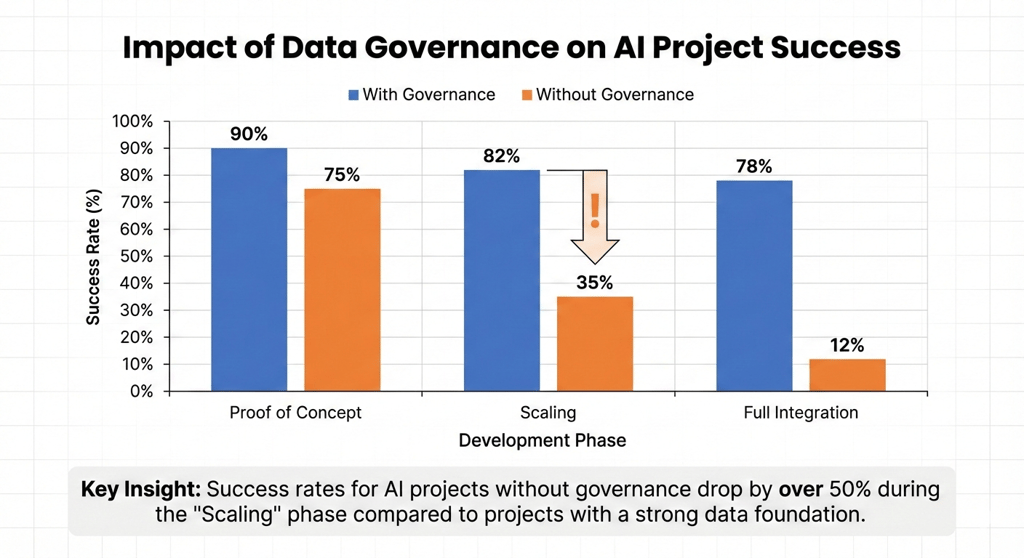
Trusted data allows you to build AI agents that handle complex workflows. These agents can manage everything from customer support to inventory management. Because they are working with governed data, they are reliable. They do not hallucinate or provide false information. This reliability is what allows a business to scale without adding more manual work.
Scaling Beyond Pilot Projects
Many companies get stuck in the "pilot phase." They build one small AI tool, but they cannot make it work for the whole company. This is usually because the pilot used a small, clean set of data that was manually prepared. When they try to use the rest of the company's data, the system breaks. Strong data governance ensures that your data is clean everywhere, not just in a small test. This is how you move from a "cool experiment" to a truly AI-powered enterprise.
How Exology Helps
Exology turns information into action. We are experts in Data Analytics and Business Intelligence (BI) who understand that technology is only as good as the data behind it. We specialize in helping companies build the foundation they need to succeed in a world driven by AI.
We provide the bridge between where you are today and where you want to be. Our team helps you avoid the common trap of launching automation on top of messy data.
Data Analytics & Business Intelligence: We don't just build dashboards. We build a single version of the truth. Our experts have processed over 10 million data rows to help leaders make confident, data-backed decisions.
Workflow Automation & AI Agents: We develop intelligent systems that actually work. By ensuring your data governance is strong from the start, we create AI agents that are reliable and scalable.
Data Literacy Program: Culture is as important as code. We offer a specialized Data Literacy Program for corporations. This program trains your team to think like data scientists, ensuring a true data-driven culture.
Global Expertise: With over 150 projects delivered worldwide, we bring international best practices to every consultation.
Proven Results: We focus on impact. In 2025 alone, we saved our clients over 5,000 hours of manual work through intelligent automation and refined data processes.
Read More
Contact us
Whether you have a request, a query, or want to work with us, use the form below to get in touch with our team.