

Why Odoo Is Ideal for Growing Businesses in Egypt
Discover why Odoo implementation is the top choice for Egyptian executives in growing businesses in 2026. Learn about ROI, ETA compliance, and scalable business strategy.
ERP
Key Points
Odoo implementation helps Egyptian businesses replace spreadsheets with one unified ERP system
Odoo is fully compliant with Egyptian Tax Authority e-invoicing, payroll, and tax regulations
Odoo is significantly more cost-effective than traditional ERPs like SAP or Oracle
The modular pricing model allows businesses to scale ERP usage as they grow
Odoo supports international expansion with multi-company, multi-currency, and multi-language features
Built-in AI improves productivity through automated accounting, inventory forecasting, and smarter operations
Actionable takeaway: Assess your current systems and start with a focused Odoo implementation in accounting or operations to ensure compliance, reduce costs, and enable scalable growth
As businesses in Egypt navigate a rapidly evolving economic landscape, the need for efficiency and data accuracy has never been higher. Many companies are outgrowing traditional spreadsheets and disconnected software. They are now looking for a unified system that can handle everything from local tax laws to international growth.
Odoo has emerged as the leading choice for organizations in the region. It offers a unique mix of affordability, local compliance, and global scalability. This post explores why Odoo is the preferred solution for Egyptian SMEs and enterprises in 2026.
Is Odoo compliant with Egyptian tax laws and e-invoicing?
One of the biggest hurdles for any business in Egypt is staying compliant with the Egyptian Tax Authority (ETA) requirements. Odoo provides a localized fiscal package specifically for Egypt that includes pre-configured tax codes and a local chart of accounts.
Starting with Odoo 15.0 and continuing through the latest 2026 versions, the system allows you to sign and send invoices directly to the ETA portal. This eliminates the need for third-party middleware and reduces the risk of manual errors. It also handles the complex Egyptian Payroll requirements, including specific social insurance deductions and progressive income tax brackets for 2026.
How does Odoo handle the ETA e-invoicing integration?
Direct API Connection: Odoo connects to your ETA portal using your Client ID and Secret.
Digital Signatures: It supports USB authentication and local proxy servers to secure your transactions.
Product Coding: The system maps your internal products to GS1 or EGS codes required by the authority.
Why is Odoo more cost-effective than other ERPs?
For growing businesses, the high cost of traditional ERPs like SAP or Oracle can be a barrier. Research shows that Odoo is typically 80% cheaper than these enterprise competitors. While SAP S/4HANA can cost $100–300 per user monthly, Odoo’s pricing for 2026 remains highly accessible for SMEs.
Odoo uses a modular "pay-for-what-you-need" model. You can start with a single app like Accounting or CRM for free and add more modules as your business grows. This flexibility prevents the heavy upfront investment that often stalls digital transformation projects.
How Odoo compares to traditional ERPs in 2026:
Investment: Odoo averages $20–$40 per user, whereas traditional systems often range from $150–$300.
Timeline: Odoo implementations typically take weeks, while traditional ERPs can take months or years.
Usability: Odoo features a high-rated, intuitive UI, while legacy systems often require heavy, expensive training.
Flexibility: Being open-source, Odoo offers unlimited customization, unlike the limited and costly changes in closed systems.
Can Odoo scale with international growth?
Many Egyptian businesses are expanding into the MENA region or exporting globally. The Egyptian government’s 2025/2026 development plan targets $8.5 billion in annual digital exports. To participate in this growth, companies need a system that supports multiple currencies, languages, and multi-company setups.
Odoo’s architecture is built for this. A single Odoo instance can manage different branches in Cairo, Dubai, and Riyadh, each with its own local tax settings. As your team grows from 10 to 500 employees, the system scales without requiring a complete overhaul of your IT infrastructure.
How does AI inside Odoo improve productivity?
In 2026, AI is no longer an add-on; it is integrated into the core of Odoo. For example, Odoo Accounting now features AI-powered bank reconciliation that automatically matches up to 95% of transactions. This saves hours of manual data entry for finance teams.
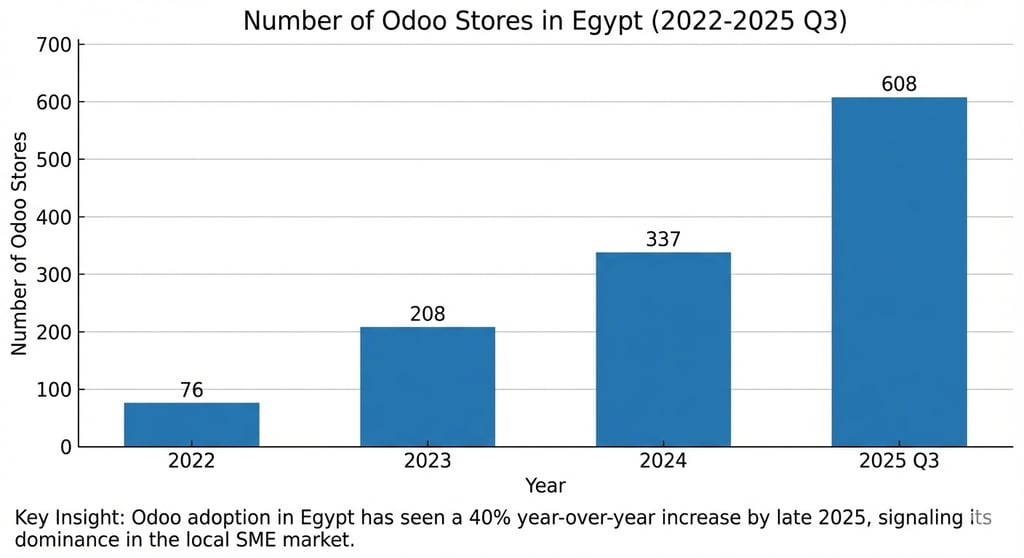
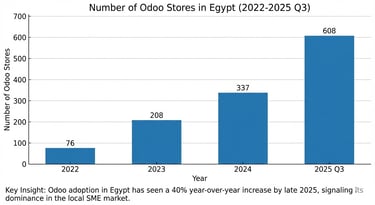
The system also uses generative modules to draft purchase orders from plain-language inputs. For Egyptian manufacturers, AI-driven inventory tools help forecast demand and optimize stock levels, reducing the waste that often eats into profit margins. Odoo adoption in Egypt has seen a massive increase as companies seek these automated efficiencies.
How Exology Helps
Exology specializes in helping businesses in Egypt and the MENA region unlock the full power of their data through expert Odoo implementation and BI solutions.
Tailored Odoo Implementation: We customize Odoo to fit your specific business processes, ensuring a seamless transition from your old systems.
Local Compliance Expertise: Our team ensures your Odoo setup is fully compliant with Egyptian Tax Authority (ETA) e-invoicing and local labor laws.
Business Intelligence Integration: We connect your Odoo ERP to custom dashboards, turning your operational data into actionable growth strategies.
Ongoing BIaaS Support: Through our subscription model, we provide continuous updates and support to keep your system running at peak performance.
Digital Transformation Consulting: We guide your organization through the modernization process, from initial planning to staff training.
Read More
Contact us
Whether you have a request, a query, or want to work with us, use the form below to get in touch with our team.