

Why a Data-Driven Culture Always Starts with Data Literacy
Discover why data literacy is the essential first step to a data-driven culture. Learn how Exology empowers global teams to Use Data effectively and turn their data int actionable insights
DATA-DRIVEN CULTURE
Key Points
Data literacy is the essential ability to read, work with, and analyze data across every department.
High-quality data serves as the backbone for all successful AI, automation, and intelligent agent projects.
Digital transformations often fail due to a lack of employee data skills rather than technical software issues.
Data-literate organizations see 35% higher productivity and 20% better financial performance.
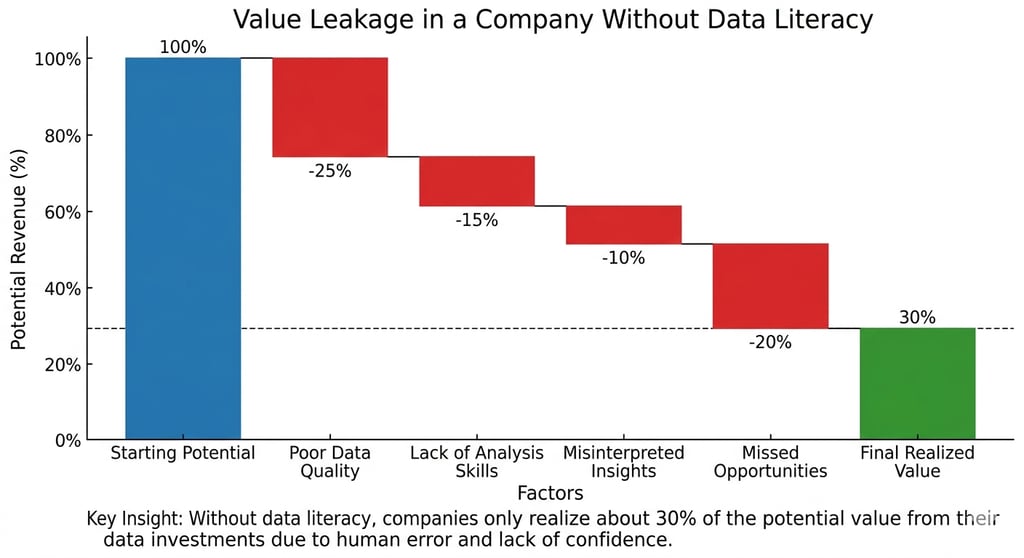
Poor data quality and a lack of literacy can cost businesses up to 25% of their annual revenue.
Building a data-driven culture requires moving away from "gut feelings" toward evidence-based decision-making.
Actionable takeaway: Assess your team's current confidence levels and launch a hands-on training program using your company’s real-world data and dashboards.
In the modern business world, terms like "data-driven" and "data literacy" are often used as buzzwords. You might hear them in every boardroom or see them in every social media post. However, these concepts are much more than just popular phrases. They represent the difference between a company that survives and one that leads.
At Exology, we have seen this firsthand. Our team has completed over 200 projects for more than 150 businesses across 20 countries. We have learned that the best tools in the world cannot fix a team that does not speak the language of data. To build a true data-driven culture, you must start with the people. You must start with data literacy.
What exactly is data literacy for business leaders?
Data literacy is the ability to read, work with, analyze, and argue with data. It is not about being a math genius. It is about understanding what the numbers are telling you. For a leader, it means being able to look at a report and know if the information is useful or not.
Is data literacy only for technical teams?
Many people think only IT staff or data scientists need these skills. This is a mistake. In a real data-driven culture, everyone needs to understand data. This includes sales teams, marketing managers, and HR professionals.
Recent reports show that 88% of enterprise leaders now say basic data literacy is essential for day-to-day work. If only your technical team understands the data, your business will move slowly. Decisions will get stuck in "bottlenecks" while waiting for an expert to explain a chart.
Why is data literacy the new second language of business?
We used to say that computer skills were the most important asset. Now, data is the primary language of global commerce. Global spending on big data and analytics is expected to reach $420 billion in 2026. Companies are investing billions because data tells the truth about customer habits and market shifts.
If you cannot speak this language, you cannot participate in the conversation. Being data literate allows you to ask the right questions. It helps you challenge assumptions. When someone says a project is "going well," a data-literate leader asks to see the trend lines and the conversion rates.
Why is data literacy the foundation of a data-driven culture?
A culture is not something you buy. It is something you build through habits. A data-driven culture means that every person in the company uses data to make choices. It means moving away from "I think" and toward "The data shows."
Can you be data-driven if your team is afraid of data?
No. Fear is the biggest enemy of progress. Many employees feel overwhelmed by complex dashboards. They might ignore them because they do not want to look like they do not understand. Only 28% of employees globally feel confident in their data skills.
When people are afraid of data, they fall back on "gut feelings." This leads to inconsistent results. A data-driven culture can only exist when people feel safe enough to use data as a tool. This is why we created the data literacy training to help teams bridge this gap.
How does understanding data lead to better collaboration?
When everyone speaks the same data language, meetings become more efficient. You stop arguing about whose opinion is more important. Instead, you look at the same dashboard and agree on what needs to change.
This transparency builds trust across departments. Marketing can see how their leads affect sales. Operations can see how their efficiency affects the bottom line. This shared understanding is what makes a company truly agile. It is a core part of any data-driven culture for modern enterprises.
Why do digital transformation projects often fail?
Many businesses think digital transformation is about buying new software. They install a new ERP or a fancy BI tool and wait for the magic to happen. Unfortunately, the magic rarely comes.
Is the problem the software or the people using it?
The problem is almost always the people. Transformation is about how people work, not just the pixels on their screens.
This happens because the staff does not understand why they are collecting data. If they see data entry as a chore, they will provide poor-quality information. Poor data quality can cost a company an average of 25% of its annual revenue. Without literacy, the software is just an expensive filing cabinet.
How does a lack of data skills impact your Return on Investment?
Your Return on Investment (ROI) depends on how quickly your team can turn insights into action. If a manager spends three days trying to understand a report, that is three days of lost opportunity.
Research shows that organizations with strong data literacy programs have 35% higher productivity. Literacy reduces the time spent on manual reporting and error correction. By investing in people, you unlock the full value of the software you already paid for.
What are the benefits of a data-literate workforce in the age of AI?
We are now in the age of artificial intelligence. Businesses are racing to deploy AI agents and automation systems. However, these technologies do not work in a vacuum. They require a human touch to be successful.
How does data literacy improve decision-making?
In a fast-moving market, you cannot wait for monthly reports. Data literacy allows employees to make real-time decisions. They can spot a problem in a supply chain or a drop in customer satisfaction immediately.
Gartner predicts that by 2027, organizations that focus on AI literacy for executives will see 20% higher financial performance. This is because those leaders can identify which data points matter most. They do not get distracted by "noise."
Why is data the backbone of successful AI agents?
Think of data as the food for your AI. If the food is bad, the AI gets sick. This is often called "garbage in, garbage out." Whether you are building automation or complex AI agents, your data must be accurate and well-structured.
Data-literate employees act as the first line of defense. They know how to spot errors before they reach the AI. 64% of organizations say data quality is their biggest barrier to success. A team that understands data ensures that your AI projects are built on a solid foundation.
How can your company start building data literacy today?
Building literacy does not have to be scary. It starts with a commitment to learning. You must create an environment where questions are encouraged and data is accessible.
What are the best ways to train non-technical staff?
A great training program is practical. It should use the real data your company handles every day. We have found that hands-on workshops are much more effective than long lectures.
At Exology, we provide corporate training programs for major organizations, including companies like Al Futtaim. We teach people how to tell a story with data. We show them how to interpret visualizations and how to use data to solve their specific work problems. According to the World Economic Forum, AI and big data skills are the fastest-growing skills needed by 2030.
How do modern BI tools make data easier to understand?
You do not need to be a coder to use data today. Modern Business Intelligence (BI) tools use visuals to show patterns. A well-designed dashboard can show you a whole year of sales in one glance.
By using intuitive visuals, you lower the "barrier to entry" for your team. They can interact with the data and find their own answers. This empowers them to take ownership of their results. It turns data from a "scary number" into a helpful guide for their daily tasks.
How Exology Helps
Exology helps businesses turn information into action through data-driven solutions that improve decision-making, productivity, and growth. We have completed over 200 projects for more than 150 businesses across 20+ countries. We work with companies in Egypt, across the MENA region, and internationally.
Corporate Training Programs: We offer specialized training to help your staff master data literacy. We have successfully trained teams for major organizations like Al Futtaim to ensure they stay competitive in the age of AI.
Expert Consulting: Our team of 5 professional consultants provides guidance on data strategy, business intelligence, digital transformation, and AI.
Proven Experience: With over 200 projects under our belt, we have the experience to handle complex data challenges across 10 key industries.
Practical Results: In 2025 alone, we delivered over 4,000 hours of professional training to help teams around the world become data-literate.
High-Speed Processing: We processed over 10 million data rows in 2025, proving our ability to manage data at any scale.
Strategic Growth: We help companies move past buzzwords to achieve real impact, like the 5,000+ hours of manual work saved for our clients in 2025 through automation.
Read More
Contact us
Whether you have a request, a query, or want to work with us, use the form below to get in touch with our team.