

Digital Transformation: Why It Is More Than Just a 2026 Buzzword
Discover why digital transformation strategy is more than a buzzword in 2026. Learn how data and AI drive real business growth and avoid common pitfalls.
DIGITAL TRANSFORMATION
Key Points
Beyond the Buzzword: True digital transformation requires a total shift in business models and culture, moving far beyond simple document scanning or process updates.
Strategic Failure: Approximately 70% of initiatives fail because leaders often prioritize buying expensive digital tools over changing how people work and use data.
Defining the Stages: Success requires understanding the difference between digitization (format change), digitalization (process improvement), and transformation (value creation).
Data as the Foundation: Clean, organized data is the essential fuel for AI and automation; without it, digital systems cannot provide accurate insights.
Industry Customization: Effective transformation strategies must be tailored to specific industry needs, such as predictive maintenance in manufacturing or personalized experiences in retail.
The 2026 AI Era: Modern transformation now centers on autonomous AI agents and natural language queries that allow non-experts to interact directly with business data.
Actionable takeaway: Start your journey by identifying one specific business pain point and ensuring your data is clean and organized before investing in high-cost AI or automation tools.
In the modern business world, terms come and go. One term that seems to stay forever is "digital transformation." You likely hear it in every meeting and see it in every business article. Because it is used so often, many leaders now view it as just another corporate buzzword. They think it is something people say to sound smart or modern.
However, at Exology, we know that true transformation is far from a hollow phrase. We have delivered over 150 projects worldwide for more than 150 businesses. We have worked in over 20 countries to help companies turn technology into a tool for real action. This guide will show you why this topic is so broad and how you can make it work for your specific business.
Why do people confuse digitization, digitalization, and digital transformation?
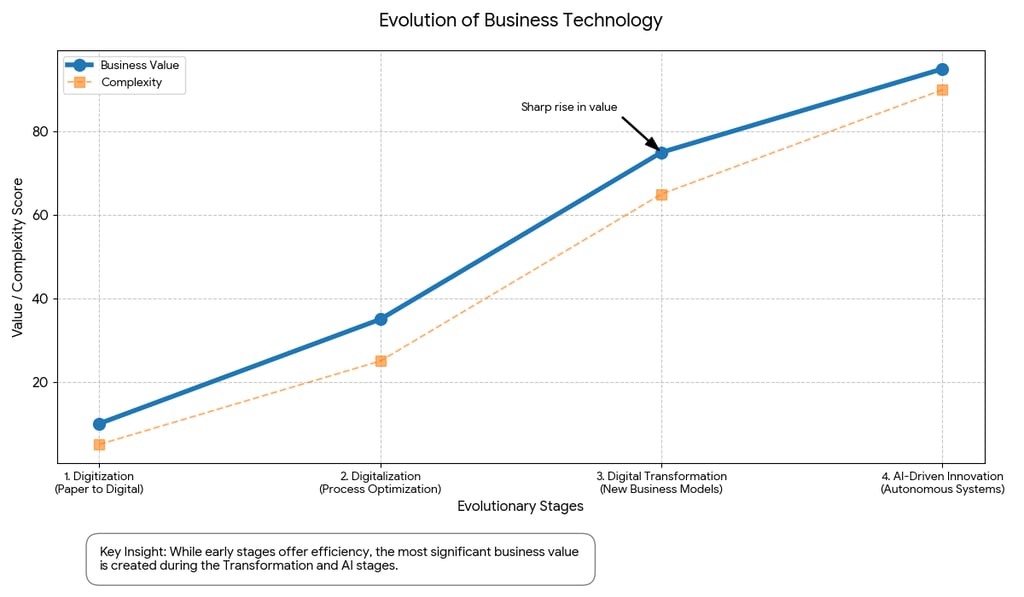
These three words sound very similar. Because of this, people often use them interchangeably. This is a mistake. Each word represents a different stage of a company's journey toward the future. It is helpful to start by understanding the difference between digitization, digitalization, and digital transformation to see where your business currently stands.
What is digitization?
Digitization is the act of converting information from a physical form to a digital one. Think about moving from paper to a computer screen. If you scan a paper contract and save it as a digital file, you have digitized it. You are not changing the way you work. You are simply changing the medium you use to store information. This is the foundation, but it is not transformation.
What is digitalization?
Digitalization goes one step further. It means using digital technologies to improve a business process. For example, instead of just storing digital files, you might use software that lets different team members edit them at the same time. This makes the existing work faster and more efficient. It improves the current way of doing things, but it does not change the core of the business.
What is digital transformation?
Digital transformation is the most advanced stage. It is not about a single piece of software or a specific process. It is a total shift in how a business operates and provides value to its customers. It requires changing the company culture and being open to new business models. When a company transforms, it uses technology to do things that were simply impossible before.
Is digital transformation just a corporate buzzword?
Many people think so because the term is very broad. It covers everything from moving to the cloud to using advanced robotics. When a word is used to describe everything, it can feel like it describes nothing.
Why the term feels overused
The term feels like a buzzword because many companies use it to describe small updates. If a company buys new laptops for its staff, they might call it a "digital transformation." This is incorrect. This overuse creates a sense of "digital washing." This happens when a company tries to look modern by using the right words without doing the actual work of changing their business.
The reality of the transformation gap
Even though the term is used a lot, the results are often missing. Research shows that 70% of digital transformation initiatives still fail to meet their original goals in 2026. This high failure rate happens because leaders focus on the "digital" tools but ignore the "transformation" of their strategy and people. When done correctly, it is a powerful tool for growth, not just a trend.
What are the specific sub-services under digital transformation?
Because the topic is so large, it is helpful to break it down. Think of digital transformation as an umbrella. Under this umbrella, there are several specific services that help a business grow.
Business Intelligence (BI) Solutions: These tools help you see your data in real-time. Instead of looking at old reports, you use dashboards to see what is happening right now.
AI and Automation Solutions: This involves creating "smart" systems. These systems can handle repetitive tasks or even make simple decisions on their own.
Cloud Computing: This is about moving your business operations to secure online servers. This allows your team to work from anywhere and makes your data more secure.
Digital Strategy Consulting: This is the planning phase. Experts help you decide which technologies are worth your investment and which are just distractions.
How does transformation change by industry and business size?
A digital transformation strategy must be unique to the business. What works for a small startup will not work for a global factory.
Industry-specific shifts
In the Retail sector, transformation often focuses on the customer experience. This includes using data to give personal recommendations to shoppers. In the Manufacturing world, the focus is on efficiency. Modern factories use sensors to track every machine. This helps them find problems before they cause a shutdown. In the Finance sector, the goal is often security and speed. Banks use digital tools to process loans in minutes instead of weeks.
Transformation for SMEs vs. Large Enterprises
For small and medium enterprises (SMEs), agility is the main goal. They need tools that help a small team do the work of a large one. They often choose cloud-based tools that are easy to set up and scale as they grow.
Large enterprises face a different challenge. They often have "legacy systems." These are old computers and software that have been used for decades. Their transformation is often about connecting these old systems to new ones. They need to break down "data silos." A data silo happens when one department has information that another department cannot see.
Why is data the heart of every transformation initiative?
You cannot transform what you do not measure. Every digital tool produces data. If you do not use that data, the tool is not very helpful. In 2026, 65% of organizations will make fully data-driven decisions.
Data-driven innovation is about more than just numbers. It is about understanding your customers and your own operations. However, many companies jump into tech without cleaning their data first. This is a major mistake because it is often why AI projects fail without data governance and strong internal rules.
When a company has a strong data foundation, it can:
Stop Guessing: You no longer have to guess why sales are down. You can look at the data and find the exact reason.
Predict the Future: You can see trends before they happen. This lets you prepare for changes in the market.
Save Money: You can find waste in your business and remove it.
Without clean, accurate data, digital transformation is like building a house on sand. It might look good for a while, but it will eventually fall apart.
How does Artificial Intelligence redefine transformation in 2026?
In 2026, we have entered the era of AI-powered transformation. Previously, digital tools were passive. They waited for a human to tell them what to do. Now, AI is active.
The rise of AI agents
Businesses are now using AI agents. These are not just chatbots. They are intelligent systems that can complete complex workflows. For example, an AI agent can read a customer email, check the inventory, and issue a refund without any human help. This level of automation is the new standard for digital excellence.
From big data to smart data
AI helps businesses process the massive amount of information they collect. Gartner predicts that by the end of 2026, 40% of all analytics queries will be created using natural language. This means you do not need to be a computer expert to ask your data questions. You can just ask, "Why did our shipping costs go up last month?" and get an instant answer.
How should businesses start their digital journey this year?
Starting a digital transformation strategy can feel overwhelming. Many leaders do not know where to begin. The best way to start is with small, meaningful steps.
Identify a Pain Point: Do not try to change everything at once. Find one problem that costs your business time or money. This could be slow reporting or manual data entry.
Check Your Data Quality: Before you buy new AI tools, make sure your data is organized. If your data is messy, your new tools will give you messy results.
Focus on People First: Technology does not work if your team does not use it. Provide training and explain "why" the change is happening.
Seek Expert Advice: Digital transformation consulting can help you avoid common mistakes. A consultant can provide a roadmap so you do not waste money on tools you do not need.
The global market for digital transformation is expected to reach nearly $3.4 trillion by the end of 2026. This growth shows that businesses are investing heavily in their future. The companies that succeed will be the ones that treat transformation as a continuous journey, not a one-time project.
How Exology Helps
Exology helps businesses turn information into action. We provide data-driven solutions that help you move beyond the buzzwords and achieve real growth. Whether you are a small business or a global enterprise, we have the expertise to guide your digital journey.
Proven Results: Exology has been able to save our client $130k in one day by using data to find and fix hidden inefficiencies.
Efficiency at Scale: In 2025 alone, our solutions provided over 5,000+ hours of manual work saved for our clients.
Massive Data Power: We have processed over 10M+ data rows in 2025, ensuring that our clients make decisions based on facts, not feelings.
Global Experience: With over 150 projects delivered worldwide, we bring a global perspective to every challenge.
Read More
Contact us
Whether you have a request, a query, or want to work with us, use the form below to get in touch with our team.