

Dashboards Leaders Actually Trust: Why Most BI Projects Fail
Why does leadership ignore your BI tools? Learn how to build dashboards leaders actually trust by focusing on business mindset, design, and actionable KPIs.
BUSINESS INTELLIGENCE
Key Points
Most executive dashboards fail because they focus on technical data instead of business goals.
Leadership trust disappears when data is inaccurate or disconnected from daily operations.
A successful Business Intelligence specialist must prioritize business logic over technical software skills.
Good dashboard design reduces cognitive load and allows leaders to make decisions in seconds.
Real-time data is only useful when it serves a specific operational purpose rather than creating noise.
High-value dashboards track actionable KPIs rather than vanity metrics that offer no clear direction.
Actionable takeaway: Audit your current dashboards to ensure every visual answers a specific business question and remove any metric that does not lead to a clear action.
Why do leadership teams ignore the dashboards IT builds?
Many companies invest months and thousands of dollars into complex Business Intelligence projects. They hire skilled developers and buy expensive software. Yet, a few weeks after the launch, the only people looking at the screens are the IT team. The CEO is still asking for a manual Excel report. The Sales Director is still making decisions based on their gut feeling.
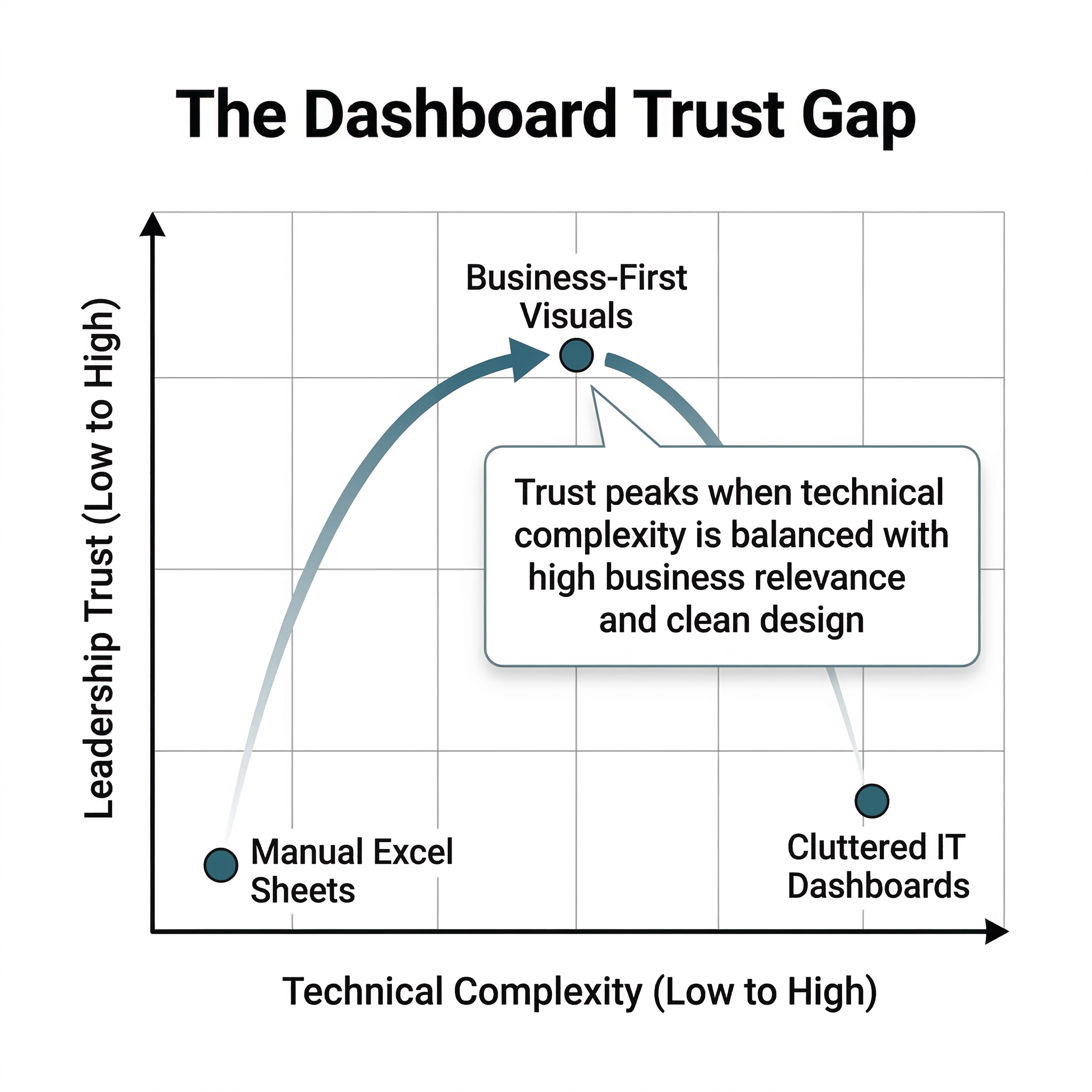
This happens because there is a massive trust gap. Leaders do not ignore dashboards because they hate technology. They ignore them because the data feels disconnected from their daily reality. According to Gartner, poor data quality costs organizations an average of $12.9 million per year. When a leader sees one wrong number, they stop trusting the entire system.
Is the data too technical for non-IT users?
IT teams often build dashboards that show what the technology can do, not what the business needs to know. A dashboard filled with server uptime, API response times, or complex database metrics is useless to a Marketing Manager. They need to know the cost per lead. If the interface is cluttered with technical jargon, leadership will retreat to the spreadsheets they understand.
Why is there a disconnect between IT metrics and business goals?
IT metrics often focus on "how" things are running. Business goals focus on "what" the result is. If your dashboard shows that 100% of emails were sent but doesn't show how many resulted in a sale, it is a "ghost dashboard." It exists, but it has no soul. Trust is built when the dashboard speaks the language of the boardroom, not the server room.
Why is a business mindset more important than technical skill in BI?
A common mistake is thinking that a "BI Specialist" is just someone who knows how to code in SQL or use Power BI. In reality, the best BI professionals are business consultants first and tech experts second. Having a Business Intelligence mindset means you understand why a company needs to track a specific number before you ever touch a line of code.
Does your BI specialist understand your "So What"?
Every data point should answer the question: "So what?" If the revenue is down 5%, so what? What should we do about it? A technical specialist might just build a red arrow. A business-minded specialist will design the dashboard to show exactly which region or product caused the drop.
Why is technical skill alone a commodity?
Tools change every year. Today it is Power BI or Tableau; tomorrow it might be a new AI agent. What never changes is the need for clear logic. Exology has seen this across over 200 projects. The technology is just the vehicle. The business logic is the engine. Without a deep understanding of profit margins, customer lifecycles, and operational friction, a dashboard is just a collection of pretty shapes.
How does dashboard design influence leadership buy-in?
Design is not about making things look pretty. It is about reducing the effort it takes for a human brain to understand information. If a leader has to spend ten minutes clicking filters to find a single answer, they will stop using the tool. Good dashboard design is about clarity and speed.
Why does "Cognitive Load" kill data adoption?
The human brain can only process a small amount of information at once. When a dashboard has 20 different colors, 15 charts, and 5 different font sizes, it creates "noise." Leaders are busy. They want to glance at a screen and know if they are winning or losing within five seconds.
How do visual hierarchies build confidence?
The most important numbers should be the largest and at the top left. This follows how we naturally read. By placing "North Star" metrics in a clear visual hierarchy, you guide the leader’s eyes to what matters most. Research shows that organizations using AI-enhanced, well-designed analytics can shrink decision cycles from weeks to hours.
Real-time vs. Static: Which one does your business actually need?
There is a big debate in the data world about real-time data. Many people think "more frequent" always means "better." That is not always true. Sometimes, real-time data is just real-time noise.
When is real-time data a distraction?
If you are a CEO looking at long-term strategy, seeing your website traffic change every second is useless. It might even lead to "knee-jerk" reactions. Real-time data is for operational teams, like a warehouse manager tracking shipments. For leadership, a high-quality static report that is updated daily or weekly is often more trustworthy because it has been cleaned and verified.
What is the danger of lagging data?
On the other hand, if your data is two weeks old, you are driving your car by looking in the rearview mirror. You will miss the turn. The goal is to find the "Goldilocks" zone of data freshness. A study by Mosaic suggests that 83% of organizations want real-time analytics, yet 70% of processes still run on old batch modes. This gap creates a lack of trust because the dashboard doesn't match the current reality of the office.
How do you choose KPIs that actually matter?
The word KPI (Key Performance Indicator) is used so much that it has lost its meaning. Most companies track "vanity metrics" instead of "actionable metrics." A vanity metric makes you look good but doesn't tell you what to do.
What are the "Key Features" of a high-value KPI?
A good metric must be measurable, easy to understand, and tied to a specific action. For example, "Total Website Visitors" is a vanity metric. "Conversion Rate per Traffic Source" is an actionable metric. It tells you which marketing channel to spend more money on. You can learn more about this in our guide on analytics dashboard features.
How many metrics are too many?
If everything is a priority, nothing is a priority. A CEO should have no more than 5 to 7 "Power Metrics" on their main view. Anything else should be tucked away in a "drill-down" layer. This keeps the focus on the big picture while allowing the team to investigate details if something looks wrong.
How do you bridge the gap between fragmented data sources?
One of the biggest reasons leaders don't trust dashboards is because the numbers don't match. The Sales dashboard says one thing, and the Finance dashboard says another. This happens when data is stuck in "silos." To build trust, you need a single source of truth.
Why do silos destroy data trust?
When departments use different tools, they define things differently. Sales might define a "Lead" as anyone who fills out a form. Finance might only count them once they have been qualified. If the dashboard doesn't account for these differences, leadership gets confused. They see two different numbers and decide that both are probably wrong.
How do you integrate different "Data Sources"?
Modern Business Intelligence relies on connecting everything. Whether it is your CRM, your ERP like Odoo, or your social media ads, the data must flow into one central place. Understanding your data sources is the first step to ensuring the numbers on the screen are the same numbers the CFO has in their ledger. The global market for this type of integration is massive, with the big data analytics market projected to reach over $1.1 trillion by 2034.
How Exology Helps
Exology turns information into action. We don't just build dashboards; we build decision-making engines that leaders actually use. Having delivered over 150 projects for 150+ businesses in 20+ countries, we understand the global challenges of data adoption.
Business Intelligence Solutions: We design fully customized, project-based dashboards that prioritize business logic over technical clutter.
Data Analytics & Visualization: Our team focuses on "Speed to Insight," ensuring your leaders can make decisions in seconds, not hours.
Digital Transformation Consulting: We help bridge the gap between your IT team and the boardroom to create a unified data culture.
Data Integration: We integrate your ERP data to create a single source of truth that removes department silos.
Topical Authority: In 2025 alone, Exology saved our clients 5,000+ hours of manual work and currently has over 40 live dashboards empowering businesses globally.
Read More
Contact us
Whether you have a request, a query, or want to work with us, use the form below to get in touch with our team.